USAID DEC
USAID’s Integrated Community Agriculture and Nutrition Activity in Uganda: Approaches and Lessons from the USAID ICAN In-Kind Grants Program in Uganda
Sign inUSAID
USAID’s Integrated Community Agriculture and Nutrition Activity in Uganda: Approaches and Lessons from the USAID ICAN In-Kind Grants Program in Uganda
The Integrated Community Agriculture and Nutrition Activity in Uganda, a flagship resilience project of USAID, has been dedicated to increasing the resilience of vulnerable households in Uganda since 2018.
2023 · 8 pages
Sign in to readA free account is required to download.
Abstract
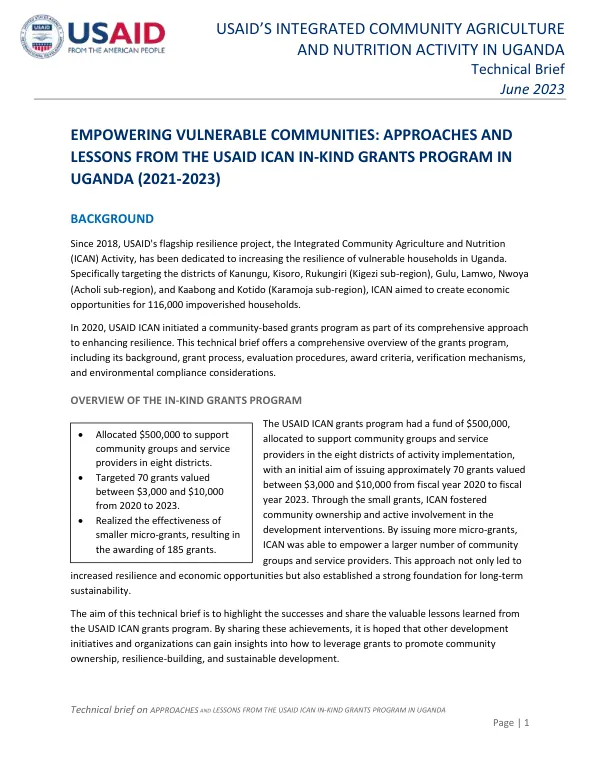
Specifically targeting the districts of Kanungu, Kisoro, Rukungiri, Gulu, Lamwo, Nwoya, Kaabong, and Kotido, ICAN aimed to create economic opportunities for 116,000 impoverished households. In 2020, USAID ICAN initiated a community-based grants program as part of its comprehensive approach to enhancing resilience. The USAID ICAN grants program had a fund of $500,000, allocated to support community groups and service providers in the eight districts of activity implementation. The program aimed to issue approximately 70 grants valued between $3,000 and $10,000 from fiscal year 2020 to fiscal year 2023. Through the small grants, ICAN fostered community ownership and active involvement in the development interventions. By issuing more micro-grants, ICAN was able to empower a larger number of community groups and service providers, leading to increased resilience and economic opportunities. The grants program utilized a two-step evaluation process to ensure that the grants awarded reflected community priorities. A five-person Grants Evaluation Committee (GEC) reviewed grant applications quarterly, evaluating each grant based on predetermined criteria and submitting the top-ranked applications to the Kampala Office for technical and Administrative Compliance Review (ACR). The recommended applications from each district underwent a second evaluation by the Kampala-based GEC. USAID ICAN's field officers were responsible for verifying that grant activities had been carried out, conducting monitoring visits at least once per quarter to ensure compliance and progress. The grants program supported a wide range of enterprises, including apiculture, aquaculture, bakery, and horticulture, among others. A total of 185 grants were awarded, with a total value of $474,000. The grants program also implemented a comprehensive post-award management and support strategy to strengthen the capacity of grantees to manage their enterprises. This included providing training support in areas such as group dynamics, business management, and environmental conservation, as well as facilitating market access and providing targeted business management knowledge tailored to the specific enterprises supported. The grants program achieved several notable outcomes, including improved livelihoods and income diversification for grantees. Grantees were able to generate more income, enabling them to expand or diversify their enterprises. The program also created employment opportunities for unemployed individuals, particularly Adolescent Girls and Young Women, to learn different trades. Additionally, the program fostered a supportive environment and increased the likelihood of future government assistance to the groups.
Related documents