USAID DEC
USAID’s Integrated Community Agriculture and Nutrition Activity in Uganda: Technical Brief
Sign inUSAID
USAID’s Integrated Community Agriculture and Nutrition Activity in Uganda: Technical Brief
The USAID Integrated Community Agriculture and Nutrition Activity in Uganda is a flagship resilience activity that works with communities to improve access to and control of resources, health and nutrition practices, participation in markets, and integration into social and governance activities.
2023 · 6 pages
Sign in to readA free account is required to download.
Abstract
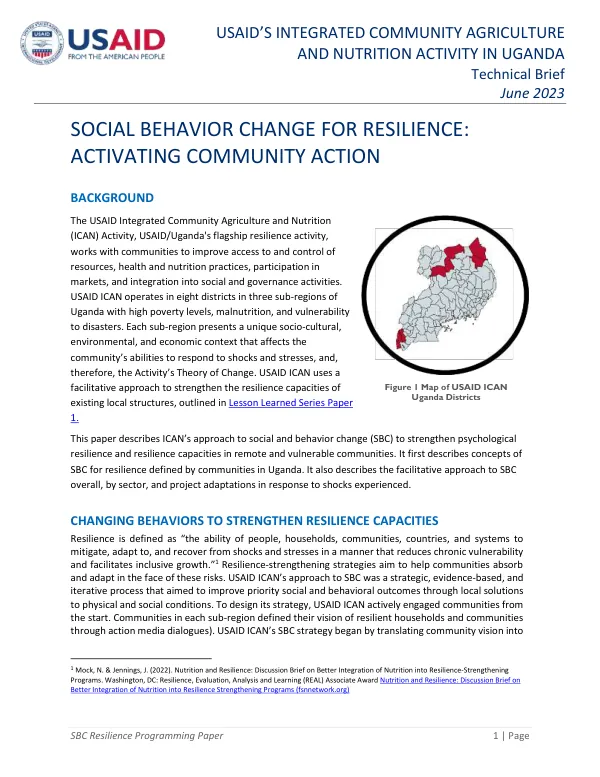
The activity operates in eight districts in three sub-regions of Uganda with high poverty levels, malnutrition, and vulnerability to disasters. Each sub-region presents a unique socio-cultural, environmental, and economic context that affects the community's abilities to respond to shocks and stresses. The activity uses a facilitative approach to strengthen the resilience capacities of existing local structures, as outlined in the Lesson Learned Series Paper 1. The approach focuses on social and behavior change (SBC) to strengthen psychological resilience and resilience capacities in remote and vulnerable communities. The SBC strategy is a strategic, evidence-based, and iterative process that aims to improve priority social and behavioral outcomes through local solutions to physical and social conditions. The activity's SBC strategy began by translating community vision into behaviors across livelihoods, water, sanitation, and hygiene (WASH), nutrition, education, and governance sectors, and cross-cutting social change themes. The strategy prioritized one behavior per sector to promote through the "We Can Do 5" framework. The five behaviors are: farmers aggregating produce to sell at higher prices and increasing incomes, households feeding diverse foods year-round to their children, households constructing, using, and maintaining latrines, households re-enrolling girls into school, and households participating in community planning meetings, especially women and youth. The activity framed the We Can Do 5 campaign as a community-owned initiative to increase the sense of collective responsibility. The campaign promoted five concrete and easy-to-remember actions that made them feel achievable and within reach. Activities encouraged households to make symbolic public commitments to the We Can Do 5 behaviors amongst their neighbors and friends. Communities decided what form commitments would take, such as planting a tree or placing rocks under a monument symbolizing the behaviors. To encourage adoption of the We Can Do Five behaviors, the activity teams analyzed secondary research and the baseline data to identify the most important factors or determinants that prevent and support households and communities from practicing the We Can Do Five behaviors. The activity recognized that people live within systems that influence their decisions about livelihoods, health, education, and life broadly. These systems operate at the internal, social, community, and policy levels. To address these factors and encourage adoption of the We Can Do Five behaviors, the activity's SBC activities worked to improve the enabling environment, increase access to quality and responsive services, generate demand for services, and promote the adoption of best practices. The activity formed partnerships with and facilitated leadership for Village Resilience Committees to develop and implement community policies to coordinate preparation and response to shocks. The activity linked farmers' groups, village savings and loan groups (VSLA) and Mother, Infant, Young Child, and Adolescent Nutrition (MIYCAN) groups with private sector partners. For VSLA and farmer's groups, the activity trained and group-identified individuals to act as Business Service Providers (BSPs). The BSPs served as a link between private sector actors and groups to improve access to improved agricultural inputs, sanitation products, and financial services. For MIYCAN groups, the activity trained Village Health Teams (VHT) to deliver health and nutrition education sessions and referred members to health services as needed. To generate demand for services and promote the adoption of behaviors, the activity's SBC communications plan was critical. The activity strategically engaged communities through change agents, local and traditional leaders, and media. The activity worked with eight local radio stations to reach households and communities across the eight districts. Radio remains a key method of reaching the public in Uganda, especially in rural areas, and has high listenership among all age groups. During the COVID-19 pandemic, the activity had to modify its way of working with communities and address the shock of the pandemic itself. The activity had to rethink the communication strategy given the inability to gather people for meetings. The SBC team assessed options to communicate with change agents and to engage households and communities directly. While most change agents had access to mobile phones, many households did not. The activity continued to place regular phone calls with pre-recorded information about sources for quality inputs and coming activities, which proved to be highly effective to engage change agents.
Related documents
Documents in this collection
 2023
2023USAID DEC
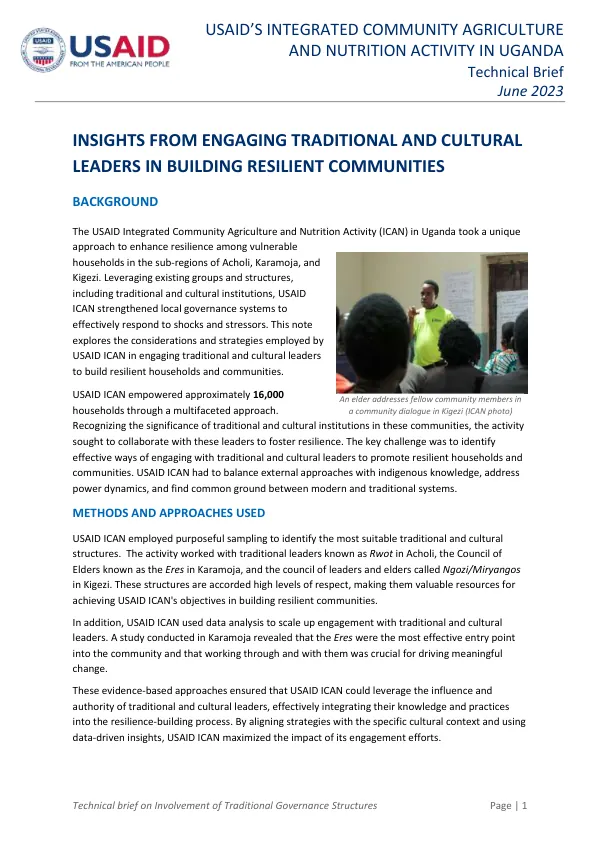
USAID’s Integrated Community Agriculture and Nutrition Activity in Uganda: Technical Brief on Involvement of Traditional Governance Structures
Open record 2023
2023USAID DEC