USAID DEC
USAID’s Integrated Community Agriculture and Nutrition Activity in Uganda: Technical Brief on Involvement of Traditional Governance Structures
Sign inUSAID
USAID’s Integrated Community Agriculture and Nutrition Activity in Uganda: Technical Brief on Involvement of Traditional Governance Structures
The USAID Integrated Community Agriculture and Nutrition Activity (ICAN) in Uganda took a unique approach to enhance resilience among vulnerable households in the sub-regions of Acholi, Karamoja, and Kigezi.
2023 · 6 pages
Sign in to readA free account is required to download.
Abstract
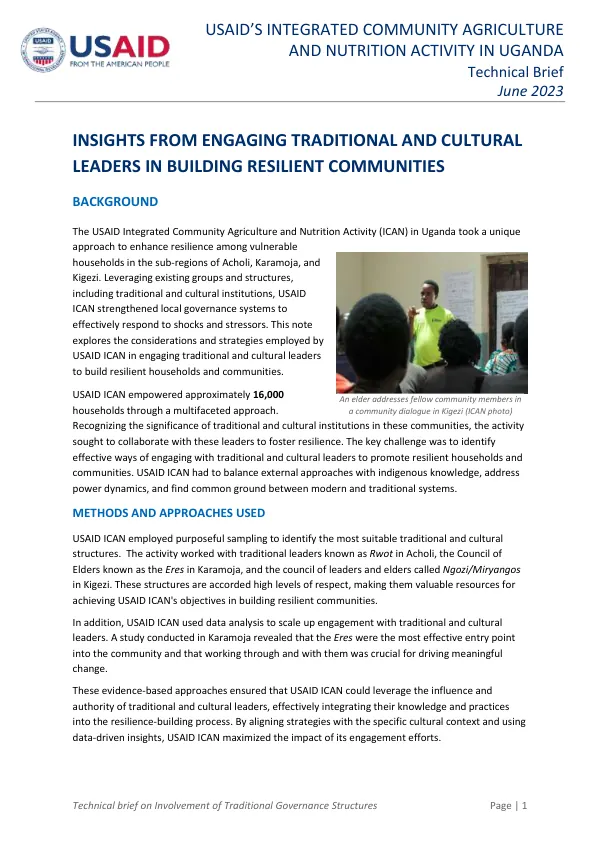
Leveraging existing groups and structures, including traditional and cultural institutions, USAID ICAN strengthened local governance systems to effectively respond to shocks and stressors. This approach involved collaborating with traditional leaders to foster resilience. USAID ICAN empowered approximately 16,000 households through a multifaceted approach. Recognizing the significance of traditional and cultural institutions in these communities, the activity sought to collaborate with these leaders to foster resilience. The key challenge was to identify effective ways of engaging with traditional and cultural leaders to promote resilient households and communities. USAID ICAN had to balance external approaches with indigenous knowledge, address power dynamics, and find common ground between modern and traditional systems. USAID ICAN employed purposeful sampling to identify the most suitable traditional and cultural structures. The activity worked with traditional leaders known as Rwot in Acholi, the Council of Elders known as the Eres in Karamoja, and the council of leaders and elders called Ngozi/Miryangos in Kigezi. These structures are accorded high levels of respect, making them valuable resources for achieving USAID ICAN's objectives in building resilient communities. In addition, USAID ICAN used data analysis to scale up engagement with traditional and cultural leaders. A study conducted in Karamoja revealed that the Eres were the most effective entry point into the community and that working through and with them was crucial for driving meaningful change. These evidence-based approaches ensured that USAID ICAN could leverage the influence and authority of traditional and cultural leaders, effectively integrating their knowledge and practices into the resilience-building process. USAID ICAN recognized the crucial role of traditional and cultural leaders in community resilience building. Their influence, knowledge of cultural norms, and deep understanding of community dynamics made them valuable partners in this process. Through extensive consultations and dialogues, the Activity fostered mutual understanding and trust with these leaders, acknowledging their expertise and knowledge. By involving traditional and cultural structures, USAID ICAN aimed to achieve several objectives. These included partnering with existing traditional systems and structures, building institutional capacities, enhancing participation in decision-making and development processes, strengthening community cohesion, preserving cultural activities and practices, promoting identity and shared norms, tapping into indigenous wisdom, promoting environmental preservation and management, and supporting traditional justice systems. The traditional and cultural leaders enjoyed a profound level of respect and trust from the community. Whatever they communicate is considered the ultimate truth. In Kigezi, particularly in Kisoro, the Miryangos – (a social support group) were highly regarded in resolving community conflicts. Traditional leaders demonstrated a comprehensive understanding of the community's context based on historical phenomena and the mitigation measures employed to address specific natural or man-made events. Over a century ago, the Rwot of Acholi presided over a thriving sub-region, fostering booming economic activities, academic excellence, and the implementation of the effective conflict resolution system called Mato Oput. Today, key priorities for the Rwodi include ensuring that all school-aged children in their communities return to school, promoting the cultivation of at least one crop per household, and implementing the Mato Oput conflict resolution system. By supporting and facilitating these processes, USAID ICAN cultivated resilient communities capable of absorbing and recovering from shocks, adapting to and managing change, and maintaining social cohesion throughout transformation.
Related documents