USAID DEC
USAID’s Integrated Community Agriculture and Nutrition Activity in Uganda: Technical Brief
Sign inUSAID
USAID’s Integrated Community Agriculture and Nutrition Activity in Uganda: Technical Brief
The USAID Integrated Community Agriculture and Nutrition (ICAN) activity in Uganda aimed to improve economic conditions for poor households, while improving nutrition for women and children, strengthening community and local governance, and increasing school enrollment and retention.
2023 · 7 pages
Sign in to readA free account is required to download.
Abstract
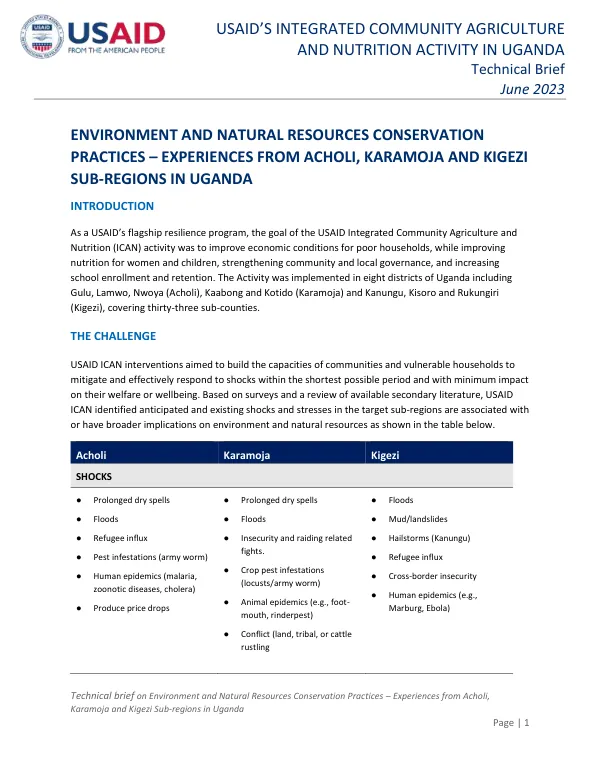
The Activity was implemented in eight districts of Uganda, including Gulu, Lamwo, Nwoya (Acholi), Kaabong and Kotido (Karamoja) and Kanungu, Kisoro and Rukungiri (Kigezi), covering thirty-three sub-counties. USAID ICAN interventions focused on building the capacities of communities and vulnerable households to mitigate and effectively respond to shocks within the shortest possible period and with minimum impact on their welfare or wellbeing. The Activity identified anticipated and existing shocks and stresses in the target sub-regions, which were associated with or had broader implications on environment and natural resources. These shocks and stresses included prolonged dry spells, floods, refugee influx, pest infestations, human epidemics, produce price drops, and insecurity and raiding related fights. To address these challenges, USAID ICAN developed or promoted existing community-based structures, such as the Business Service Providers (BSPs), Governance Champions (GCs), and Patrons/Matrons in primary schools, to amplify the program agenda. The Activity also engaged, mobilized, and sensitized locally based, non-state actors such as Civil Society Organizations (CSOs) and private sector partners to encourage communities to adopt good environmental management practices. Through community structures and using facilitative approaches, USAID ICAN trained communities, organized groups, and local public institutions on improved natural resource management practices and technologies, such as planting fruit and woody trees for non-timber forest products, firewood, and timber, promoting chili and apiary production to reduce human-wildlife conflict, using organic pesticides, and adopting energy-saving and rainwater harvesting technologies. The Activity also provided communities with weather information and early warning and supported the districts to develop disaster management plans. One of the key interventions was the promotion of tree planting, agroforestry, and conservation. Thanks to the activity, participants planted over 50,000 indigenous trees, such as teak, avocado, jackfruit, pawpaw, Afzelia africanus, and musisi trees. Eight community groups received ICAN in-kind grants worth UGX 105,380,000 (US$28,200.75) to promote tree planting for income and environmental conservation, including restoring the hills prone to mudslides in Kisoro. In addition, USAID ICAN supported the construction of terraces, ridges, trenches, and tree planting to manage the hills and simultaneously reduce soil erosion and mudslides, while increasing timber availability and incomes. Communities in the Kigezi sub-region planted 5,000 bamboo seedlings in 2022, on the hills and as hedge rows in farmers' gardens. The nursery operator established a tree nursery as a business in the Kanungu district, contributing to the community effort by offering individuals enough bamboo seedlings to cover one acre for free. The Activity also promoted the use of energy-efficient stoves, such as the Rocket Lorena stove, which reduces the overall cost and time required for cooking, especially for women. The stove uses 50 percent less fuel (firewood) and charcoal compared to conventional stoves, reducing deforestation and giving women more time to take care of their families and engage in other livelihood activities. USAID ICAN trained BSPs on how to build the stoves, and participants indicated that they adopted these stoves due to dwindling or scarce firewood, the desire to save cooking time, and after USAID ICAN sensitized them to the health dangers posed by inhalation of smoke from directly burning firewood.
Related documents
Documents in this collection
 2023
2023USAID DEC
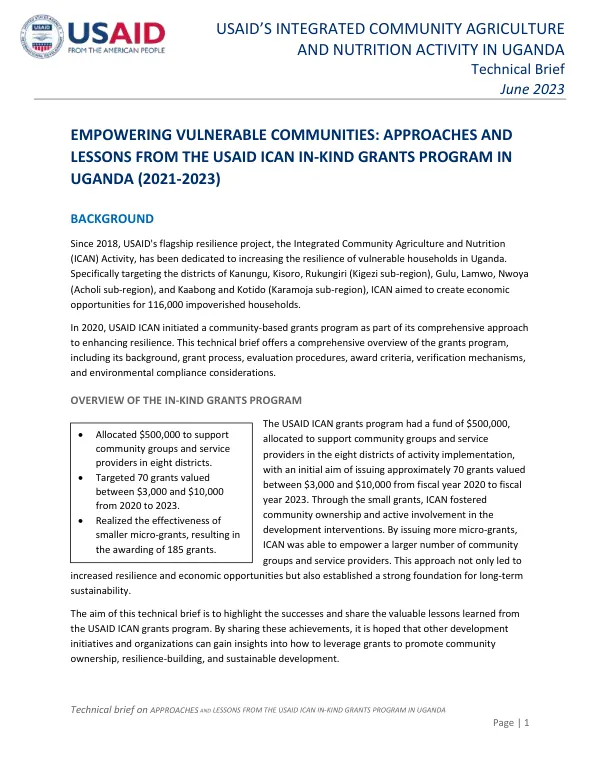
USAID’s Integrated Community Agriculture and Nutrition Activity in Uganda: Approaches and Lessons from the USAID ICAN In-Kind Grants Program in Uganda
Open record 2023
2023USAID DEC