ABT ASSOCIATES
USAID's Integrated Health Program: Capacity Development Approach
The Capacity Development Approach report provides a description of the capacity-development approach that will be employed by USAID's Integrated Health Program (USAID IHP) over the course of the seven-year program.
2018 · 46 pages
Sign in to readA free account is required to download.
Abstract
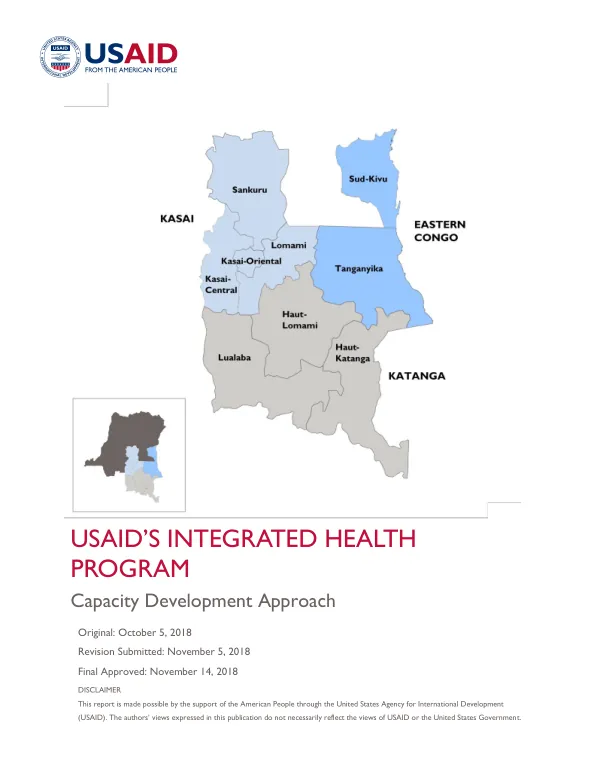
This report informs program partners of the guiding principles, methodology, strategy, and expected results that will frame the design and implementation of effective capacity-building interventions. The purpose of USAID IHP is to strengthen the capacity of Congolese institutions and communities to deliver quality, integrated health services to sustainably improve the health status of the Congolese population. The program is being implemented in the regions of Eastern Congo, Kasai, and Katanga, with a base period of January 31, 2018 through May 30, 2022 and one three-year option period from May 31, 2022 through May 29, 2025. The program has three main objectives: to strengthen health systems, governance, and leadership at provincial, health zone, and facility levels in target health zones; to increase access to quality, integrated health services in target health zones; and to increase adoption of healthy behaviors, including use of health services, in target health zones. The strengthening of institutional capacity cuts across all components of USAID IHP and is an essential element of the program's sustainability strategy. Institutional reforms in the Democratic Republic of the Congo (DRC) have increased the number of health zones and facilities, but have also created challenges in terms of governance, leadership, and capacity. The Capacity Development Approach report outlines the guiding principles, methodology, strategy, and expected results that will frame the design and implementation of effective capacity-building interventions. The report emphasizes the importance of a participatory approach, collaboration, and learning in capacity development. The report highlights the need to strengthen health systems, governance, and leadership at provincial, health zone, and facility levels in target health zones. This includes building the capacity of health zone and facility staff, improving health information systems, and enhancing the ability of health facilities to provide quality services. The report also emphasizes the importance of increasing access to quality, integrated health services in target health zones. This includes improving the availability and accessibility of health services, enhancing the quality of health services, and increasing the use of health services by the target population. In addition, the report highlights the need to increase adoption of healthy behaviors, including use of health services, in target health zones. This includes promoting healthy behaviors through social and behavior change communication, improving the availability and accessibility of health services, and enhancing the quality of health services. The Capacity Development Approach report provides a comprehensive framework for capacity development that will guide the design and implementation of effective capacity-building interventions. The report emphasizes the importance of a participatory approach, collaboration, and learning in capacity development and highlights the need to strengthen health systems, governance, and leadership at provincial, health zone, and facility levels in target health zones. The report outlines the methodology and strategy that will be employed to achieve the program's objectives, including the use of participatory institutional capacity assessment and learning index (PICAL) to assess institutional capacity and identify areas for improvement. The report also highlights the importance of monitoring and evaluation in capacity development and outlines the approach that will be employed to monitor and evaluate the program's progress. The report outlines the expected results of the program, including the strengthening of health systems, governance, and leadership at provincial, health zone, and facility levels in target health zones; the increase in access to quality, integrated health services in target health zones; and the increase in adoption of healthy behaviors, including use of health services, in target health zones.