USAID DEC
USAID’s Natural Wealth Program: Strategy for Sustainable Dairy Farming to Conserve Tropical Dry Forest in Cesar Department
Sign inCHEMONICS
USAID’s Natural Wealth Program: Strategy for Sustainable Dairy Farming to Conserve Tropical Dry Forest in Cesar Department
The Natural Wealth Program, in partnership with Nestlé Dairy Partners of America (DPA), the Secretary of Agriculture for the Department of Cesar, and the Cattle Ranching Federation of Cesar (FEGACESAR), is developing a strategy for sustainable dairy farming to conserve tropical dry forest in Cesar Department.
2018 · 3 pages
Sign in to readA free account is required to download.
Abstract
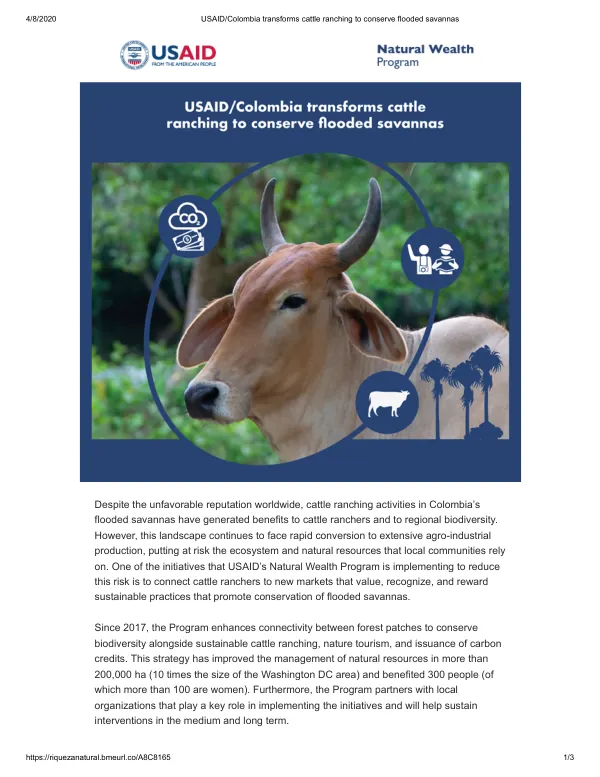
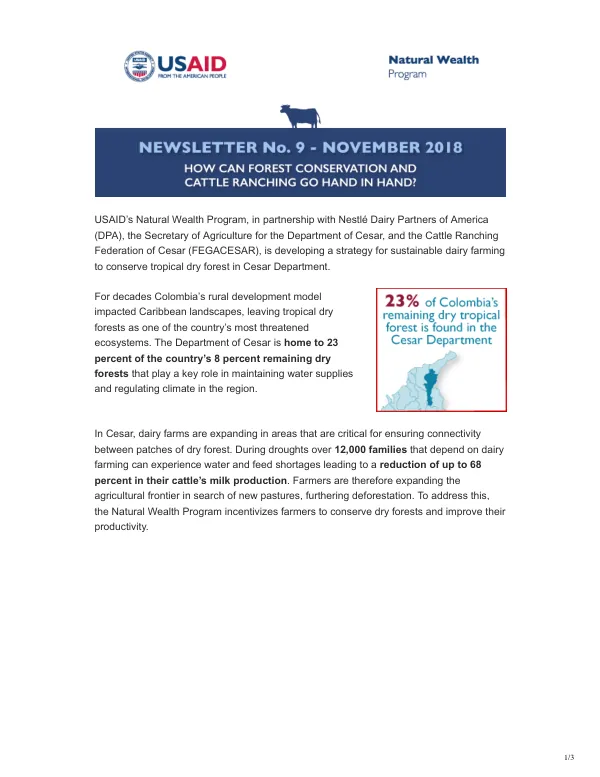
This initiative aims to address the expansion of dairy farms into areas critical for maintaining connectivity between patches of dry forest, which is threatening the ecosystem. Colombia's rural development model has had a significant impact on Caribbean landscapes, leaving tropical dry forests as one of the country's most threatened ecosystems. The Department of Cesar is home to 23 percent of the country's remaining dry forests, which play a key role in maintaining water supplies and regulating climate in the region. Dairy farms in Cesar are expanding into areas that are essential for ensuring connectivity between patches of dry forest, leading to water and feed shortages for over 12,000 families that depend on dairy farming. During droughts, these families can experience a reduction of up to 68 percent in their cattle's milk production. To address this issue, the Natural Wealth Program incentivizes farmers to conserve dry forests and improve their productivity. The program has identified dairy farming practices that conserve tropical dry forest and improve both milk quality and productivity. These best practices include improving water, land, and forest management on strategically located small dairy farms. The Natural Wealth Program's strategy includes several key components. First, the program will identify dairy farming practices that conserve tropical dry forest and improve milk quality and productivity. The goal is to reduce the expansion of the agricultural frontier to conserve tropical dry forest through strengthening connectivity between forest patches. Second, the program will implement environmental best practices with an initial group of 40 milk producers in the municipalities of Copey and La Jagua de Ibirico under a partnership with FEGACESAR. Nestlé DPA will enter into commercial agreements with these producers as a market incentive for conservation efforts and provide financial resources to implement best practices. Third, the program will work with value chain stakeholders in the dairy sector with the International Center for Tropical Agriculture (CIAT) to develop a common vision in the Cesar Department that includes biodiversity and dry forest conservation to improve competitiveness in the sector. Finally, the program will participate in Cesar's Sustainable Cattle Ranching Roundtable to explore opportunities with the Department's Secretary of Agriculture for scaling up implementation of the Natural Wealth's strategy.