USAID DEC
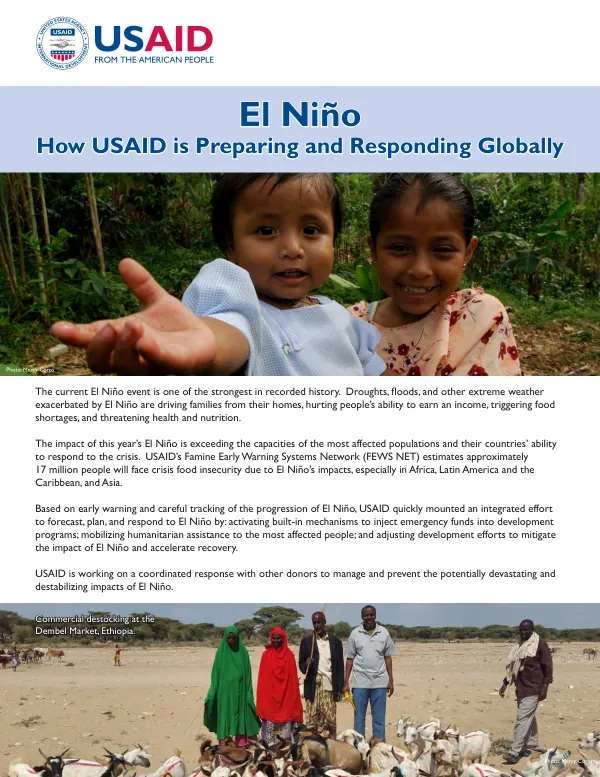
USAID’s Office of U.S. Foreign Disaster Assistance is Preparing and Responding to El Niño-Related Disasters
Sign inU.S. FOREST SERVICE
USAID’s Office of U.S. Foreign Disaster Assistance is Preparing and Responding to El Niño-Related Disasters
The Office of U.S.
2015 · 2 pages
Sign in to readA free account is required to download.
Abstract
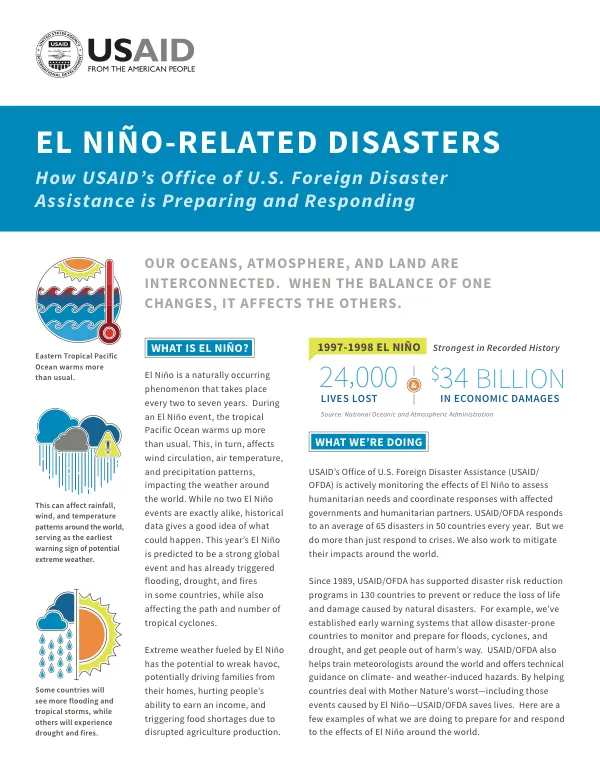
Foreign Disaster Assistance (USAID/OFDA) is actively monitoring the effects of El Niño to assess humanitarian needs and coordinate responses with affected governments and humanitarian partners. El Niño is a naturally occurring phenomenon that takes place every two to seven years, during which the tropical Pacific Ocean warms up more than usual, affecting wind circulation, air temperature, and precipitation patterns, impacting the weather around the world. The warming of the Pacific Ocean has the potential to wreak havoc, potentially driving families from their homes, hurting people's ability to earn an income, and triggering food shortages due to disrupted agriculture production. In 1997-1998, El Niño caused $34 billion in economic damages and resulted in 24,000 lives lost, making it the strongest El Niño event in recorded history. The effects of El Niño are far-reaching, with some countries experiencing more flooding and tropical storms, while others face drought and fires. USAID/OFDA is working to mitigate the impacts of El Niño around the world. Since 1989, the office has supported disaster risk reduction programs in 130 countries to prevent or reduce the loss of life and damage caused by natural disasters. For example, USAID/OFDA has established early warning systems that allow disaster-prone countries to monitor and prepare for floods, cyclones, and drought, and get people out of harm's way. The office also helps train meteorologists around the world and offers technical guidance on climate- and weather-induced hazards. In response to the current El Niño event, USAID/OFDA is providing assistance to several countries affected by the phenomenon. In Papua New Guinea, El Niño-related drought has damaged crops and caused a shortage of safe drinking water, affecting an estimated 1.8 million people. USAID/OFDA helped distribute seeds and plants to farmers and provided agricultural training on drought and frost-resistant crops. In Guatemala, low rainfall made worse by El Niño has led to drought and poor harvests, and USAID/OFDA is helping communities cope by supporting activities such as soil conservation, rainwater harvesting, and crop diversification. In addition to providing humanitarian assistance, USAID/OFDA is also working to strengthen the ability of countries to respond to disasters. The office has partnered with the National Oceanic and Atmospheric Administration to support early warning systems that notify people before storms hit. In Somalia, potential flooding and drought triggered by El Niño will bring added devastation to the more than 3 million people already in need of humanitarian assistance, and USAID partners have developed contingency plans and pre-positioned relief supplies in areas expected to be impacted by floods.