USAID
USAID'S Urban and Environmental Credit Program
The Urban and Environmental Credit Program was created by Congress almost 40 years ago as the U.S.
2018 · 2 pages
Sign in to readA free account is required to download.
Abstract
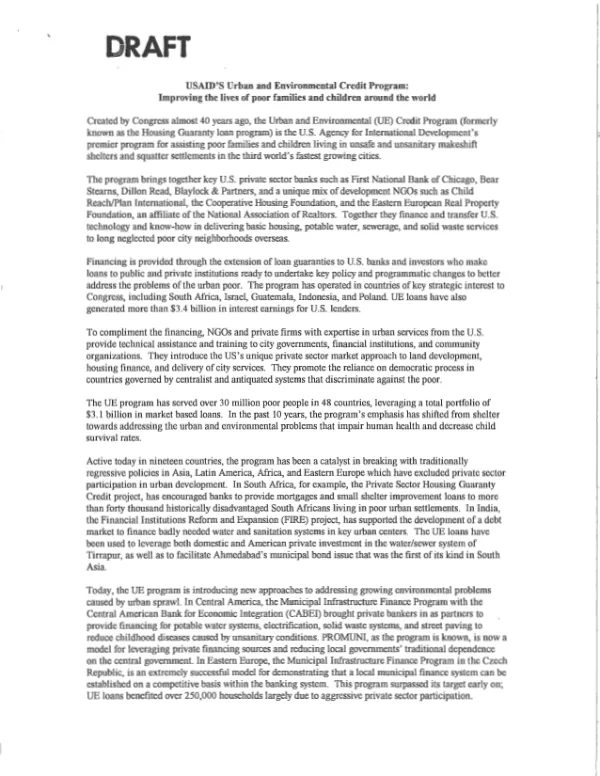
Agency for International Development's premier program for assisting poor families and children living in unsafe and unsanitary makeshift shelters and squatter settlements in the world's fastest growing cities. The program brings together key U.S. private sector banks and development NGOs to finance and transfer U.S. technology and know-how in delivering basic housing, potable water, sewerage, and solid waste services to neglected poor city neighborhoods overseas. Financing is provided through the extension of loan guaranties to U.S. banks and investors who make loans to public and private institutions ready to undertake key policy and programmatic changes to better address the problems of the urban poor. The program has operated in countries of key strategic interest to Congress, including South Africa, Israel, Guatemala, Indonesia, and Poland. UE loans have also generated more than $3.4 billion in interest earnings for U.S. lenders. To complement the financing, NGOs and private firms with expertise in urban services from the U.S. provide technical assistance and training to city governments, financial institutions, and community organizations. The program has served over 30 million poor people in 48 countries, leveraging a total portfolio of $3.1 billion in market-based loans. In the past 10 years, the program's emphasis has shifted from shelter towards addressing the urban and environmental problems that impair human health and decrease child survival rates. Active today in 19 countries, the program has been a catalyst in breaking with traditionally regressive policies in Asia, Latin America, Africa, and Eastern Europe, which have excluded private sector participation in urban development. In South Africa, the Private Sector Housing Guaranty Credit project has encouraged banks to provide mortgages and small shelter improvement loans to more than 40,000 historically disadvantaged South Africans living in poor urban settlements. In India, the Financial Institutions Reform and Expansion (FIRE) project has supported the development of a debt market to finance badly needed water and sanitation systems in key urban centers. The UE loans have been used to leverage both domestic and American private investment in the water/sewer system of Tirrapur, as well as to facilitate Ahmedabad's municipal bond issue that was the first of its kind in South Asia. Today, the UE program is introducing new approaches to addressing growing environmental problems caused by urban sprawl. In Central America, the Municipal Infrastructure Finance Program with the Central American Bank for Economic Integration (CABEI) brought private bankers in as partners to provide financing for potable water systems, electrification, solid waste systems, and street paving to reduce childhood diseases caused by unsanitary conditions. The program has also established Regional Urban Development Offices (RUDOs) staffed by housing and urban development experts who manage their regions' loan and technical assistance portfolios, providing a unique model for managing scarce resources in the face of growing demand for development assistance around the world.