IBI
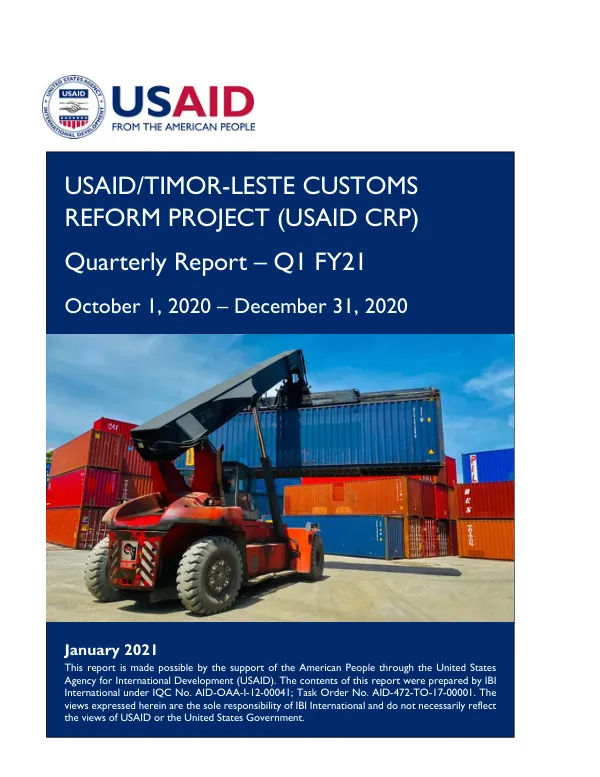
USAID/TIMOR-LESTE CUSTOMS REFORM PROJECT: QUARTERLY REPORT — Q1 FY21
The USAID/Timor-Leste Customs Reform Project (USAID CRP) is a comprehensive initiative aimed at enhancing the capacity of the Customs Authority of Timor-Leste to implement the Revised Kyoto Convention and the Framework of Standards to Secure and Facilitate Global Trade.
2021 · 126 pages
Sign in to readA free account is required to download.
Abstract
The project's primary objective is to improve the efficiency and effectiveness of customs procedures, thereby facilitating trade and economic growth in Timor-Leste. The project is divided into three key outcomes: Outcome 1, which focuses on implementing the Revised Kyoto Convention and the Framework of Standards; Outcome 2, which involves implementing the World Customs Organization (WCO) Revised Arusha Declaration; and Outcome 3, which aims to establish a National Trade Information Portal. To achieve these outcomes, the project has identified several activities, including building risk management capacity, streamlining procedures and enhancing automation, drafting cooperative agreements, and developing and implementing integrated services. One of the key activities under Outcome 1 is the development of risk management capacity, which involves the implementation of the Customs Intelligence Database (CID) and the development of risk profiles for Authorized Economic Operators (AEOs). The project has also focused on streamlining procedures and enhancing automation, including the implementation of the Automated System for Customs Data (ASYCUDA) and the development of a Customs Trade Portal (CTP). Under Outcome 2, the project has supported the implementation of the WCO Revised Arusha Declaration, which aims to enhance the capacity of customs administrations to prevent and combat corruption. This has involved the development of anti-corruption activities, including the establishment of a consultative forum and the development of workplace mentoring and training programs. The project has also made significant progress in establishing a National Trade Information Portal, which aims to provide a single window for traders to access information on customs procedures and regulations. The portal has been enhanced to include key information, and policies and procedural manuals have been prepared to support its implementation. In terms of personnel activities, the project has focused on building the capacity of the Customs Authority's staff, including training and mentoring programs. The project has also established a monitoring and evaluation system to track progress and identify areas for improvement. Overall, the USAID/Timor-Leste Customs Reform Project has made significant progress in its first quarter, with several key activities completed or underway. The project's success will depend on the continued support of the Customs Authority and the Government of Timor-Leste, as well as the effective implementation of the project's activities and outcomes. The project has also identified several challenges and lessons learned, including the need for improved communication and coordination between stakeholders, as well as the importance of building the capacity of the Customs Authority's staff. The project has also highlighted the need for continued support and resources to ensure the effective implementation of the project's activities and outcomes. In terms of environmental compliance and mitigation measures, the project has implemented several measures to minimize its environmental impact, including the use of energy-efficient equipment and the implementation of waste management practices. Finally, the project has identified several suggested steps moving forward, including the continued implementation of the project's activities and outcomes, as well as the establishment of a sustainability plan to ensure the long-term success of the project.