USAID DEC
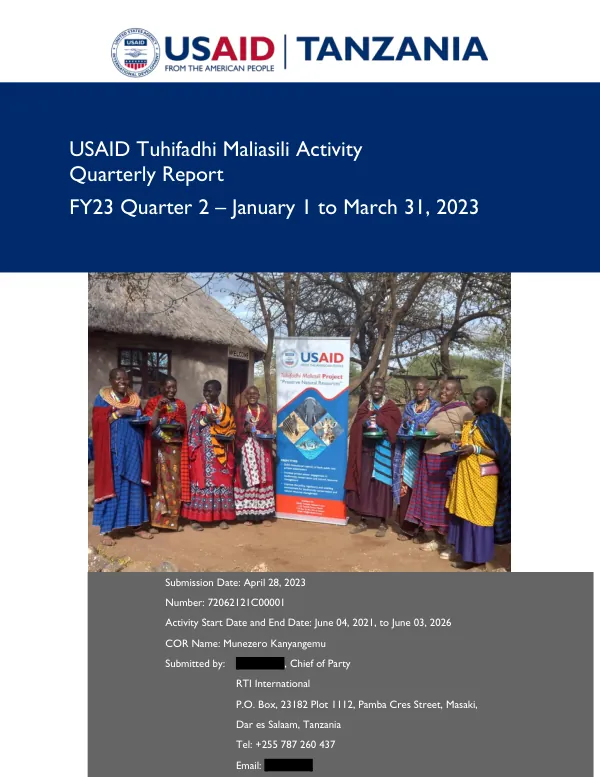
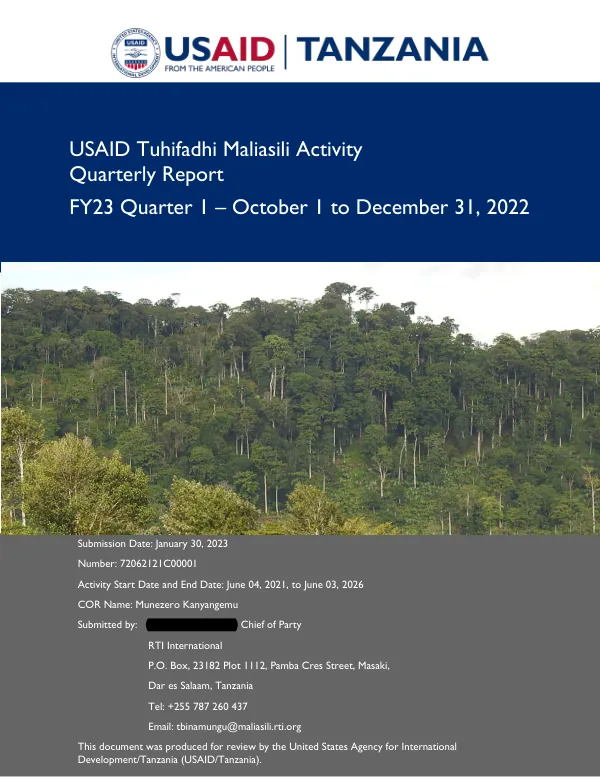
USAID Tuhifadhi Maliasili Activity Quarterly Report FY23 Quarter 1 – October 1 to December 31, 2022
Sign inAFRICAN WILDLIFE FOUNDATION
USAID Tuhifadhi Maliasili Activity Quarterly Report FY23 Quarter 1 – October 1 to December 31, 2022
The USAID Tuhifadhi Maliasili Activity is a five-year initiative aimed at conserving biodiversity and natural resources in Tanzania.
2023 · 41 pages
Sign in to readA free account is required to download.
Abstract
The activity began on June 4, 2021, and is set to conclude on June 3, 2026. The prime implementing partner is RTI International, with subcontractors and grantees including organizations such as the African Wildlife Foundation, the Southern Tanzania Elephant Program, and the Tanzania Private Sector Foundation. The activity focuses on six wildlife corridors, including the Kwakuchinja Corridor, the Kigosi Moyowosi Corridor, the Nyerere Selous Corridor, the Amani-Nilo Corridor, the Ruaha Rungwa-Katavi Corridor, and the Ruaha Rungwa-Inyonga Corridor. These corridors are located in various regions of Tanzania, including Manyara, Arusha, Kagera, Kigoma, Morogoro, Tanga, Mbeya, and Ifakara. The activity's primary objective is to build institutional capacities of both public and private stakeholders, increase private sector engagement in biodiversity conservation and natural resources management, and improve the policy, regulatory, and enabling environment for biodiversity conservation and natural resources management. Implementation progress has been made in various areas, including the establishment of demonstration plots, farmer training programs, and market linkage facilitation. The activity has also engaged with local communities, including women-headed households, to promote sustainable agriculture practices and improve household income. The activity has achieved several intermediate results, including a 27% increase in household income among program participants compared to the control group. The activity has also integrated cross-cutting issues, including gender equality and women's empowerment, youth engagement, grants under contract, integration and collaboration, sustainability, environmental compliance, global climate change, policy and governance support, private sector engagement, public-private partnerships, and science, technology, and innovation. Stakeholder participation and involvement have been crucial in the activity's success, with engagement from local communities, civil society organizations, and private sector partners. Management and administrative issues have also been addressed, including administration, finance, monitoring, evaluation, and learning. The activity has also reported on special events for the next quarter, addressed comments from the last quarter, and provided a financial summary. Success stories from the activity have been documented in Annex 1. The activity's geographic coverage includes various districts, regions, and Zanzibar, with a focus on six wildlife corridors. The activity's implementation is expected to continue until June 3, 2026, with ongoing efforts to build institutional capacities, increase private sector engagement, and improve the policy and regulatory environment for biodiversity conservation and natural resources management.
Related documents