FHI360
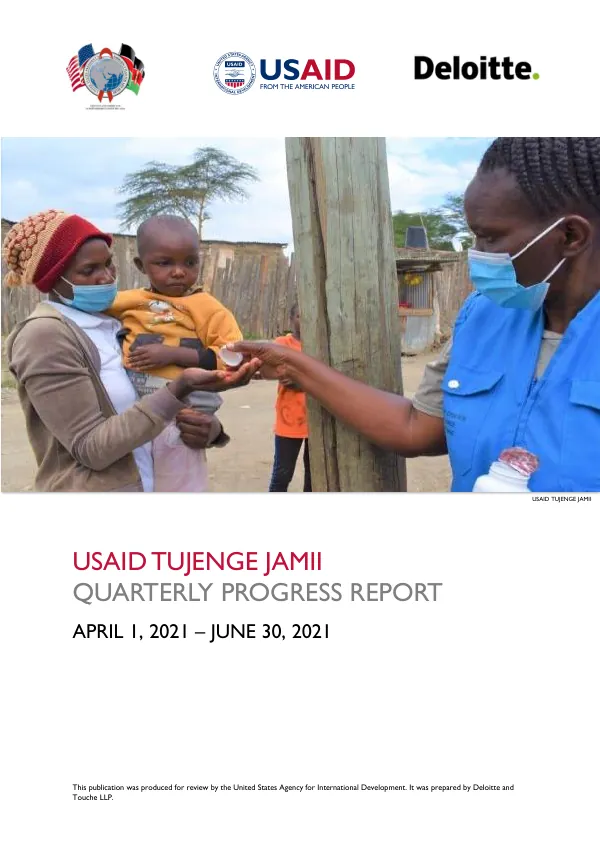
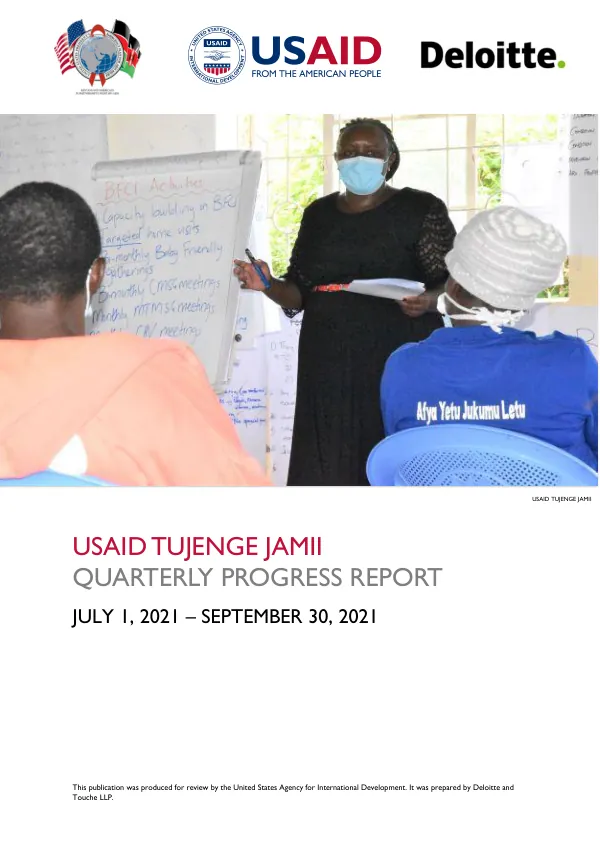
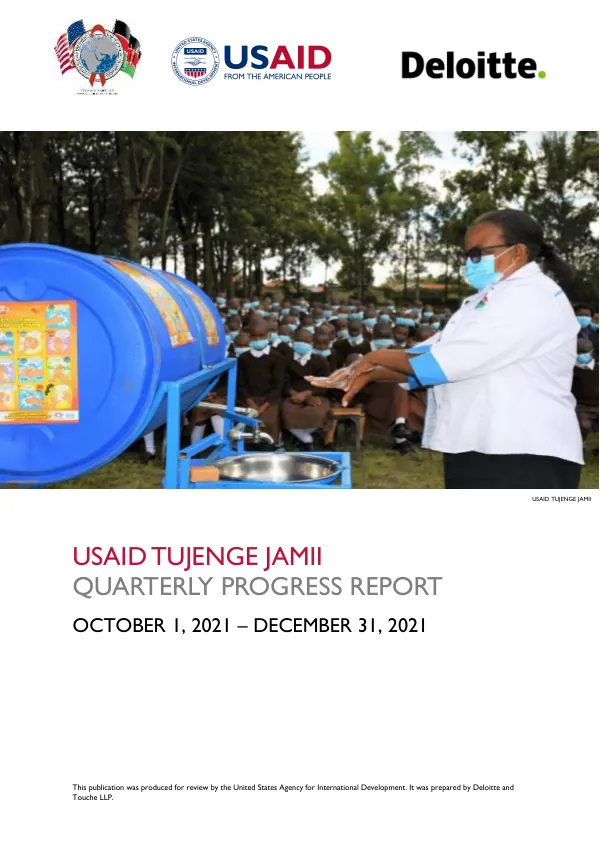
USAID Tujenge Jamii Quarterly Progress Report October 1, 2021 – December 31, 2021
The USAID Tujenge Jamii project is a health initiative aimed at improving access to quality HIV prevention and treatment services, as well as family planning, reproductive, maternal, newborn, child, and adolescent health (RMNCAH), nutrition, and water, sanitation, and hygiene (WASH) services in Kenya.
2021 · 79 pages
Sign in to readA free account is required to download.
Abstract
The project is implemented by Deloitte and Touche LLP, with sub-partners Goldstar Kenya and FHI360, and is funded by the United States Agency for International Development (USAID) through the Kenya and East Africa Cooperative Agreement. The project focuses on five sub-purposes: increasing access and demand for quality HIV prevention services, increasing access and demand for quality HIV treatment services, increasing access and demand for quality FP/RMNCAH, nutrition, and WASH services, strengthening the capacity of county health systems, local partners, and communities to deliver quality health services, and monitoring, evaluation, and reporting. Key achievements under the first sub-purpose include increased access to and demand for targeted HIV prevention services among key populations, adolescents, and girls, as well as increased reporting and prevention of sexual and gender-based violence (SGBV). The project also reported increased uptake of targeted HIV testing services, with a focus on key populations and adolescents. Under the second sub-purpose, the project achieved increased access and demand for quality prevention of mother-to-child transmission (PMTCT) services, as well as increased access and demand for quality antiretroviral therapy (ART) services. The project also reported increased initiation of treatment and ART optimization, as well as differentiated service delivery, including cervical cancer screening and treatment for women living with HIV. The third sub-purpose focused on increasing access and demand for quality FP/RMNCAH, nutrition, and WASH services. Key achievements include increased utilization of family planning services, improved maternal and newborn health outcomes, and increased child health and nutrition services. The project also reported increased health care-seeking behavior for FP/RMNCAH, nutrition, and WASH services. Under the fourth sub-purpose, the project strengthened the capacity of county health systems, local partners, and communities to deliver quality health services. Key achievements include strengthened human resource for health (HRH) systems, strengthened capacity for financing and accountability of county health services, and increased coordination and provision of laboratory services to support quality of HIV care. The project also reported strengthened commodity logistics and inventory management, as well as strengthened strategic information systems for quality improvement, planning, coordination, monitoring, and learning. Additionally, the project strengthened case-based surveillance and public health response systems, as well as community engagement in the delivery of quality health services. The project's monitoring, evaluation, and reporting framework is based on a set of indicators and targets, including family health targets. The project's progress is reported quarterly, with a focus on tracking progress towards the project's objectives and outcomes.