INTERNATIONAL FOOD AND POLICY RESEARCH INSTITUTE
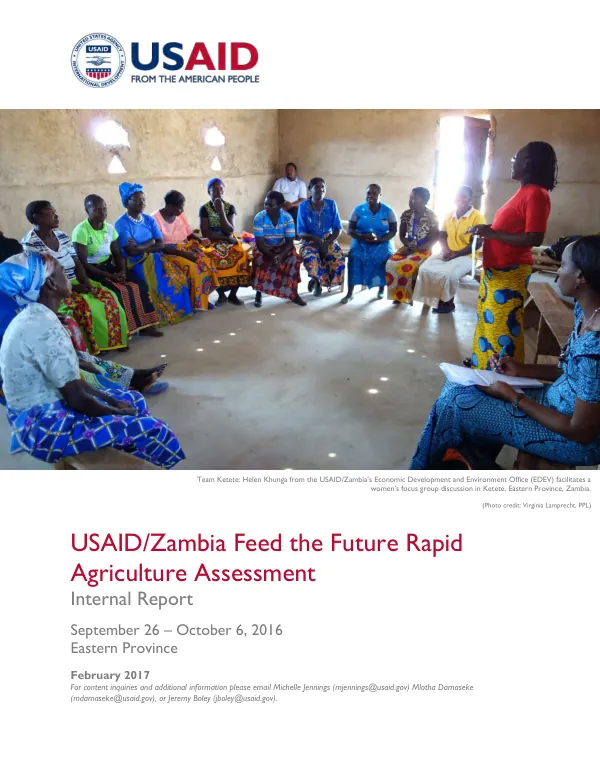
USAID/Zambia Feed the Future Rapid Agriculture Assessment Internal Report
The USAID/Zambia Feed the Future Rapid Agriculture Assessment was conducted from September 26 to October 6, 2016, in the Eastern Province.
2017 · 76 pages
Sign in to readA free account is required to download.
Abstract
The assessment involved participation from seven USAID/Zambia cross-sectoral Mission offices, USAID's Offices of the Bureau for Food Security, Policy, Planning, and Learning, the United States Peace Corps, and the International Food Policy Research Institute. Four teams traveled to multiple communities in the four Districts within the Eastern Province, including Chipata, Katete, Lundazi, and Petauke. The objectives of the assessment were to listen, learn, and reflect on current agricultural livelihood challenges and opportunities, provide insights into the status and progress of current programs, inform the second generation of USAID/Zambia FTF programs, and gather qualitative input for the upcoming Country Development Cooperation Strategy. The assessment utilized focus group discussions and key informant interviews to collect qualitative data, which was analyzed by each district team and then consolidated and synthesized among all four district teams. The USAID/Zambia FTF Strategy aims to lift 350,000 people out of poverty over its five-year implementation through investments in improved staple food production, processing, and marketing in the Zone of Influence. The FTF programs aim to increase smallholder agricultural productivity and diversification, improve markets and trade, including enabling policy environment, improve resilience of vulnerable households and nutritional status, and improve natural resource management. Results to date indicate that the current FTF Programs are exceeding or meeting the majority of targets per performance report systems. The assessment teams heard that the overall trend in rural Zambian agriculture productivity and food/nutrition has improved for many as compared to five years ago. Yields are increasing, crop diversity is widening, and food and nutrition security is improving in most cases. This conclusion is supported by quantitative data from three sources: the Government of Zambia's Living Conditions Monitoring Survey Report, the Indaba Agriculture Policy Research Institute, and the Rural Agriculture Livelihoods Survey. The assessment provided an excellent example of strategic leadership in its commitment to an in-house, multi-week assessment, whereby USAID staff was inspired and motivated to better understand the development context and USAID's programmatic progress. The report reflects the voices of Zambian farmers, traders, government authorities, private sector partners, project implementers, and community leaders who provided the raw information from which this analysis was undertaken. The assessment teams identified several key challenges and opportunities in the FTF zone of influence, including the need for improved market access, increased crop diversification, and enhanced natural resource management. The teams also highlighted the importance of building resilience among vulnerable households and improving nutritional status. The assessment provided valuable insights into the status and progress of current programs and informed the development of the second generation of USAID/Zambia FTF programs. The assessment teams utilized a uniform spreadsheet to organize the information collected from focus group discussions and key informant interviews. The data was analyzed by each district team and then consolidated and synthesized among all four district teams in a plenary workshop. The final consolidation and synthesis of the main findings of the assessment were discussed and synthesized over a three-day period. The assessment provided a comprehensive understanding of the current agricultural livelihood challenges and opportunities in the FTF zone of influence. The findings of the assessment will inform the development of the second generation of USAID/Zambia FTF programs and provide valuable insights into the status and progress of current programs. The assessment also highlighted the importance of building resilience among vulnerable households and improving nutritional status.
Related documents