SONJARA, INC.
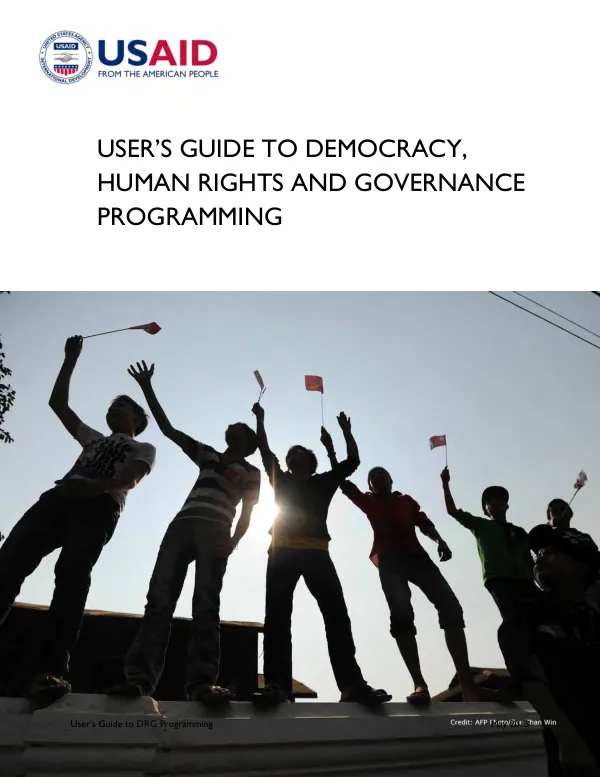
User’s Guide to Democracy, Human Rights and Governance Programming
The Center of Excellence on Democracy, Human Rights and Governance (DRG Center) was formally launched by USAID Administrator Rajiv Shah on February 27, 2012.
2014 · 97 pages
Sign in to readA free account is required to download.
Abstract
The launch occurred just over a year after the release of the first-ever U.S. Quadrennial Diplomacy and Development Review (QDDR), which explicitly tasked USAID with establishing the DRG Center as the primary means of elevating and integrating democracy, human rights, and governance within the agency's overall development portfolio. The DRG Center has a noble and challenging mandate, captured in USAID's Mission Statement: "To end extreme poverty and promote resilient, democratic societies while advancing our security and prosperity." The DRG Center's mission statement is to "advance democracy, human rights, and governance for the sake of political freedom, while contributing to socioeconomic progress and overall developmental resilience by integrating DRG across all sectors." The DRG Center organizes its work to achieve three strategic objectives: 1) Learn: Increase knowledge concerning the global advancement of DRG; 2) Serve: Improve the quality and impact of DRG technical assistance to the field; and 3) Influence: Elevate the role of DRG in key USAID, USG, and multilateral strategies, policies, and budgets. The DRG Center has a strong emphasis on rigorous learning, promoting and supporting evidence-based DRG programming. The User's Guide to DRG Programming has been crafted to serve as a fundamental reference tool for USAID Missions and Bureaus to utilize in pursuit of advancing democracy, human rights, and good governance. This Guide outlines the structure and breadth of the DRG Center's technical expertise, as well as the DC-based DRG cadre. The Guide catalogs the funding and implementing mechanisms that may be accessed through the DRG Center and other offices, and technical resources which inform DRG work. The DRG Center's support of missions is provided through an interlinked approach that involves technical leadership, targeted field support, cadre development and training, and direct program management. Various training, as well as assessment and programming tools, are developed by the DRG Center to assist missions in analyzing and choosing appropriate strategies to address the DRG issues in their host countries, as well as implement Agency-wide policies. The eight teams that comprise the DRG Center are: 1) Civil Society and Media (CSM); 2) Cross-Sectoral Programs (CSP); 3) Elections & Political Transitions (EPT); 4) Global and Regional Policy (GRP); 5) Governance and Rule of Law (GRL); 6) Human Rights (HR); 7) Learning; and 8) Strategic Planning. The DRG Center also has two permanent working groups: the DRG Gender Working Group and the Training and Learning Team. The User's Guide to DRG Programming is regularly updated and accessible on the Center of Excellence on Democracy, Human Rights and Governance intranet site at http://inside.usaid.gov/drg. The Guide provides a comprehensive overview of the DRG Center's structure, expertise, and resources, as well as the various implementing mechanisms and technical resources available to support DRG programming. The DRG Center's work is organized around several key areas, including Civil Society and Media, Cross-Sectoral Programs, Elections & Political Transitions, Global and Regional Policy, Governance and Rule of Law, Human Rights, and Learning. Each of these areas has its own set of implementing mechanisms, technical resources, and expertise, which are outlined in the User's Guide to DRG Programming. The Guide also provides information on how to access a DRG implementing mechanism, as well as cross-cutting services and IQCs for democracy and governance analytical services. The DRG Center's work is focused on advancing democracy, human rights, and governance in countries around the world. The Center's approach is based on a strong emphasis on rigorous learning, evidence-based programming, and collaboration with a range of stakeholders, including civil society organizations, governments, and other development partners. The User's Guide to DRG Programming provides a comprehensive overview of the DRG Center's work and resources, and is an essential tool for anyone working on DRG programming at USAID.