USAID DEC
Vermicompost – Care and Maintenance for your worm bin
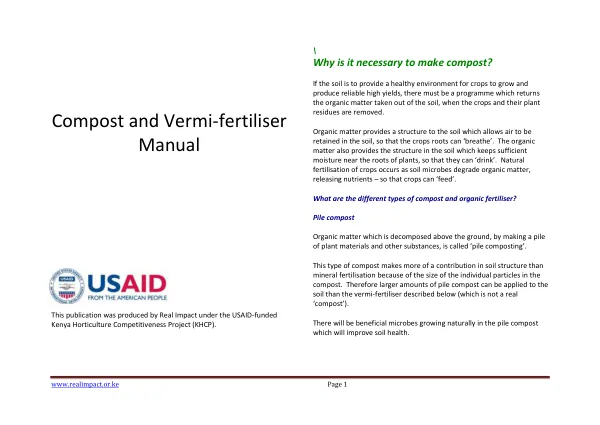
The Kenya Horticulture Competitiveness Project (KHCP) has produced a manual on compost and vermi-fertiliser production.
2012 · 17 pages
Sign in to readA free account is required to download.
Abstract
The manual highlights the importance of compost in maintaining soil health and providing a healthy environment for crops to grow. Compost is essential for retaining air and moisture in the soil, allowing crops to "breathe" and "drink." It also facilitates natural fertilisation of crops as soil microbes degrade organic matter, releasing nutrients. The manual identifies two types of compost and organic fertiliser: pile compost and vermi-fertiliser. Pile compost is made by decomposing organic matter above the ground, while vermi-fertiliser is produced from worm casts. Vermi-fertiliser is a controlled fertiliser that must be applied in moderation to avoid crop damage. Liquid vermi-fertiliser is collected from shallow trays of solid vermi-fertiliser and can be used as a liquid fertiliser, but it must be diluted before spraying to avoid scorching the plant. The manual provides a step-by-step guide on how to make pile compost. The process involves constructing a new compost pile every week, using a weekly programme to manage the production system. The piles are made up in layers, alternating between dry brown waste and fresh moist green waste, with a sprinkling of manure and/or Trichoderma granules. The piles are covered with plastic to retain heat and moisture, and turned every week to increase air and encourage microbes to multiply. The manual also outlines a method for turning the compost piles, which involves turning two piles per day, Monday to Friday. This method makes it easy to supervise the process and ensures that all piles are turned once per week. As the technician becomes more competent, the size and number of piles can be increased, and the process can be adapted to accommodate more waste. The manual provides a layout for 20 piles of compost, with one empty pit to permit turning space for two piles per week. The process is described in two steps, with the first step involving turning pile 1 into the adjacent empty pit, creating a new empty pit next to pile 2. The second step involves turning pile 2 into the adjacent empty pit, creating a new empty pit next to pile 3. This method allows for efficient and systematic compost production, making it easier to manage and supervise the process.