TETRA TECH
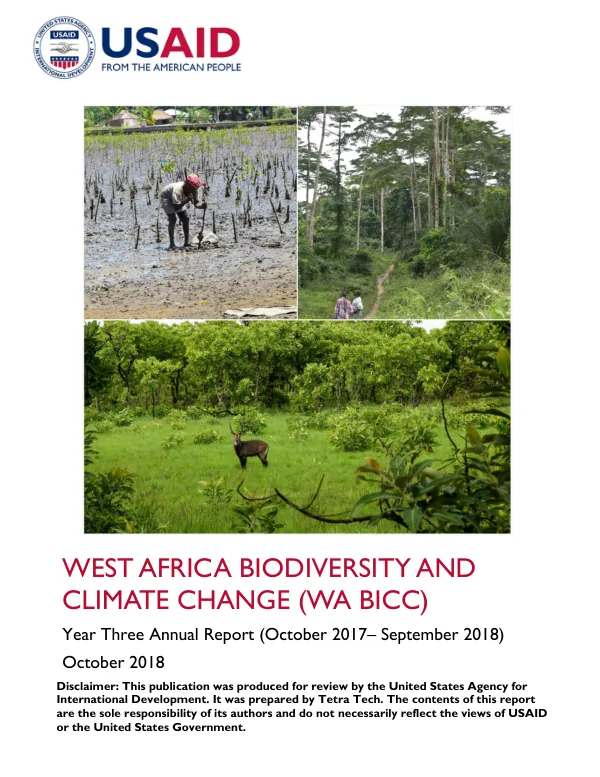
WA BiCC Year 3 Annual Report (October 2017–September 2018)
The West Africa Biodiversity and Climate Change (WA BiCC) initiative is a program aimed at addressing biodiversity loss and climate change in West Africa.
2018 · 78 pages
Sign in to readA free account is required to download.
Abstract
The program is implemented by Tetra Tech, with funding from the United States Agency for International Development (USAID). The initiative focuses on three main components: Combating Wildlife Trafficking (CWT), Increasing Coastal Resilience to Climate Change, and Reducing Deforestation, Forest Degradation, and Biodiversity Loss. Component 1: Combating Wildlife Trafficking involves improving policy and enabling environment for wildlife protection, building capacity for CWT enforcement and prosecution, and strengthening regional and national coordination and cooperation in data generation, sharing, and use for enforcement. Strategy 1A aims to improve policy and enabling environment for wildlife protection by working with governments and civil society organizations to develop and implement effective policies and laws to combat wildlife trafficking. Strategy 1B focuses on building capacity for CWT enforcement and prosecution by providing training and technical assistance to law enforcement agencies and prosecutors. Component 2: Increasing Coastal Resilience to Climate Change involves identifying and promoting effective interventions, developing an enabling policy environment, and implementing projects to enhance coastal resilience. Strategy 2A aims to identify and promote effective interventions by conducting research and analysis to identify the most effective ways to enhance coastal resilience. Strategy 2B focuses on developing an enabling policy environment by working with governments and other stakeholders to develop and implement policies and laws that support coastal resilience. Component 3: Reducing Deforestation, Forest Degradation, and Biodiversity Loss involves promoting effective interventions for forest and mangrove conservation, improving policy and enabling environment for forest and mangrove conservation, and identifying, developing, and implementing strategies for threatened species. Strategy 3A aims to promote effective interventions for forest and mangrove conservation by working with communities and other stakeholders to develop and implement effective conservation strategies. Strategy 3B focuses on improving policy and enabling environment for forest and mangrove conservation by working with governments and other stakeholders to develop and implement effective policies and laws to support forest and mangrove conservation. The WA BiCC initiative also includes a grants program, which provides funding to local organizations and communities to support biodiversity conservation and climate change adaptation efforts. The grants program focuses on supporting projects that promote sustainable land use, enhance coastal resilience, and conserve biodiversity. The initiative also includes cross-cutting activities, such as policy and partnerships, collaborating, learning, and adapting, gender equality and social inclusion, advocacy, communications, capacity development and sustainability, and monitoring and evaluation. The WA BiCC initiative has made significant progress in its third year, with achievements including the development of effective policies and laws to combat wildlife trafficking, the implementation of projects to enhance coastal resilience, and the conservation of biodiversity in West Africa. The initiative has also built capacity among local organizations and communities to support biodiversity conservation and climate change adaptation efforts. The WA BiCC initiative has also made significant progress in its third year in terms of grants management, with the disbursement of grants to local organizations and communities to support biodiversity conservation and climate change adaptation efforts. The initiative has also made progress in program management, with the development of effective systems and processes to support the implementation of the program. Overall, the WA BiCC initiative has made significant progress in its third year, with achievements in all three components and cross-cutting activities. The initiative continues to work towards its goal of addressing biodiversity loss and climate change in West Africa, and its progress will be closely monitored and evaluated to ensure that it is meeting its objectives.