USAID
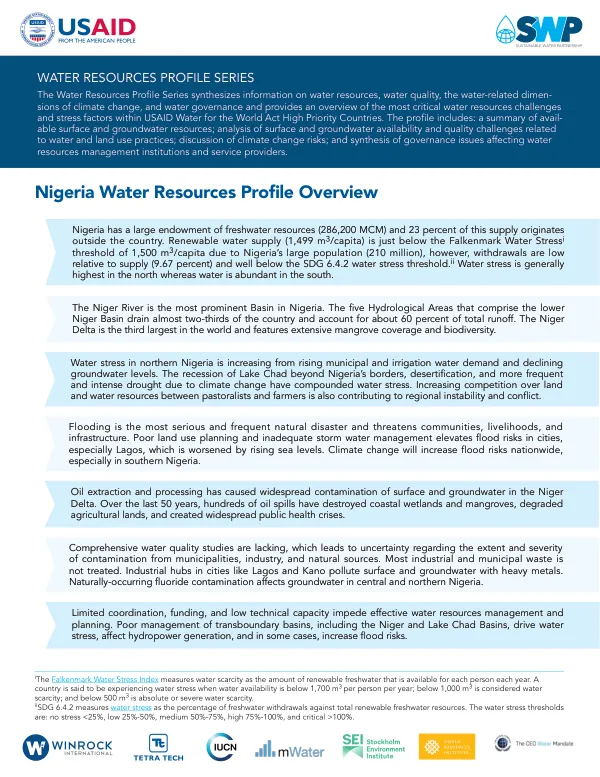
Nigeria Water Resources Profile Overview
Nigeria's water resources are characterized by a large endowment of freshwater, with 286,200 million cubic meters (MCM) available.
2021 · 11 pages
Sign in to readA free account is required to download.
Abstract
This supply originates from both within and outside the country, with 23 percent coming from external sources. The renewable water supply per capita is 1,499 cubic meters, which is just below the Falkenmark Water Stress threshold of 1,500 cubic meters. However, withdrawals are low relative to supply, at 9.67 percent, and well below the SDG 6.4.2 water stress threshold. Flooding is the most serious and frequent natural disaster in Nigeria, threatening communities, livelihoods, and infrastructure. Poor land use planning and inadequate storm water management exacerbate flood risks, particularly in cities like Lagos. Climate change is expected to increase flood risks nationwide, especially in southern Nigeria. Water stress in northern Nigeria is increasing due to rising municipal and irrigation water demand, declining groundwater levels, and the recession of Lake Chad. The Niger River is the most prominent basin in Nigeria, with the five Hydrological Areas that comprise the lower Niger Basin draining almost two-thirds of the country and accounting for about 60 percent of total runoff. The Niger Delta is the third largest in the world and features extensive mangrove coverage and biodiversity. Aquifer productivity is highly variable, with alluvium aquifers being very productive but not widespread, and sedimentary basin aquifers in the northeast having moderate yields. Nigeria's surface waters primarily drain through the Niger and Lake Chad Basin, as well as several smaller coastal river basins. The country organizes its basins into eight Hydrological Areas, with the Niger North, Niger Central, Niger South, Upper Benue, and Lower Benue HAs forming the lower reaches of the Niger Basin. The Niger River originates in Guinea and outlets to the Gulf of Guinea through the Niger Delta, which is the third largest delta in the world. Groundwater resources in Nigeria exist primarily in basement complexes or sedimentary basins, with alluvium aquifers being less common but the most productive groundwater systems. Groundwater recharge rates are lowest in the northwest and highest in the southeast. Basement complexes cover 60 percent of Nigeria and are located throughout the southwest, central region, and along the eastern border with Cameroon. Most of these groundwater systems have shallow depths to the water table and low to moderate well yields. Agriculture, municipal/domestic, and industry are the principal sources of demand for freshwater in Nigeria, with approximately 41 percent of all freshwater abstractions coming from surface water. The largest increases in surface water demand are expected in the Upper Benue, Lake Chad, and Western Littoral HAs due to growing demand for irrigation. Nigeria has over 200 dams, with the Kainji, Shiroro, and Jebba Dams in the Niger Basin accounting for 70 percent of the country's total dam storage capacity. Seasonal surface water availability and drought in northern Nigeria increase vulnerability to ecosystem degradation and regional instability.