AFRICARE, INC.
Water, Sanitation, and Hygiene Sector Update
Water, sanitation, and hygiene (WASH) programs are critical components of USAID Office of U.S.
2013 · 2 pages
Sign in to readA free account is required to download.
Abstract
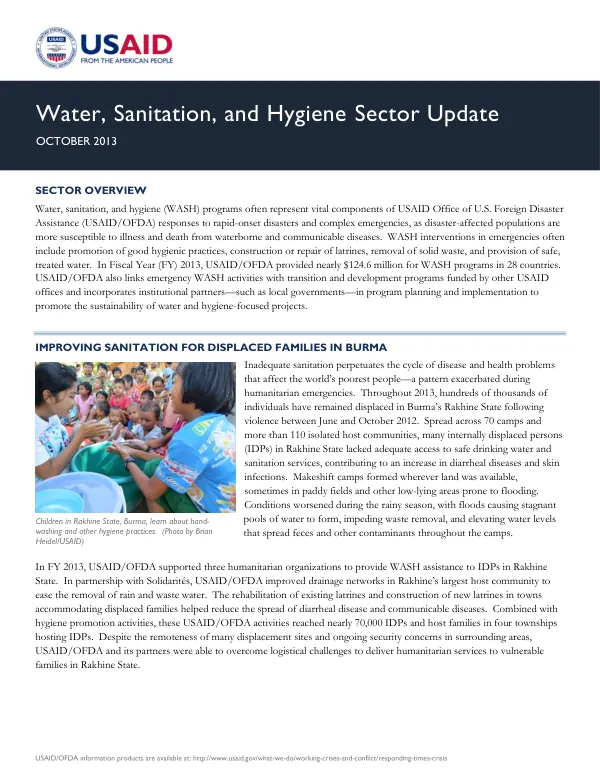
Foreign Disaster Assistance (USAID/OFDA) responses to rapid-onset disasters and complex emergencies. Disaster-affected populations are more susceptible to illness and death from waterborne and communicable diseases, making WASH interventions essential. In Fiscal Year (FY) 2013, USAID/OFDA provided nearly $124.6 million for WASH programs in 28 countries, linking emergency WASH activities with transition and development programs funded by other USAID offices and incorporating institutional partners to promote the sustainability of water and hygiene-focused projects. Inadequate sanitation perpetuates the cycle of disease and health problems that affect the world's poorest people, a pattern exacerbated during humanitarian emergencies. In Burma's Rakhine State, hundreds of thousands of individuals remained displaced following violence in 2012, with many lacking access to safe drinking water and sanitation services. The makeshift camps formed in low-lying areas prone to flooding worsened conditions, with floods causing stagnant pools of water to form, impeding waste removal, and elevating water levels that spread feces and other contaminants throughout the camps. In FY 2013, USAID/OFDA supported three humanitarian organizations to provide WASH assistance to IDPs in Rakhine State, improving drainage networks, rehabilitating latrines, and promoting hygiene practices that reached nearly 70,000 IDPs and host families. In Zimbabwe, more than two decades of neglect led to a state of disrepair in the country's water and sanitation infrastructure, creating unsanitary living conditions for many low-income urban neighborhoods. Frequent municipal water shortages resulted in the shutdown of sanitation facilities, leading to poor hygiene practices such as open defecation, which contaminates available water used for drinking, bathing, and cooking. In FY 2013, USAID/OFDA provided more than $1.7 million to a non-governmental organization (NGO) Joint Initiative (JI) consortium to reach more than 12,000 households, or more than 55,000 people, in six urban centers with improved sanitation services and hygiene messaging. With USAID/OFDA support, JI teams rehabilitated public toilets, installed waste receptacles, and distributed vouchers enabling low-income families to purchase water purification products. Approximately 2.6 billion people worldwide lack access to improved sanitation facilities, such as flush toilets and hand-washing stations. When responding to sanitation needs in emergencies, building latrines and establishing waste removal systems can be challenging, particularly in areas with high water tables, hard rock sites, and dense populations. Since 2009, an increasing number of emergencies in urban areas have faced amplified excreta disposal challenges. In FY 2013, USAID/OFDA continued working with the International Federation of the Red Cross and Red Crescent Societies to develop and design immediate response excreta disposal facilities that can better serve disaster-affected residential areas, communal buildings, schools, and markets. The Emergency Sanitation Project has launched a prototype facility design contests for suppliers and students, with the winners' designs to be field tested to gain the perspective of host communities, host government institutions, and other WASH actors. USAID/OFDA continues providing effective water and sanitation activities in emergencies around the world, as well as working with other humanitarian actors to find innovative solutions to water, sanitation, and hygiene challenges.