USAID DEC
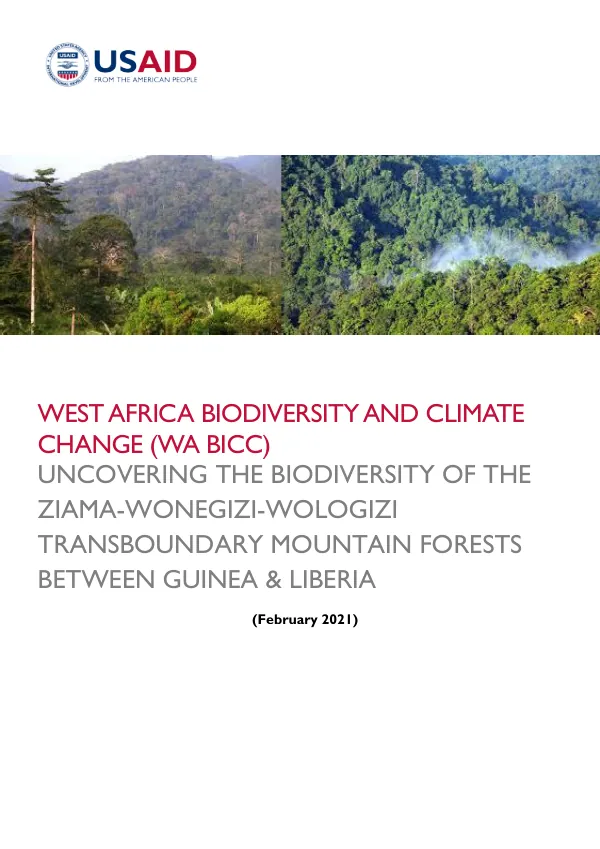
West Africa Biodiversity and Climate Change (WA BiCC): Uncovering the Biodiversity of the Ziama-Wonegizi-Wologizi Transboundary Mountain Forests between Guinea and Liberia
Sign inTETRA TECH
West Africa Biodiversity and Climate Change (WA BiCC): Uncovering the Biodiversity of the Ziama-Wonegizi-Wologizi Transboundary Mountain Forests between Guinea and Liberia
The Ziama-Wonegizi-Wologizi (ZWW) transboundary forest between Liberia and Guinea is one of the priority landscapes in the Mano River Union (MRU) supported by the United States Agency for International Development (USAID)/West Africa Biodiversity and Climate Change (WA BiCC) program.
2021 · 15 pages
Sign in to readA free account is required to download.
Abstract
The landscape begins at Ziama (11,019 ha) in Guinea and extends for about 25 km to Liberia covering Ziama (37,979 ha) and Wologizi (99,538 ha). It ranges from approximately 300 m above sea level to 1,500 m above sea level. The ZWW transboundary forest is part of the few remaining blocks of the Upper Guinea forest ecoregion in West Africa and is recognized as a key biodiversity area. It is home to many species of global conservation concern, including pygmy hippos, forest elephant, forest buffalos, western chimpanzees, red colobus monkeys, zebra duikers, rufous fishing owls, white-breasted guinea fowls, white-necked picathartes, and large-headed shrews. The floristic composition of Liberia's Wologizi forest was first researched in detail during a rapid assessment study carried out by FFI from May 11 to June 12, 2019. The overall objective of the study was to identify the different plant species present and the various habitats in which they existed. Data from the field was collected using two methods: 1) the forest inventory method (based on the variable-area transect); and 2) the general botanical collection method of herbarium specimens (for both sterile and fertile specimens). The types of habitats identified include forest, savannah, and agricultural habitats. The forest habitat has four sub-divisions: 1) high-altitude wet dense forest; 2) medium-altitude wet dense forest; 3) low-lying wet dense forest; and 4) gallery forests. Evaluations on species richness and diversity indices, carried out on the six plant formations, showed that the low-lying wet dense forests had the richest habitats, while grassy savannahs had the least sufficient habitat. A total of 403 plant species were identified (361 determined and 42 indeterminate), of which 127 were trees, 114 shrubs, 78 grasses, 48 vines, 19 bushes, 12 epiphytes, and five lianas. Of the 403 plant species identified in the Wologizi forest, 21 have been identified by the International Union for Conservation of Nature (IUCN) as conservation priorities. The floristic composition of Liberia's Ziama forest was assessed from February 21 to March 21, 2019. The research team identified three main natural environments in the forest, including high slopes, mid slopes, and low slopes. Each of these environments contained three types of habitat: 1) forest habitat with five vegetation types (high-altitude dense humid forest, mid-altitude dense humid forests, low-altitude dense humid forests, gallery forest, and swamp forests); 2) savannah habitat with a single vegetation type (shrubby savannah on thin soil); and 3) agricultural habitat with four vegetation types (secondary forests, monospecific forest plantations, agroforests, and wetlands). Analysis on the specific richness and diversity of the flora showed that the dominant plant formations in core areas and buffer zones were gallery forests, with low-altitude dense humid forests being the least. Within the 10 plant formations, a total of 712 plant species were recorded (663 determinate and 49 indeterminate), of which 218 were grasses, 185 tree species, 156 shrubs, 130 lianas, 16 epiphytes, and seven bushes. A total of 28 plant species are featured on the IUCN priority conservation list. The ZWW transboundary forest is threatened by various human activities, including hunting, mining, logging, and farming from over 240 neighboring communities (with over 120,000 inhabitants). Uncontrolled hunting and farming are among the threats to the ZWW biodiversity conservation. The landscape is home to many endangered species, including pygmy hippos, forest elephant, forest buffalos, western chimpanzees, red colobus monkeys, zebra duikers, rufous fishing owls, white-breasted guinea fowls, white-necked picathartes, and large-headed shrews. The IUCN has identified 21 plant species in the Wologizi forest and 28 plant species in the Ziama forest as conservation priorities. The ZWW transboundary forest is a key biodiversity area and requires enhanced conservation efforts to protect its rich biodiversity. The diversity of small mammals in the ZWW transboundary forest is also a concern. The landscape is home to various species of small mammals, including rodents, bats, and primates. The research team identified 12 species of small mammals in the Wologizi