DIGITAL GREEN FOUNDATION
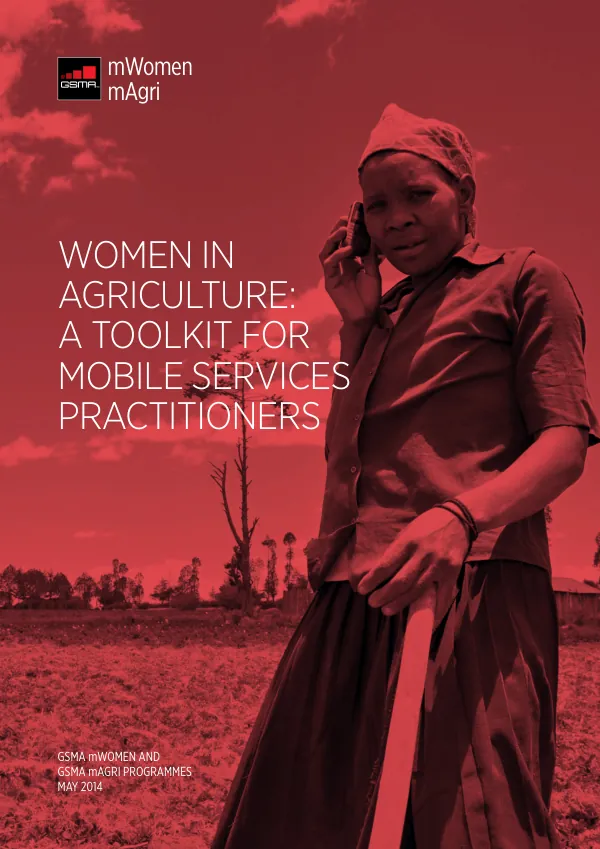
Women in Agriculture: A Toolkit for Mobile Services Practitioners
Delivering mobile-enabled agricultural services to women in developing countries is a major market opportunity for the mobile industry that also offers substantial social benefits.
2014 · 47 pages
Sign in to readA free account is required to download.
Abstract
The mAgri services market is nascent but growing, with GSMA tracking 106 active, global deployments by mobile network operators and third-party providers. Women working in agriculture account for an estimated 556 million potential users globally, but are underserved as a unique customer segment. The GSMA mWomen and mAgri programmes have produced the Mobile Agricultural Services Toolkit as a guide for mobile operators, other mobile providers, and development practitioners to better serve women in this segment. The toolkit includes recommendations and tools for each stage of the product development process, as well as examples of good practices. The products and services in question include value-added services (information, advisory, matchmaking, or other), mobile financial services, and basic services (voice, SMS, and data) delivered via mobile phone. Women in agriculture require a tailored approach because they play different roles in agricultural production and the household, have different price sensitivities and purchasing priorities than men, access information through different channels, and are less likely to have access to technology due to cultural barriers, lower literacy levels, and less disposable income. The toolkit provides a framework for understanding how gender influences consumer needs and for developing products and services that meet the unique needs of women working in agriculture. The toolkit outlines five stages in product development, with recommendations and tools for each stage. The stages include defining the market, assessing the market opportunity, generating consumer insights, designing products and services, and distributing and growing the product. The toolkit also provides a range of tools and case studies, including a guide to value chain analysis through a gender lens, estimating market size, and evaluating the best pricing package for women working in agriculture. The toolkit has been developed in partnership with a range of organizations, including Airtel Africa, Centre for Agricultural Bioscience International (CABI), UK Department for International Development (DFID), Digital Green, Firetail Limited, The Bill & Melinda Gates Foundation, Handygo Technologies, IFFCO Kisan Sanchar Limited (IKSL), International Livestock Research Institute (ILRI), Jemimah Njuki, MercyCorps, Technoserve, Tigo Tanzania, United States Agency for International Development (USAID), and Vodafone Ghana. The toolkit is a valuable resource for mAgri service providers and development practitioners seeking to reach and serve women working in agriculture more effectively. It provides a comprehensive framework for understanding the needs of women working in agriculture and for developing products and services that meet those needs. By using the toolkit, mAgri service providers and development practitioners can help to improve the livelihoods of women working in agriculture and contribute to the achievement of the United Nations' Sustainable Development Goals. The toolkit's recommendations and tools are designed to be applicable to a range of contexts, including Sub-Saharan Africa, South Asia, and Southeast Asia. However, the framework may also be applied to other developing regions. The toolkit's focus on women working in agriculture is based on the recognition that women play a critical role in agriculture and that they are often underserved by existing agricultural services. The toolkit's development has been informed by a range of research and evidence, including the GSMA mWomen Consumer Insights Research Toolkit, the Gender in Agriculture Toolkit, and the World Bank's Engendering Development through Gender Equality report. The toolkit's recommendations and tools are based on the latest research and evidence in the field and are designed to be practical and applicable in a range of contexts.
Related documents