USAID
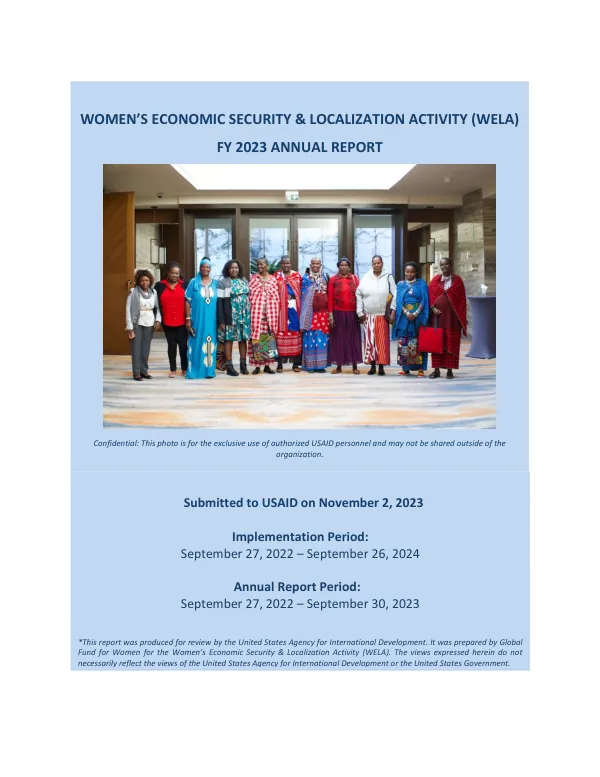
WOMEN’S ECONOMIC SECURITY & LOCALIZATION ACTIVITY (WELA) FY 2023 ANNUAL REPORT
The Women's Economic Security & Localization Activity (WELA) is a collaboration between the United States Agency for International Development (USAID) and Global Fund for Women.
2023 · 20 pages
Sign in to readA free account is required to download.
Abstract
This initiative is designed to foster a symbiotic relationship with local partners, emphasizing grassroots women-led organizations, and aims to pioneer strategies that address gender equality and climate resilience. By harnessing the power and the promise of locally led solutions, WELA aims to network and build connections between women-led social movements, empowering them to initiate solutions that enhance women’s economic stability and promote gender parity. WELA is redefining the paradigms of gender equality and climate resilience. It is anchored in a vision of shifting power to grassroots women-led organizations, enabling them to devise innovative strategies that address the dual challenges of gender disparity and climate vulnerability. Through this collaboration, WELA aims to globally connect women-led organizations and movements and leverage their knowledge and capacities to design solutions. The program is committed to amplifying the voice, agency, and capabilities of movement actors, equipping them with technical assistance and essential resources to address pressing challenges impacting women, girls, and gender non-conforming groups. During the September 2022 – September 2023 period, WELA demonstrated significant advancements in support of the program’s goals. The three pivotal objectives of the program are to strengthen local and regional women-led organizations as partners of USAID, develop and implement rapid response mechanisms, and enhance the evidence base. Under the first objective, the Global Fund for Women actively supported the formation of climate justice movements in the Caribbean and Africa. In the Pacific Islands, the team worked collaboratively with movement leaders to determine how best to shift the power to enhance operational efficiencies of the climate justice initiatives. Using a gender justice framework, WELA prioritizes solidarity, trust, and collective decision-making power. The program supports convenings, regional collaborations, and learning opportunities that connect partners to the people and resources they need to grow their movements. Climate justice activities spanned across the focus regions: the Caribbean Basin, Sub-Saharan Africa, and the Pacific Island territories. These regions benefitted from strategic and technical support, financial resources, and strategic support. The partnership with Columbia University provided improved methods for tracking progress, analyzing outcomes, and distilling invaluable insights. The development of the Capacity Strengthening Framework and the successful implementation of the Caribbean Climate Justice regional advisory council further underscored WELA's commitment to sustainable impact. In this first year, the program helped partners navigate global climate crises, from geological events in Morocco and East Africa, to the socio-political unrest in Sudan. In support of Objective 2, the Global Fund for Women team created strategic partnerships with key organizations working on conflict and crisis, such as the International Women’s Peace Center in Uganda and the Urgent Action Fund Africa in Kenya. Through these partnerships, a more rapid and contextualized climate crisis response mechanism was established, providing timely and effective support to grassroots organizations working on the frontlines of crisis and conflict. In pursuit of the third objective, Global Fund for Women WELA team implemented a robust evidence-based framework. The partnership with Columbia University provided improved methods for tracking progress, analyzing outcomes, and distilling invaluable insights. The development of the Capacity Strengthening Framework and the successful implementation of the Caribbean Climate Justice regional advisory council further underscored WELA's commitment to sustainable impact.
Related documents