UNIVERSITY OF CALIFORNIA BERKELEY
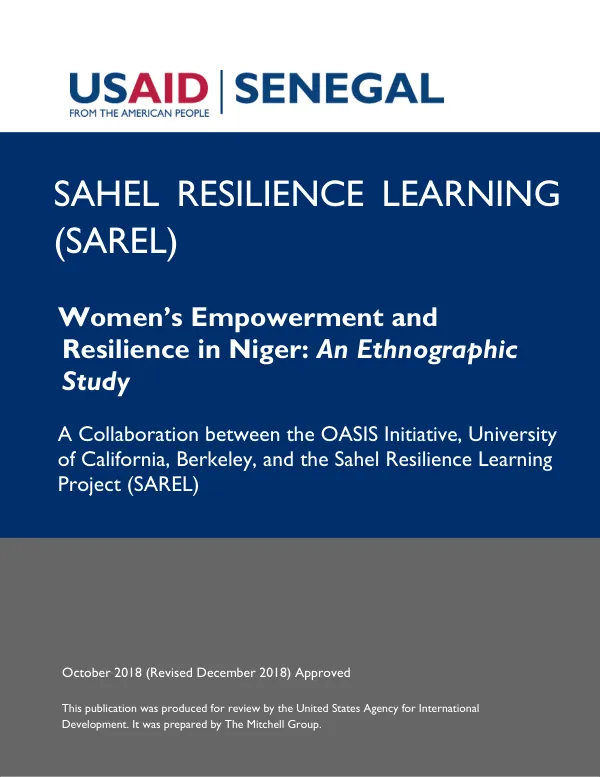
Women’s Empowerment and Resilience in Niger: An Ethnographic Study
Women's Empowerment and Resilience in Niger: An Ethnographic Study was conducted in four rural communities in Maradi Department, located in south-central Niger.
2018 · 47 pages
Sign in to readA free account is required to download.
Abstract
The study aimed to explore gender inequality in Hausa communities and the meaning of women's empowerment in this context. The research employed an ethnographic approach, including participant observation, in-depth interviewing, and informal group discussions. The study found that men and women in the study communities see women's and girls' strategic life choices as enrollment or withdrawal from school, when and whom to marry, when and how many children to have, acquisition of vocational skills, the choice of income-generating activities, shelter, and how to best build a reciprocal network of kin and friends. These choices are often limited by the social structures of the community, including gender, age, status, and wealth. The study identified several key findings related to women's empowerment in rural Hausa communities. Women's empowerment was seen as an increase in the ability to make strategic life choices in a context where this ability was previously denied. This understanding of empowerment was found to be relevant to women in rural Hausa communities, and it was used to inform the design and evaluation of programming for women in rural Niger and the Sahel. The study also found that indigenous models of empowerment exist in rural Hausa communities. For example, women's savings groups were found to be an important means of empowerment, as they provided women with access to resources and a sense of agency. Additionally, women's bodily integrity was found to be an important aspect of empowerment, as it allowed women to make choices about their own bodies and lives. The study's findings suggest that programming for women in rural Niger and the Sahel should be designed to address the social structures that limit women's empowerment. This may involve working with community leaders to promote women's rights and empowerment, as well as providing women with access to resources and education. The study's methodology involved participant observation, in-depth interviewing, and informal group discussions. The research team consisted of five native Hausa-speaking research associates who stayed in collaborating communities during the 9 months of the study. The researchers participated in the daily life of the community, lived with families (when possible), and wrote fieldnotes of their observations and interviews. The study's findings have implications for the design and evaluation of programming for women in rural Niger and the Sahel. They suggest that programming should be designed to address the social structures that limit women's empowerment, and that indigenous models of empowerment should be taken into account. Additionally, the study's findings highlight the importance of working with community leaders to promote women's rights and empowerment. The study's conclusions emphasize the importance of creating a life that women have reason to value. This involves creating the vessel, or capacity, for women to make strategic life choices. The study also highlights the importance of working collectively in women's own interest, and of creating a sense of agency and resources for women.
Related documents