USAID
Women’s Land Rights
Land is the most critical economic resource for the vast majority of the rural poor who depend on agriculture for their livelihoods.
2016 · 6 pages
Sign in to readA free account is required to download.
Abstract
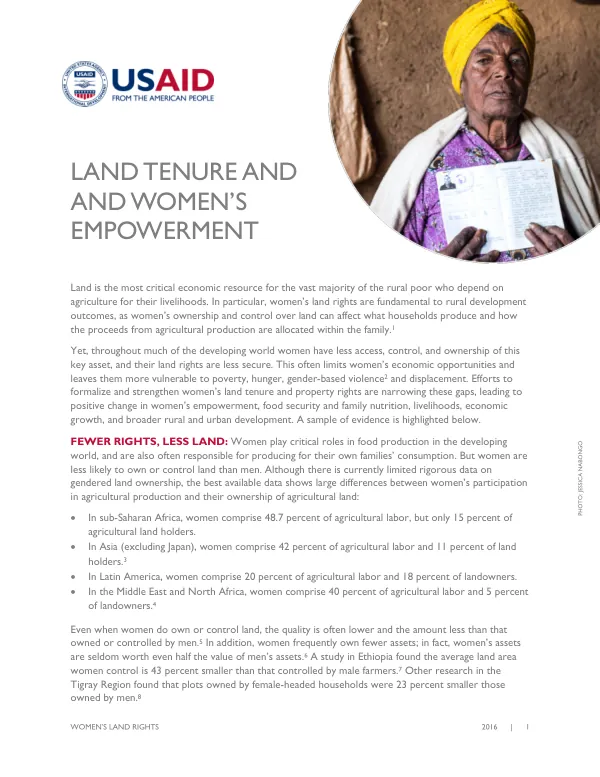
Women's land rights are fundamental to rural development outcomes, as women's ownership and control over land can affect what households produce and how the proceeds from agricultural production are allocated within the family. Women's access, control, and ownership of land are less secure throughout much of the developing world, limiting their economic opportunities and leaving them more vulnerable to poverty, hunger, and gender-based violence. Women play critical roles in food production in the developing world, but they are less likely to own or control land than men. In sub-Saharan Africa, women comprise 48.7 percent of agricultural labor, but only 15 percent of agricultural land holders. In Asia, women comprise 42 percent of agricultural labor and 11 percent of land holders. Even when women do own or control land, the quality is often lower and the amount less than that owned or controlled by men. Limitations on women's access to and use of land restrict economic gains. For example, evidence from Ethiopia has found that female-headed households received 10 percent fewer visits from agricultural extension agents and 12 percent fewer visits by development agents than male-headed households. Plots farmed by women often have lower agricultural productivity than those farmed by men. Women may not have equal access to land and rental markets, and social norms and gender-based preferences may constrain their ability to access and use needed agricultural inputs. When women have secure rights to land, they make investments to improve land and acquire better quality inputs, participate in land rental markets, and receive more income. In Tanzania, women with strong land rights were 3 times more likely to work off-farm, earned up to 3.8 times more income, and were 1.35 times more likely to have individual savings. In Rwanda, women having land titles was correlated with a 12 percent increase in women taking out loans. Secure access to land acts as a source of empowerment by increasing women's economic security and increasing their control over household decisions. Women's land rights improve food security and benefit the entire household. Closing the gender gap in secure access to land is fundamental not only for women's empowerment but also for broader family food security, children's health, and economic gains. Research shows that if women had the same access to resources for agricultural production as men, they could increase yields on their farms by 20 to 30 percent, raising total agricultural output in developing countries by 2.5 to 4 percent and reducing the number of undernourished people in the world by 12 to 17 percent. Strategies for strengthening women's land rights include ensuring that women have legal rights to own, inherit, and transfer land, supporting efforts to help women exercise their legal rights, educating local land administration officials on women's land rights, and enhancing women's decision-making capabilities on land they use. USAID considers strengthening women's land rights central to its efforts to eliminate extreme poverty and promote resilient, democratic societies. The U.S. Government and USAID have played a leading role in several high-profile actions in support of women's land rights, including the United Nations Sustainable Development Goals and the Voluntary Guidelines on the Responsible Governance of Tenure.