INTERNATIONAL ORGANIZATION FOR MIGRATION
Women's Participation in Colombian Politics and Peace Process
Women have been involved in conventional and non-state armed groups across all continents, with more contemporary actions in countries such as El Salvador, Uganda, Indonesia, and the Democratic Republic of Congo.
2016 · 2 pages
Sign in to readA free account is required to download.
Abstract
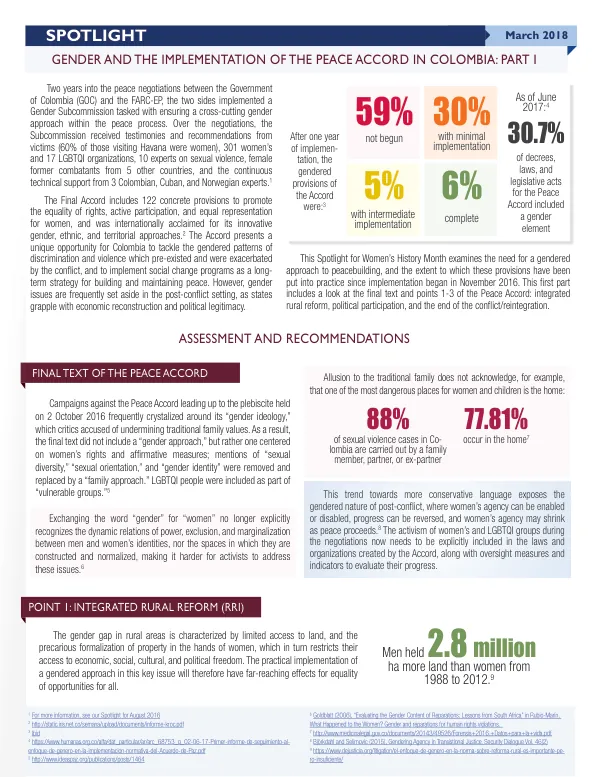
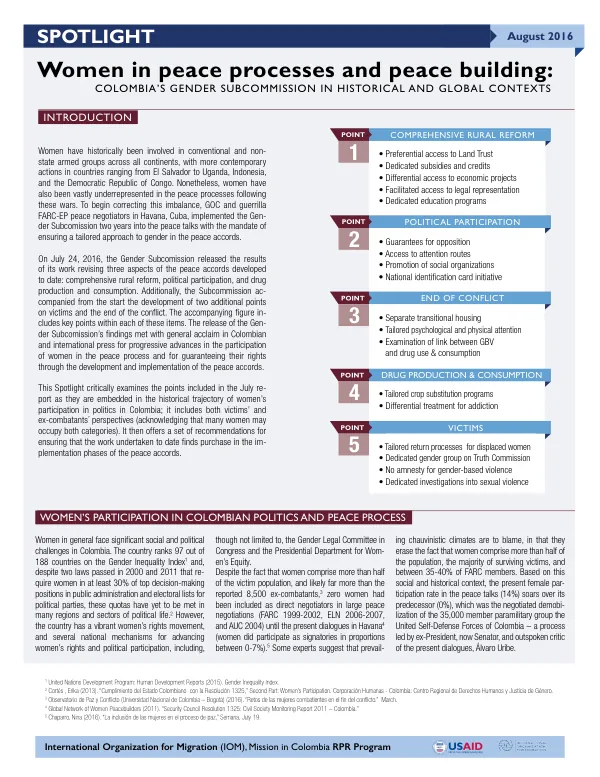
Despite this, women have been vastly underrepresented in peace processes following these wars. To address this imbalance, the Government of Colombia (GOC) and guerrilla FARC-EP peace negotiators in Havana, Cuba, established the Gender Subcomission two years into the peace talks. The Subcomission's mandate was to ensure a tailored approach to gender in the peace accords. The Gender Subcomission released its results on July 24, 2016, revising three aspects of the peace accords: comprehensive rural reform, political participation, and drug production and consumption. The Subcomission also accompanied the development of two additional points: guarantees for opposition and access to attention routes. The release of the report was seen as a progressive advance in the participation of women in the peace process and for guaranteeing their rights through the development and implementation of the peace accords. Colombia ranks 97 out of 188 countries on the Gender Inequality Index, despite two laws passed in 2000 and 2011 that require women in at least 30% of top decision-making positions in public administration and electoral lists for political parties. However, the country has a vibrant women's rights movement, and several national mechanisms for advancing women's rights and political participation, including the Gender Legal Committee in Congress and the Presidential Department for Women's Equity. Women comprise more than half of the victim population and likely far more than the reported 8,500 ex-combatants. However, zero women had been included as direct negotiators in large peace negotiations until the present dialogues in Havana, where women participate as signatories in proportions between 0-7%. The present female participation rate in the peace talks (14%) soars over its predecessor (0%), which was the negotiated demobilization of the 35,000 member paramilitary group the United Self-Defense Forces of Colombia. The Gender Subcomission's recommendations include preferential access to land trust, dedicated subsidies and credits, differential access to economic projects, facilitated access to legal representation, dedicated education programs, guarantees for opposition, access to attention routes, and promotion of social organizations. The recommendations also include separate transitional housing, tailored psychological and physical attention, examination of the link between gender-based violence and drug use and consumption, tailored crop substitution programs, differential treatment for addiction, tailored return processes for displaced women, dedicated gender group on Truth Commission, no amnesty for gender-based violence, and dedicated investigations into sexual violence. The Subcomission's work has been praised for its recognition of women as political subjects with a role in the present and future peace building and social justice efforts. However, some analysts express concern that the recommendations may not be implemented effectively. To address these concerns, the Spotlight offers the following recommendations for gendered approaches to the peace process and the early stages of laying down arms and reincorporation: integrate gender-sensitive programming into all aspects of the peace process, ensure that women comprise equal proportions of authority in the process of laying down arms, oversee transitional zones, and facilitate early reintegration processes, make information available to gender equality advocates and women's civil society organizations early on in the process, and train all professionals involved in the transitional processes on gender-sensitive approaches to DDR.