FLORIDA INTERNATIONAL UNIVERSITY
Workshop on Livestock Epidemiology, Data Analysis, and Health Policy
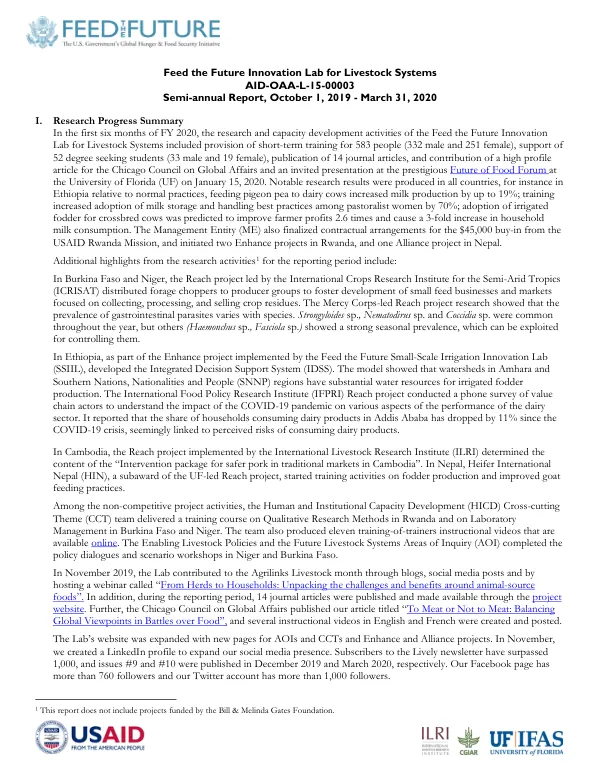
The Feed the Future Innovation Lab for Livestock Systems, a five-year initiative funded by the U.S.
2016 · 10 pages
Sign in to readA free account is required to download.
Abstract
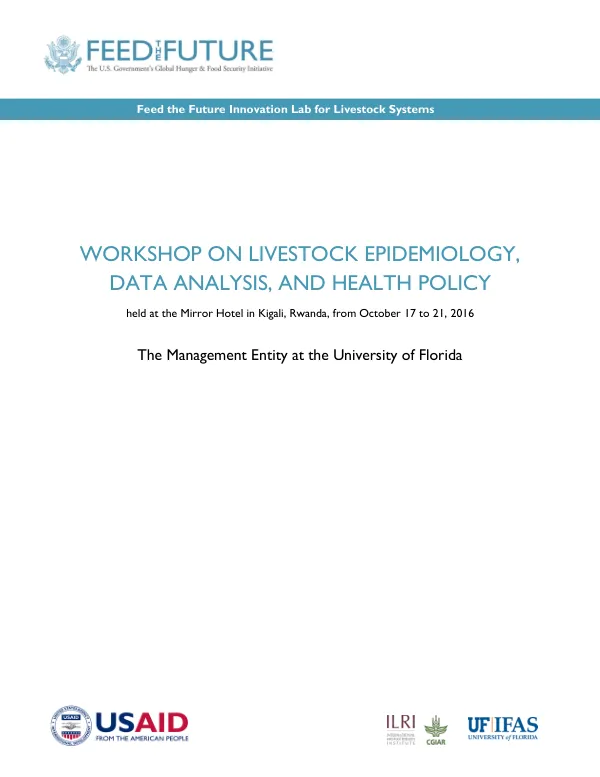
Agency for International Development (USAID), aims to improve the nutrition, health, and incomes of the poor by sustainably increasing livestock production and marketing, and consumption of animal-source foods (ASF). The initiative, led by the University of Florida's Institute of Food and Agricultural Sciences (IFAS), in partnership with the International Livestock Research Institute (ILRI), targets six countries, including Rwanda, to introduce new location-appropriate technologies, improve management practices, and support the development of a policy environment that fosters sustainable intensification and increased profitability of smallholder livestock systems. National government veterinary services in Rwanda face challenges in delivering animal health programs with limited resources. Animal disease surveillance systems are key components for early detection and management of livestock diseases of economic and public health importance. To address these challenges, a workshop on livestock epidemiology, data analysis, and health policy was held at the Mirror Hotel in Kigali, Rwanda, from October 17 to 21, 2016. The workshop provided a forum for young scientists at the University of Rwanda (UR) and animal health professionals at the Ministry of Agriculture and Animal Resources (MINAGRI) and Rwanda Agricultural Board (RAB) to exchange information and enhance their knowledge and skills in the formulation, implementation, and evaluation of animal disease surveillance systems in Rwanda. The workshop included presentations on various topics, such as the review of animal disease surveillance systems in Rwanda, introduction to epidemiology, data analysis, and health policy, laboratory tests used for diagnosis of livestock diseases in Rwanda, evaluation and application of diagnostic tests, design and analysis of epidemiologic cross-sectional and case-control studies, and the roles that epidemiology can play in health policy. The workshop also provided an opportunity for participants to present research data, surveillance data, or project progress for feedback by the instructor. The workshop was attended by 12 participants, including two faculty members from the University of Rwanda, three professionals from MINAGRI, and seven professionals from RAB. The workshop included a pre-evaluation to measure participants' general knowledge base in epidemiology and animal disease surveillance systems. The results showed that the knowledge base was not high among most participants. A post-evaluation was conducted at the end of the workshop to assess participants' learning objectives. The results showed that participants gained new knowledge in epidemiology and animal disease surveillance during the workshop. Participants also provided feedback about the quality or usefulness of the workshop, with most ranking it as very good to excellent. The workshop was facilitated by Dr. Jorge Hernandez, Professor in Veterinary Epidemiology at the University of Florida. The course agenda is provided in Annex 1. The workshop aimed to enhance the epidemiology capacity for delivery of more efficacious and efficient government animal health services in Rwanda. The objective was to create opportunities for young scientists and health professionals to gain new knowledge and skills in disease surveillance, epidemiologic studies, and animal health research that can impact health policy.