MERCY CORPS INTERNATIONAL
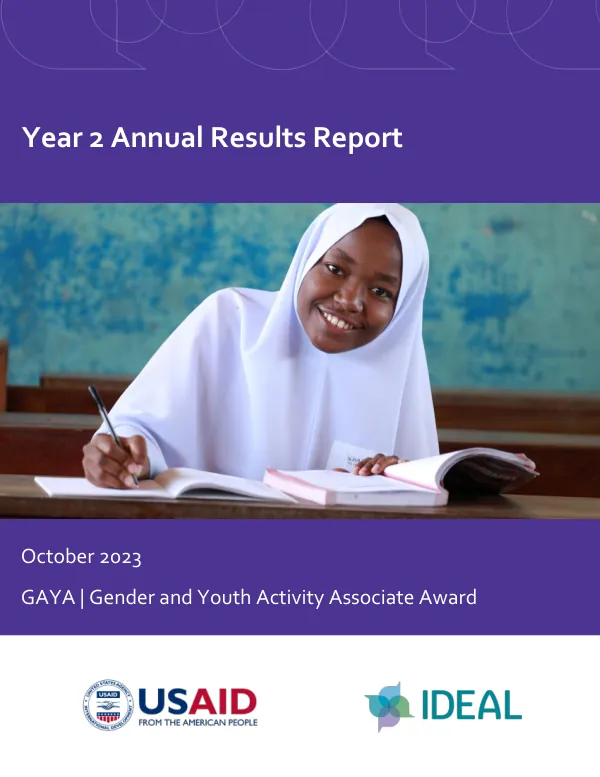
Year 2 Annual Results Report: Gender and Youth Activity Associate Award
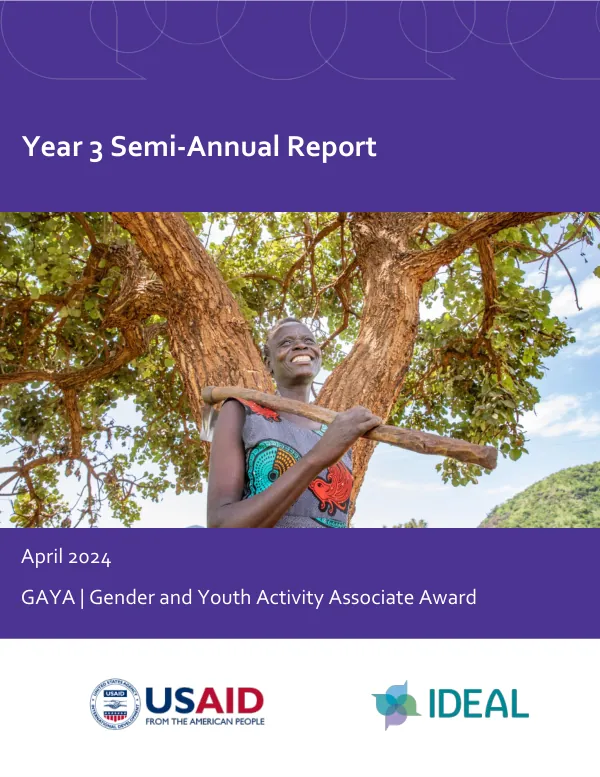
The Gender and Youth Activity (GAYA) Associate Award works to improve the quality and impact of food security activities by addressing the barriers and challenges implementing partners face when integrating gender and youth within their activities.
2023 · 18 pages
Sign in to readA free account is required to download.
Abstract
Understanding and meeting the unique and intersectional needs of women and youth and addressing the root causes of the inequalities that affect them are essential to achieving broad and equitable impacts in food and nutrition security. GAYA supports partners implementing emergency response, early recovery, risk reduction, and resilience programs. GAYA designed its year two (YR 2) interventions based on data gathered during an extensive formative research process in year one (YR 1), which engaged over 600 members of the implementing partner (IP) community. GAYA's performance on these interventions is outlined below. In YR 2, GAYA reached 405 unique attendees across 10 IP-facing events, compared to 304 unique attendees in YR 1. Convening IPs in Community Dialogue and Regional BHA Emergency Monitoring, Evaluation, and Learning Workshop were key events in YR 2. The Regional BHA Emergency Monitoring, Evaluation, and Learning Workshop in November 2022 was a significant event for GAYA. As a result of this engagement, BHA and the IDEAL monitoring, evaluation, and learning (MEL) teams invited GAYA to participate in the IDEAL MEL workshop for the Middle East, North Africa, and Europe (MENA-E) region in August 2023. GAYA contributed gender and youth-related MEL topics to IDEAL's registration survey, which measured IP interest in various MEL topics. Based on these survey results, GAYA and BHA co-designed a session on challenging misconceptions related to gender analysis and youth assessment for workshop participants. The session was well-received, with 20% of respondents to the event evaluation rating the gender and youth session as one of the top three most valuable sessions during the workshop. In addition to the core content during the three-day workshop, IDEAL also offered optional two-day capacity strengthening workshops across three technical topics. GAYA participated in the design and facilitation of the workshop on qualitative research, including facilitating small group discussions on a gender case study and a session on enumerator training. GAYA also hosted a participatory webinar entitled Cross Organizational Commitments to Gender and Youth within the Food Crisis in September 2023. The webinar aimed to drive dialogue around how implementers can increase gender and youth inclusion in their food crisis-focused initiatives. In YR 2, the team reconvened staff from five organizations to discuss how to further disseminate and socialize the commitments participants identified during the webinar. GAYA proposed a blog series around Nourishing Inclusion in the Food Crisis to highlight success stories around the nine commitments, which received unanimous support from the committee. The blog series, published in English and French, discussed successful approaches to leveraging data to address gender-based inequalities, the role of recurrent monitoring systems to drive data-driven decision-making, Mercy Corps' Gender Transformative Toolkit, a successful collaboration event to promote knowledge-sharing across Resilience Food Security Activities (RFSAs) in the Sahel, and successful approaches to engage private and public sectors for sustainable youth solutions. Notably, in YR 2, both the text and graphics from the blog series were shared in the Canopy Cut, a quarterly resource guide for gender equality and social inclusion resources. GAYA will continue to expand this workstream in YR 3. In YR 1, the GAYA team reviewed resources from the Technical and Operational Performance Support (TOPS) Program and noted the importance of core competencies in implementing gender and youth-sensitive programs. The team identified key competencies, including gender analysis, youth assessment, and inclusive program design. GAYA will continue to build the capacity of implementing partners in these areas through training and technical assistance. GAYA's performance in YR 2 demonstrates its commitment to improving the quality and impact of food security activities by addressing the barriers and challenges implementing partners face when integrating gender and youth within their activities. The team's efforts to convene IPs in community dialogue, participate in regional workshops, and host webinars and blog series have contributed to increased gender and youth inclusion in food crisis-focused initiatives. GAYA will continue to build on this momentum in YR 3, expanding its workstream on Nourishing Inclusion in the Food Crisis and continuing to build the capacity of implementing partners in key competencies.
Related documents