THE NATURE CONSERVANCY
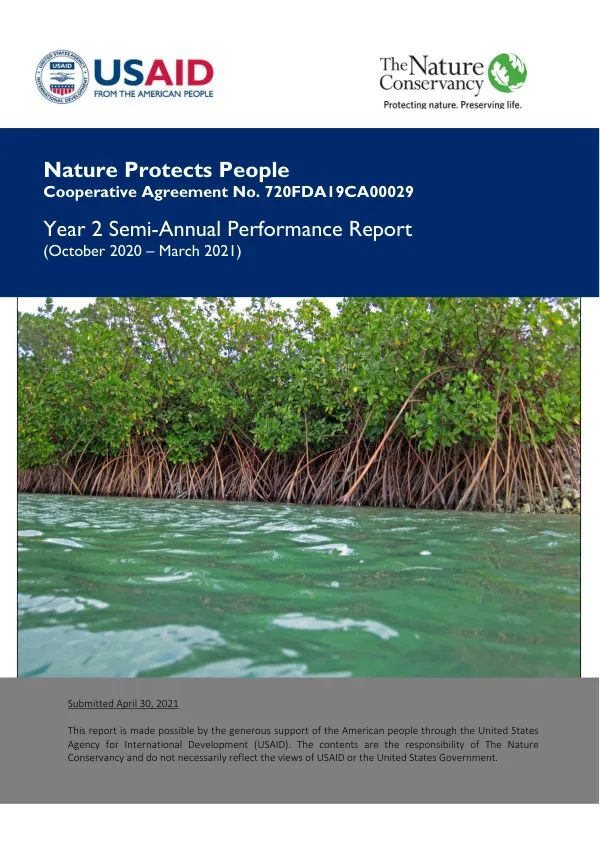
Year 2 Semi-Annual Performance Report: Nature Protects People
The Nature Protects People program aims to safeguard and strengthen coastal communities by promoting effective science-driven nature-based solutions that reduce risk for people and their habitats.
2021 · 30 pages
Sign in to readA free account is required to download.
Abstract
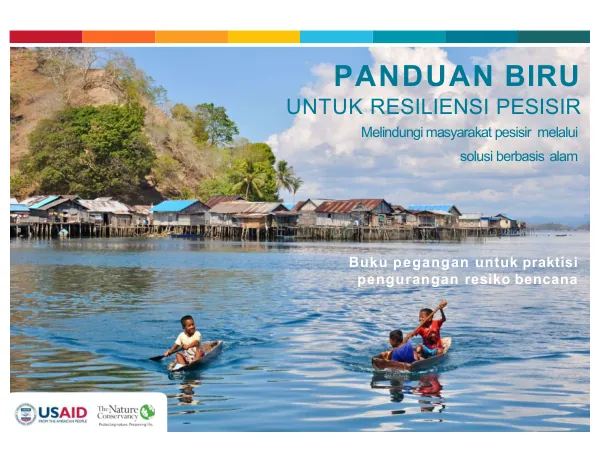
The program is implemented through a grant agreement between the U.S. Agency for International Development's Bureau of Humanitarian Affairs and The Nature Conservancy. The goal is to reach 100,000 beneficiaries, including vulnerable community members, urban and coastal planners, local businesses, government authorities, and humanitarian practitioners. The program focuses on Southeast Asia, the Caribbean, and the Caribbean, with a high degree of human disaster vulnerability. Central components include an easily accessible Blue Guide, a comprehensive multi-media virtual learning platform, an ecological disaster reduction mobile application, educational videos, eco-DRR research, and resources adapted to be more people-centric. The program also aims to modify disaster management and adaptation plans, conduct field-level trainings on eco-DRR, and connect women's networks to eco-DRR activities. The Blue Guide to Resilience and the Nature Protects People virtual learning platform were launched on February 2, 2021, in commemoration of World Wetlands Day. The platform has been used by 37 individuals across the Caribbean, Micronesia, and Indonesia, with 221 repeat visitors and 734 total users. The Blue Guide has been downloaded 144 times, and the navigation and layout of natureprotects.org have been improved following user assessment. A plan has been formulated to enhance the Ready for Business app to add modules on nature-based solutions and climate resilience. The Caribbean Coastal Resilience mapping portal and the Ocean OECS mapping tool have been enhanced with high-resolution demographic data to be more people-centric. Nine women's networks were connected during a Learning Exchange activity in Micronesia, and one elderly community group was included in the exchange. The program has also improved the dissemination of information around the Blue Guide, leading to increased uptake of the document. The program has made significant progress in implementing its proposed outputs, with seven outputs aimed at reaching the life of the project target of 100,000 people. The outputs include the Blue Guide, the virtual learning platform, the eco-DRR mobile application, educational videos, eco-DRR research, resources adapted to be more people-centric, and links made to existing initiatives. The program has also made progress in modifying disaster management and adaptation plans, conducting field-level trainings on eco-DRR, and connecting women's networks to eco-DRR activities. The program has a strong focus on reaching vulnerable communities, with a target of 100,000 beneficiaries. The program's central components include the Blue Guide, the virtual learning platform, the eco-DRR mobile application, educational videos, eco-DRR research, and resources adapted to be more people-centric. The program also aims to modify disaster management and adaptation plans, conduct field-level trainings on eco-DRR, and connect women's networks to eco-DRR activities. The program has made significant progress in implementing its proposed outputs,