USAID DEC
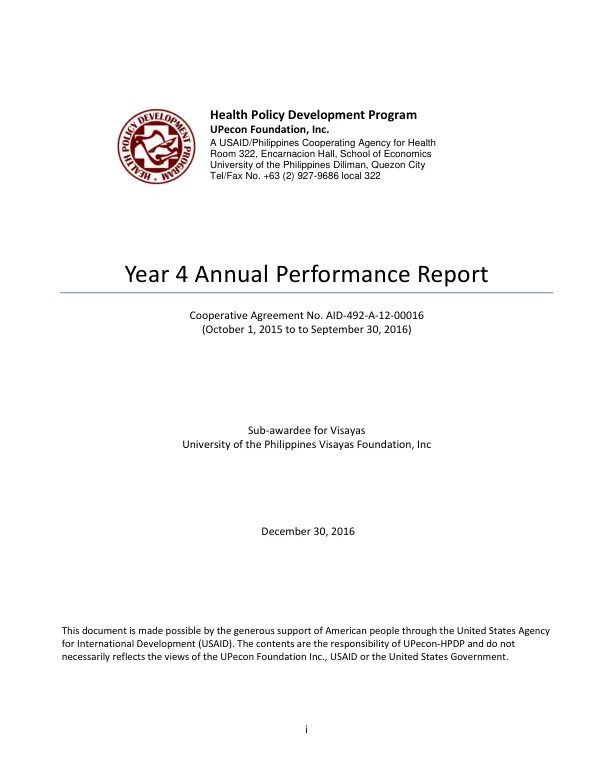
Year 4 Annual Performance Report
The Health Policy Development Program (HPDP) is a USAID-funded initiative implemented by the UPecon Foundation, Inc.
2016 · 431 pages
Sign in to readA free account is required to download.
Abstract
in the Philippines. The program aims to improve the country's health policy and systems, with a focus on reproductive health, tuberculosis, and maternal and child health. The program's objectives are aligned with the Philippine government's health sector review, which identified key challenges and opportunities for improvement. The HPDP has been working to address these challenges through a range of activities, including technical assistance, capacity building, and policy development. One of the key areas of focus for the HPDP has been the expansion of family planning services in Cavite. The program has been working with local government units and health facilities to improve access to family planning commodities and services, with a focus on demand-driven forecasting and supply chain management. The HPDP has also been supporting the development of policies on reproductive health and tuberculosis implementation. The program has been working with government agencies and other stakeholders to develop guidelines and protocols for the implementation of these policies. In addition to policy development, the HPDP has been providing technical assistance to government agencies and health facilities to improve their capacity to deliver health services. The program has been working with the Department of Health (DOH) to strengthen regional operations in Western Visayas, and has been providing support to the DOH's efforts to reduce missed tuberculosis cases in Cavite and Davao City. The HPDP has also been conducting research and evaluation activities to assess the impact of its interventions. The program has been working with local universities and research institutions to conduct studies on the effectiveness of its interventions, and has been using the findings to inform its programming and policy recommendations. The program's monitoring and evaluation plan is designed to track progress against its benchmarks and objectives. The plan includes a range of indicators and metrics to assess the program's impact, including the number of people reached with family planning services, the number of tuberculosis cases detected and treated, and the number of health facilities strengthened. The HPDP has been working with a range of implementing partners to achieve its objectives, including local government units, health facilities, and civil society organizations. The program has been providing technical assistance and capacity building support to these partners to help them deliver health services and implement health policies. The program's financial report for the period October 1, 2015 to September 30, 2016 shows that the HPDP has been using its funds effectively to achieve its objectives. The report includes a range of financial statements and tables to provide a detailed picture of the program's financial performance. Overall, the HPDP has been making significant contributions to the improvement of health policy and systems in the Philippines. The program's focus on reproductive health, tuberculosis, and maternal and child health has been particularly important, given the country's high burden of these diseases. The program's technical assistance, capacity building, and policy development activities have been helping to strengthen the country's health systems and improve access to health services for vulnerable populations.
Related documents