USAID DEC
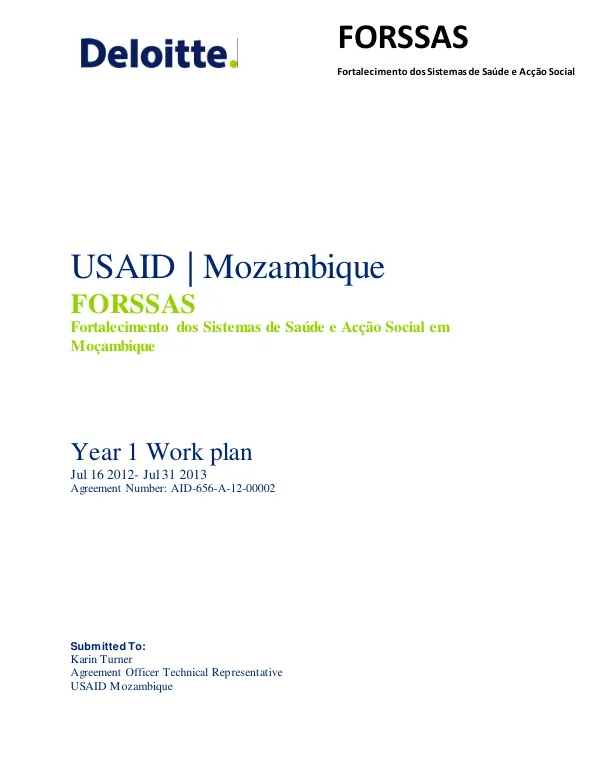
Year 4 Work Plan Narrative: Fortalecimento dos Sistemas de Saúde e Acção Social em Moçambique
Sign inDELOITTE CONSULTING, LLP
Year 4 Work Plan Narrative: Fortalecimento dos Sistemas de Saúde e Acção Social em Moçambique
The Mozambique Health and Social Welfare Systems Strengthening Program (HSWSS, known locally as FORSSAS) is a USAID project awarded to Deloitte Consulting LLP in July 2012.
2015 · 5 pages
Sign in to readA free account is required to download.
Abstract
The project approach has three phases: 1) vision and plan; 2) design and implement; and 3) institutionalize. In Year Three, the FORSSAS team worked with counterparts across the Ministry of Health (MISAU) and the Ministry of Gender, Child, and Social Welfare (MGCAS) to build upon the systems and procedures developed in Years One and Two of the project. Key achievements in governance, procurement, and financial management include standardizing governance and financial management procedures at all levels of the health system, including district hospitals. MISAU central and provincial level offices now possess standard operating manuals, which leave a lasting impact on financial governance. FORSSAS has trained 434 staff from all 11 provinces cumulatively in public financial management practices, introducing greater efficiency in the flow of funding to decentralized levels of the system. In supply chain governance, FORSSAS supported over 200 internal supply chain process audits throughout the country since the beginning of the project while digitizing the data collection procedures for internal audit, reducing reporting timelines from 60 to 17 days. The Procurement Information System (SIP) was developed to empower CMAM leadership to oversee supply chain compliance, procurement procedures, and supplier performance. Health planning and financing advisors completed the Health Financing Situational Analysis and Health Insurance Landscape studies, increasing understanding and application of health financing scenarios. FORSSAS documented and standardized the NHA development process, including training on the methodology. MISAU now has an improved understanding of the role and reality of insurance as a risk mitigating factor for the health sector. The OneHealth Tool Institutionalization Plan was developed, describing the steps required to effectively institutionalize the use of the OneHealth tool and its data and PESS costing results for programmatic and operational decision-making. The plan will be finalized during Year Four, with support from DPC counterparts. FORSSAS advisors institutionalized the costing tool for use during strategic planning cycles, creating stronger links between health program needs and MISAU budgets. Supporting Mozambique's ability to manage external donor financing and projects, FORSSAS helped DPC to develop an action plan to respond to Global Fund audit recommendations related to improved M&E, information systems, and data quality. FORSSAS also supports DAF's key role in managing Global Fund and World Bank finances, further helping to increase the sustainability of national systems for the purpose of managing external donor financing. Under the umbrella of health information systems and M&E, FORSSAS staff supported DPC in operationalizing a working group for the Performance Assessment framework (Quadro de Avaliação do Desempenho, QAD) for 2015-2019, focusing on the development of quality indicators for the plan. The team updated procedures for the M&E Department's monitoring and development of the progress reports (Balanço) for PES, PARI, QAD, and PQG plans and respective indicators for greater accountability and monitoring of health sector programs. Building on considerable achievements in previous years, human resources for health advisors continued to build the capacity of the social welfare sector, including local training institutions, to organize, implement, and monitor competency-based social welfare and early childhood educator courses. Over the life of the project, FORSSAS has supported the pre-training of almost 200 Social Welfare Technicians and Early Childhood Educators. Moving into Year Four, FORSSAS maintains its work in line with the results framework, focusing on the institutionalization of the systems, tools, and processes developed in previous years. The project will support the operationalization of the achievements from prior years, including the links between strengthening health system building blocks – governance, supply chain, data and information systems, health financing, financial management, and human resources – and improving health outcomes at points of service.