NORC AT THE UNIVERSITY OF CHICAGO
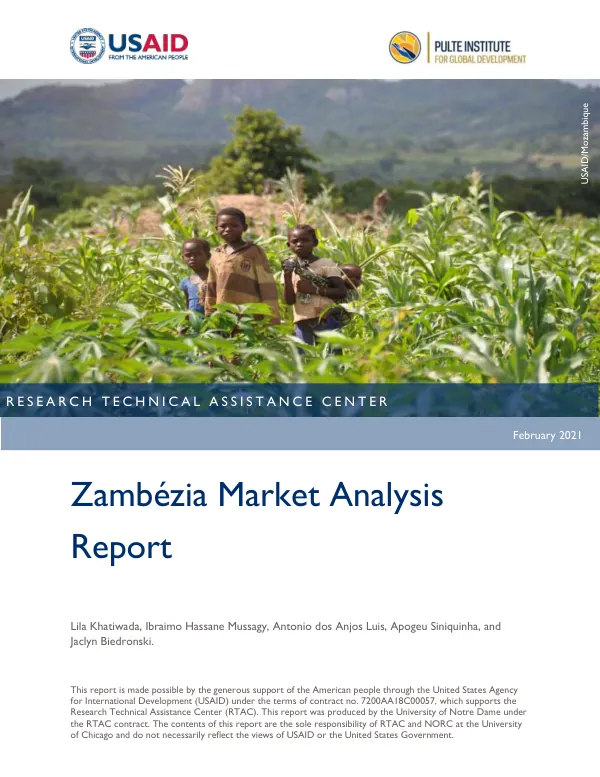
Zambézia Market Analysis Report
Zambézia Market Analysis Report The agricultural sector in Zambézia Province, Mozambique, is characterized by a strong dependence on agriculture as the main occupation for the population.
2021 · 55 pages
Sign in to readA free account is required to download.
Abstract
The typical household food basket consists of a variety of staple foods, including maize meal, bread, soy, rice, wheat, beans, peanut, cabbage, tomato, pumpkins, cucumber, onion, cassava, potato, orange, mango, fish, meat, and eggs. Households also purchase sugar, butter, cooking oil, and salt. The main foods produced and consumed in Zambézia are maize, cassava, pigeon peas, millet, rice, peanuts, cashews, and sesame. Zambézia households retain 60 percent of what they produce for consumption and sell the rest. Seventy-eight percent of farms produce cassava, contributing to 37 percent of domestic cassava production. In addition, 75 percent of farms produce maize (14 percent of domestic maize production), 34 percent produce rice (57 percent of domestic production), and 27 percent produce cowpeas (11 percent of domestic production). Zambézia also produces the majority of small peanuts grown in Mozambique—57 percent of the domestic market. Based on 2020 government estimates of various cereals, root crops, beans, and vegetables, Zambézia is a food surplus province. This analysis estimates that more than 506,000 metric tons of cereals, 918,740 metric tons of legumes and roots, and 116,839 metric tons of horticultural products will be surplus in LZ5 in 2020. Market centers have emerged in Zambézia to address consumer needs, including weekly fairs where farmers sell their goods and buy household items. These market centers are integrated with regional markets to maintain balanced supply and demand of commodities. Food items produced and sold locally are cassava, maize, rice, sorghum, millets, beans, butter beans, and sweet potato. Other commodities, including edible oil, sugar, and processed foods, are transported from outside the province. Rice is produced locally, but Asian rice is dominant in local markets. The trading of commodities depends on how strongly local markets are integrated with regional and provincial markets. Mocuba is the main reference market in Zambézia Province and surrounding area, with strong linkages with Milange, which borders Malawi and Quelimane. Surplus commodities are sold to other provinces, including Sofala and Maputo. Some commodities (e.g. pigeon peas and cashew nuts) are also sold to other countries, including South Africa, Malawi, and India. Historically, maize prices decrease each year from April to July, the harvest season, and increase from December to February, the lean season. Harvest season price reductions are amplified when transient maize from the previous year is available. The price of maize flour remains largely steady year-round, with prices lowest in June and highest in November. However, in 2019 the average price of maize flour fell to about 60 percent of its historical average price. The price of rice has remained steady year-round over the last eight years. However, in the first six months of 2020 the average price of rice was only about 80 percent of its historical average price. The price of major household commodities is available year-round in local markets. On average, households spend US$10-$151 per week on household goods. On average, the price of maize flour is US$1 per kg, beans US$1.10 per kg, rice US$13 per 25 kg, cooking oil US$1.50 per liter, cooking salt US$0.50 per kg, and sugar US$0.80 per kg. The prices of these commodities are independent, as there is no co-movement of the prices of maize, rice, beans, peanuts, and potatoes. The market analysis provides a robust evidence base on domestic food production and the availability of storage facilities in Mozambique, which will allow USAID to make an informed Bellmon determination.
Related documents