ENGENDERHEALTH
Expanding Access to Family Planning Services for Garment Workers in Bangladesh
The Bangladesh Garment Manufacturers and Exporters Association (BGMEA) is a trade association committed to protecting and promoting the interests of the apparel industry and ensuring garment workers' rights and privileges.
2018 · 4 pages
Sign in to readA free account is required to download.
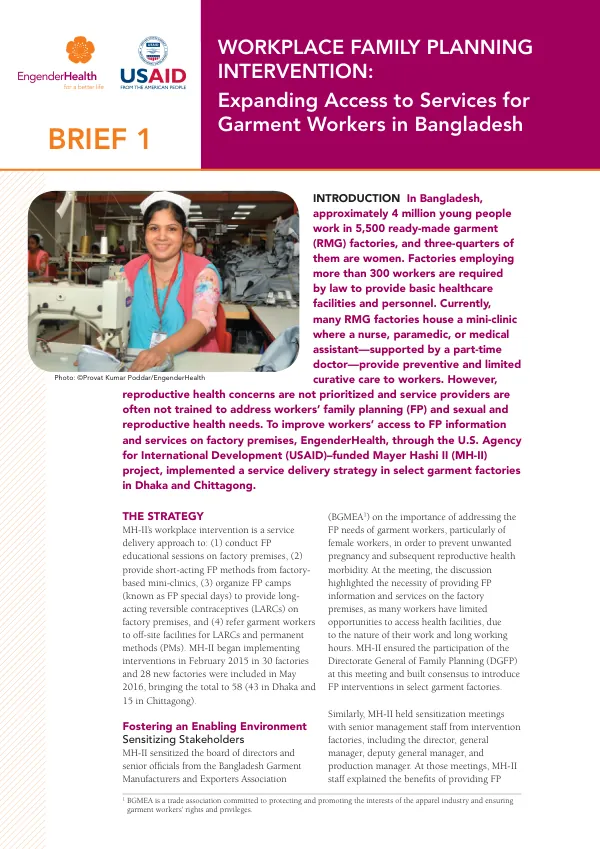
Abstract
In Bangladesh, approximately 4 million young people work in 5,500 ready-made garment (RMG) factories, with three-quarters of them being women. Factories employing more than 300 workers are required by law to provide basic healthcare facilities and personnel. To improve workers' access to family planning (FP) information and services on factory premises, EngenderHealth, through the U.S. Agency for International Development (USAID)-funded Mayer Hashi II (MH-II) project, implemented a service delivery strategy in select garment factories in Dhaka and Chittagong. The strategy included conducting FP educational sessions on factory premises, providing short-acting FP methods from factory-based mini-clinics, organizing FP camps (known as FP special days) to provide long-acting reversible contraceptives (LARCs) on factory premises, and referring garment workers to off-site facilities for LARCs and permanent methods (PMs). MH-II sensitized the board of directors and senior officials from the BGMEA on the importance of addressing the FP needs of garment workers, particularly female workers, to prevent unwanted pregnancy and subsequent reproductive health morbidity. The project also held sensitization meetings with senior management staff from intervention factories, including the director, general manager, deputy general manager, and production manager. MH-II staff explained the benefits of providing FP services to keep female workers healthy for factory work and to reduce absenteeism. MH-II developed a cadre of health educators known as "workplace coordinators" and "peer educators," who were chosen from the factory's mid-level and junior management staff and service providers stationed in factory mini-clinics. MH-II trained the health educators to provide FP information to workers and to link them with appropriate service providers. The project also established partnerships for contraceptive supplies, including a bilateral memorandum of understanding between the BGMEA and EngenderHealth, and a tripartite memorandum of understanding between the Directorate General of Family Planning (DGFP), BGMEA, and EngenderHealth. The MH-II project's workplace FP model included peer-led demand-generation activities with linkages to factory mini-clinics and off-site health facilities. The model used a two-tiered service delivery approach to provide short-acting methods instantly at factory mini-clinics with functional referral linkages with BGMEA health centers for implants and with government facilities and non-governmental organization (NGO) clinics for LARCs and PMs. MH-II mapped FP special service days and organized them on factory premises, with support from the BGMEA health center. The project facilitated a total of 2,920 in-factory educational sessions to increase FP-related knowledge and awareness among factory workers. Through these educational sessions, 88,169 factory workers received information on modern FP methods and referrals to relevant facilities and services. A total of 8,691 workers adopted FP methods from factory mini-clinics, including 5,668 workers who obtained pills and condoms from mini-clinics and 3,023 workers who adopted injectables, LARCs, and PMs on FP special service days. The project also established a functional linkage between 164 garment factories and the 100-bed CEPZ Hospital to facilitate access to FP information and services from the hospital.