USAID DEC
Activity Monitoring, Evaluation, & Learning (AMEL) Plan for USAID's Land for Prosperity Activity under the Strengthening Tenure and Resource Rights II (STARR II) IDIQ
Sign inTETRA TECH
Activity Monitoring, Evaluation, & Learning (AMEL) Plan for USAID's Land for Prosperity Activity under the Strengthening Tenure and Resource Rights II (STARR II) IDIQ
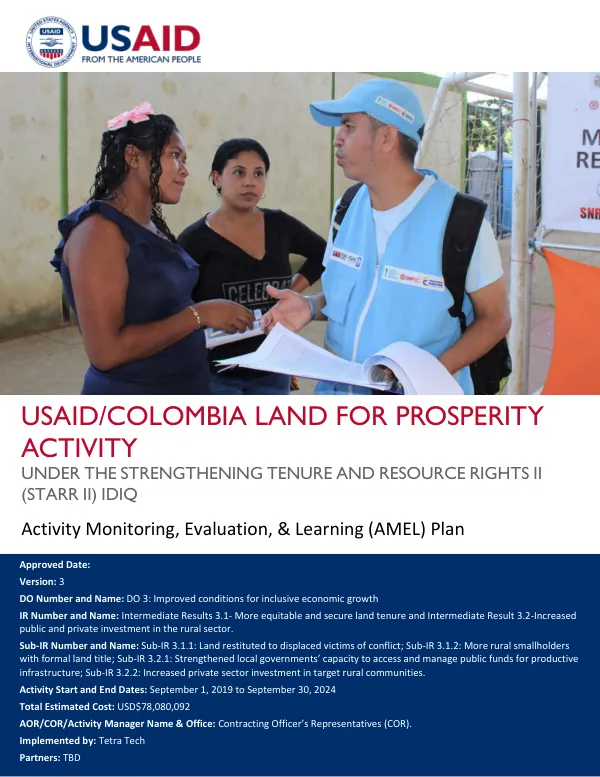
The Land for Prosperity Activity in Colombia is a USAID-funded project aimed at improving conditions for inclusive economic growth.
2019 · 127 pages
Sign in to readA free account is required to download.
Abstract
The activity is implemented under the Strengthening Tenure and Resource Rights II (STARR II) Indefinite Deliverables, Indefinite Quantity Contract. The project's main objective is to support the Government of Colombia in improving land tenure security and increasing public and private investment in the rural sector. The activity has several intermediate results, including more equitable and secure land tenure, and increased public and private investment in the rural sector. These intermediate results are further broken down into sub-intermediate results, such as land restituted to displaced victims of conflict, more rural smallholders with formal land title, strengthened local governments' capacity to access and manage public funds for productive infrastructure, and increased private sector investment in target rural communities. The project's activity monitoring, evaluation, and learning (AMEL) plan outlines the framework for monitoring and evaluating the activity's progress. The plan includes performance monitoring, context monitoring, evaluation, and learning. Performance monitoring involves tracking the activity's progress against its performance indicators, while context monitoring involves tracking changes in the external environment that may affect the activity's outcomes. The evaluation plan outlines the methodology for evaluating the activity's impact, while the learning plan outlines the approach for capturing and sharing lessons learned. The activity's data management plan outlines the procedures for collecting, storing, and analyzing data. The plan includes data collection, data quality assurance, data storage, data security, and data analysis and use. The activity's roles and responsibilities are outlined in the plan, including the operations manager, MEL manager, M&E coordinator, M&E specialist, and environmental specialist. The activity's performance indicators are outlined in the plan, including indicators for land tenure security, public and private investment in the rural sector, and local governments' capacity to access and manage public funds. The plan also includes a schedule for monitoring, evaluation, and learning reports to USAID. The activity's theory of change outlines the expected outcomes and impact of the project. The theory of change is based on the assumption that improved land tenure security and increased public and private investment in the rural sector will lead to more equitable and secure land tenure, and increased economic growth and poverty reduction. The activity's monitoring and evaluation framework is based on the USAID's Automated Directive System (ADS) and the Activity Monitoring, Evaluation, and Learning (AMEL) plan. The framework includes performance indicators, baseline assessments, and performance assessments. The activity's data quality assurance plan includes best practices, internal data quality assessments, and data quality assessments of USAID. The activity's data storage plan includes the use of internal operation management systems, USAID-Colombia's MONITOR system, and TEAMS. The plan also includes data security measures to ensure the confidentiality, integrity, and availability of data. The activity's data analysis and use plan outlines the approach for analyzing and using data to inform decision-making. The activity's roles and responsibilities are outlined in the plan, including the operations manager, MEL manager, M&E coordinator, M&E specialist, and environmental specialist. The plan also includes a schedule for monitoring, evaluation, and learning reports to USAID.