GOVERNMENT OF THE ISLAMIC REPUBLIC OF AFGHANISTAN
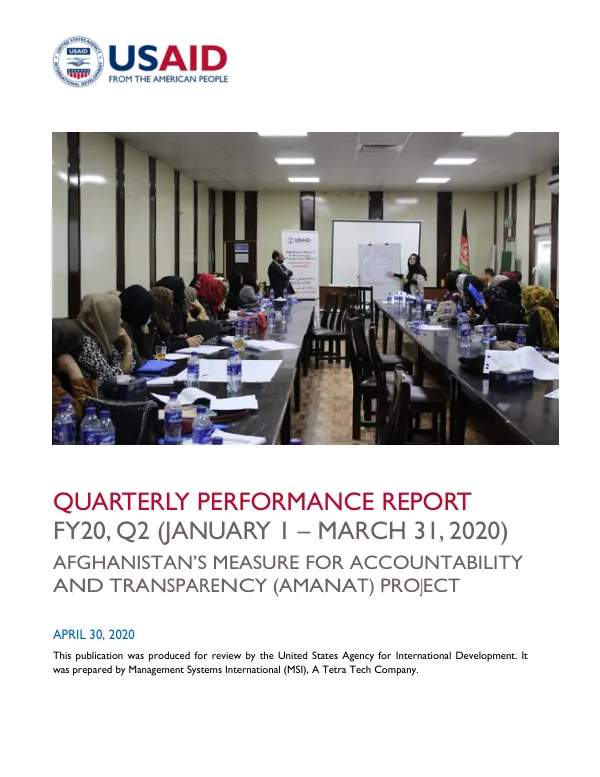
Quarterly Performance Report FY20, Q2 (January 1 – March 31, 2020)
The Afghanistan's Measure for Accountability and Transparency (AMANAT) project was awarded to Management Systems International (MSI) on August 23, 2017, with a contract number of AID-306-H-17-00003.
2020 · 48 pages
Sign in to readA free account is required to download.
Abstract
The project began on December 16, 2017, with the goal of supporting the Government of the Islamic Republic of Afghanistan (GIROA) in reducing and preventing corruption in public services. The project has two main objectives. The first objective is to strengthen transparency and accountability mechanisms, which involves enhancing government initiatives to identify corruption risks and implement anti-corruption reforms. This includes selecting government institutions to conduct facilitated self-assessments, strengthening internal audit functions, and providing support to implement anti-corruption reforms. The second objective is to strengthen civil society's ability to advocate for reform, which involves mobilizing civil society groups, training civil society organizations (CSOs) to perform watchdog functions, and building the capacity of CSOs to analyze anti-corruption shortcomings in legislation. In the second quarter of FY20, AMANAT completed a second round of institutional political economy analysis (iPEA) for five ministries, including the Ministry of Refugees and Repatriation, Ministry of Public Health, Ministry of Education, Ministry of Higher Education, and Ministry for Martyrs and the Disabled. This analysis provided additional information to further develop anti-corruption strategies. AMANAT also strengthened the capacity of 331 members of local school shuras in Kunar and Panjir provinces, enabling them to respond to complaints and provide oversight on school performance. The project responded to the Ministry of Public Health's urgent request to support awareness on COVID-19 and anti-corruption, and drafted a strategic paper on complaints handling for health in consultation with stakeholders. Additionally, AMANAT created three internal audit policies in a consultative process with the Ministry of Higher Education, Ministry for Martyrs and the Disabled, and Ministry of Refugees and Repatriation, strengthening the framework for internal auditing in these sectors. The project also developed training packages to help CSOs address legislative advocacy weaknesses and delivered watchdog initiatives, engaging citizen groups in the provinces. The CSO team continued mobilizing CSOs in Kabul to strengthen anti-corruption networking efforts and build their capacity to address corruption in their communities. AMANAT delivered training on budget preparation and budget oversight for CSOs in Herat and Balkh provinces, with a total of 89 participants. Overall, the AMANAT project has made significant progress in strengthening transparency and accountability mechanisms and civil society's ability to advocate for reform in Afghanistan.