USAID DEC
Quarterly Performance Report FY19 Q2: Afghanistan’s Measure for Accountability and Transparency (AMANAT) Project
Sign inGOVERNMENT OF THE ISLAMIC REPUBLIC OF AFGHANISTAN
Quarterly Performance Report FY19 Q2: Afghanistan’s Measure for Accountability and Transparency (AMANAT) Project
The Afghanistan's Measure for Accountability and Transparency (AMANAT) project is a USAID-funded initiative aimed at reducing and preventing corruption in government public services.
2019 · 32 pages
Sign in to readA free account is required to download.
Abstract
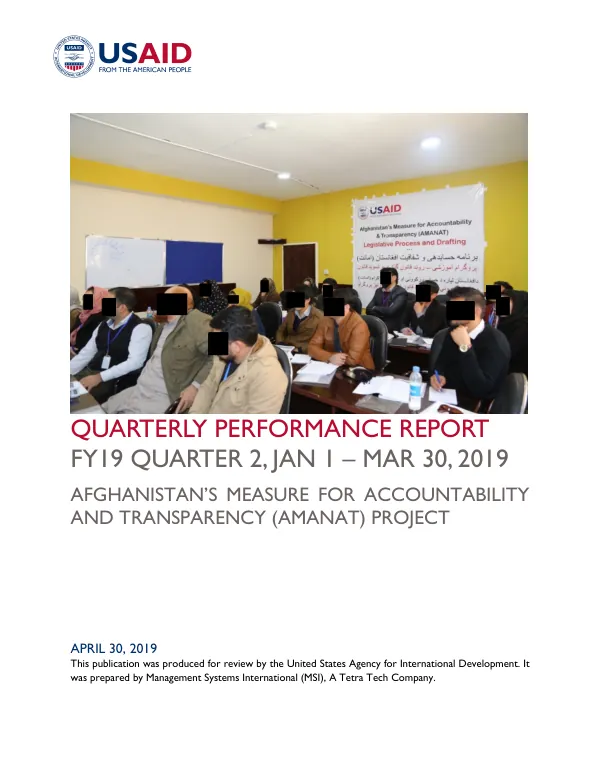
The project was awarded to Management Systems International (MSI) on August 23, 2017, and work began on December 16, 2017. The project's primary objective is to support the Afghan government's efforts to strengthen transparency and accountability mechanisms. To achieve this goal, AMANAT has two key objectives: Goal 1, which focuses on strengthening transparency and accountability mechanisms, and Goal 2, which aims to strengthen civil society's ability to advocate for reform. Under Goal 1, AMANAT will enhance government initiatives to identify vulnerabilities to corruption and implement anti-corruption reforms. This will involve selecting and assisting government institutions to conduct facilitated self-assessments, strengthening internal audit functions, and enhancing the capacity of the Independent Anti-Corruption Monitoring and Evaluation Committee (MEC) to conduct corruption risk assessments. Under Goal 2, AMANAT will strengthen civil society capabilities to assess government anti-corruption efforts. This will involve mobilizing civil society groups, training civil society organizations (CSOs) to perform watchdog functions, and building the capacity of CSOs to analyze anti-corruption shortcomings in legislation. AMANAT will also use grant programs to support CSO initiatives that increase public awareness, advocacy, monitoring, and oversight activities. During the second quarter of FY19, AMANAT made significant progress in achieving its objectives. The project developed training materials and conducted Watchdog (Budget Process and Budget Oversight) Training for CSOs, as well as Legislative Process and Drafting Training for CSOs. AMANAT also continued to mobilize CSOs in various provinces on anti-corruption networking efforts and established the Anti-Corruption Network for Kabul Province. In addition, AMANAT conducted five internal audit institutional assessments in the Ministry of Public Health (MoPH), Ministry of Education (MoE), Ministry of Higher Education (MoHE), Ministry of Martyrs and Disabled (MoMD), and Ministry of Refugees and Returnees (MoRR). The project also began initial support for building the government's communications capacity for anti-corruption efforts, raising public awareness of corruption, and promoting learning. AMANAT consulted with and developed specific capacity building support with the Independent Anti-Corruption Monitoring and Evaluation Authority (MEC), as well as with the project's main government beneficiaries. These beneficiaries include the Ministry of Education (MoE), Ministry of Higher Education (MoHE), Ministry of Public Health (MoPH), Ministry of Refugees and Repatriation (MoRR), and the Office of the Minister for Martyrs and the Disabled (MoMD). The project's team of international and national internal audit experts has started to assess internal audit capacity across all five ministries. The Ministry of Refugees and Repatriation (MoRR) Minister has requested AMANAT to support MORR's land distribution reform efforts through the provision of two short-term experts to support capacity building and specific outputs to improve the land distribution process, which is known to be vulnerable to corruption. The Ministry of Education (MoE) has prioritized AMANAT support to School Management Shuras in four provinces this year, and the Ministry of Higher Education (MoHE) has shown its commitment to initiating at least two VCA self-assessment processes with AMANAT support. AMANAT is partnering with APPRO and Global Enterprise Consulting to design and deliver practical skills trainings with the MEC. The project's CSO team was deeply involved with CSO and CSO network consultations regarding the establishment of the Anti-Corruption Network for Kabul Province, with the goal of promoting enhanced networking, cooperation, and shared learning. A technical working group was established by the CSO networks to draft and finalize the by-laws for the Anti-Corruption Network, which will likely face some challenges.