USAID DEC
Africa's Changing Farm Structure and Challenge
Africa's Changing Farm Structure and Employment Challenge Africa's agricultural sector is expected to remain the primary source of livelihood for the majority of Africans for at least several decades.
2015 · 4 pages
Sign in to readA free account is required to download.
Abstract
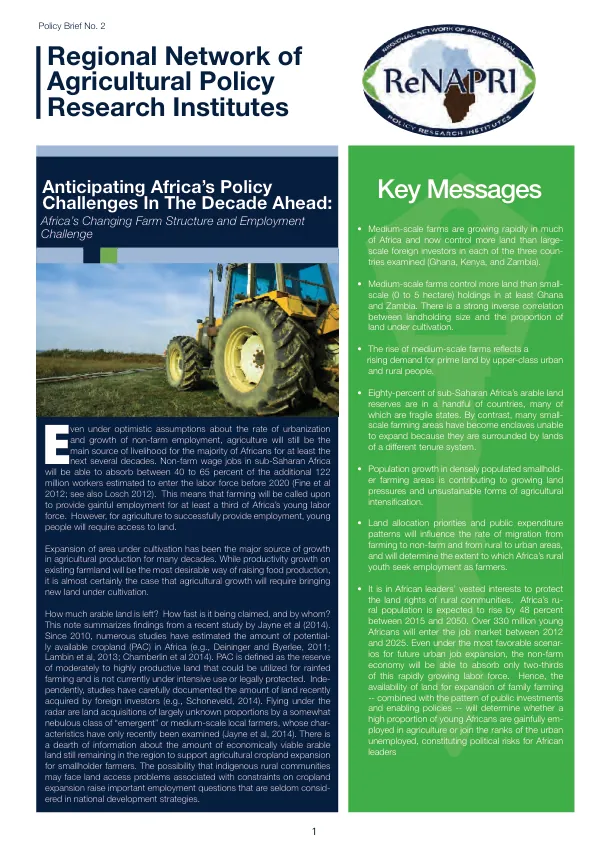
Despite optimistic assumptions about the rate of urbanization and growth in non-farm employment, the sector will still be responsible for providing gainful employment for a significant portion of the continent's young labor force. For agriculture to meet this demand, young people will require access to land. The expansion of arable land has been the primary source of growth in agricultural production for many decades. However, this approach is almost certainly unsustainable, and agricultural growth will require bringing new land under cultivation. The availability of arable land is a pressing concern, with numerous studies estimating the amount of potentially available cropland (PAC) in Africa. PAC is defined as the reserve of land that is not under intensive use or legally protected and is suitable for rainfed farming. Recent studies have estimated that 22.7 million hectares of arable land in sub-Saharan Africa have been acquired by large-scale entities, with roughly 90% of this involving a foreign primary shareholder. This is equivalent to 15 to 35% of the region's potentially available cropland, depending on whether forestland is included. However, Africa's PAC is highly concentrated in a few countries, many of which are fragile states. The conversion of forests to cropland would entail significant environmental costs. The rise of medium-scale farms has been a revolutionary change in farm structure. In all three countries studied, the land controlled by medium-scale farms now exceeds that of foreign and domestic large-scale holdings combined. Holdings between 5 and 100 hectares now account for more land than small-scale farms (0-5 hectares) in two of the three countries examined. There is a strong inverse correlation between landholding size and the proportion of landholding under cultivation. The majority of medium-scale farmers are male, with primary jobs in the non-farm sector, particularly in government. Many of these farmers live in urban areas and are relatively well-educated. They acquired their farms using savings from their non-farm jobs, often during their mid-life stages. This profile is consistent with 60% of the sampled medium-scale farmers in Kenya and Zambia. A smaller but still significant category of medium-scale farmer was relatively rural-born men who acquired large landholdings as they started their careers. The distribution of landholdings is becoming increasingly concentrated. The Gini coefficients of landholdings have increased in all three countries, with Ghana's Gini coefficient rising from 0.52 in 1992 to 0.65 in 2005. While landholdings in Africa are not as concentrated as in Latin America, the Ginis in the three African case studies are higher than most Asian countries. In Kenya, rural population growth and land subdivision have led to an alarming rise in the proportion of very small farms, with 83% of farms smaller than three hectares in 1994 and 96% in 2006. Despite the availability of land for acquisition by some groups, population growth in smallholder farming areas is contributing to land pressures and unsustainable forms of intensification. Rural populations in sub-Saharan Africa are highly concentrated in fertile areas, with 20% of the continent's 10km gridcells containing 83% of its rural people. Rising population density is associated with smaller farms, continuous use of land, reduced fallows, and marginal increases in fertilizer use and irrigation. Migration from these areas may be advantageous for those with skills and education, but has major limitations. Urban migration is already occurring at too rapid a pace to prevent rising unemployment and underemployment, and migration to more sparsely populated areas can continue to relieve land pressures, provided that land remains accessible in the receiving areas.
Related documents