USAID DEC
African Cities for the Future Real Impact Case Example
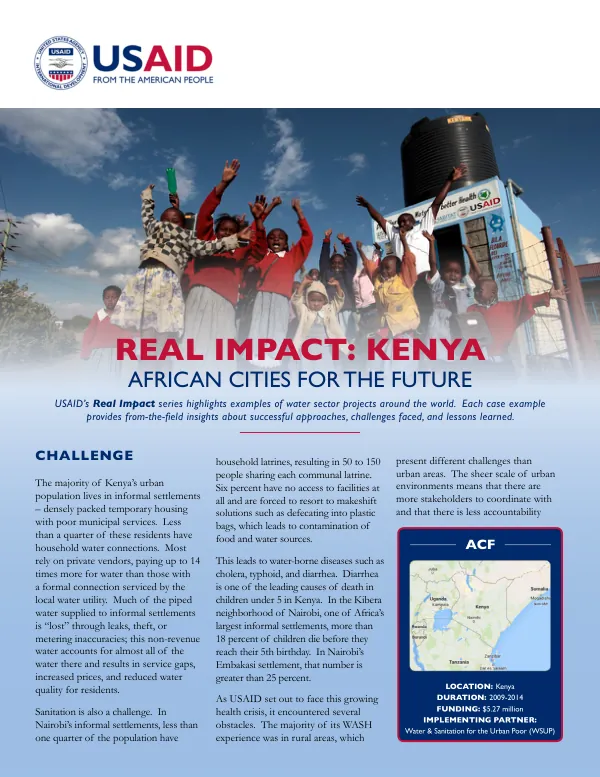
The African Cities for the Future (ACF) program in Kenya aimed to improve urban water, sanitation, and hygiene (WASH) services in six of Africa's fastest-growing cities, including Nairobi and Naivasha.
2015 · 4 pages
Sign in to readA free account is required to download.
Abstract
The program was implemented by Water and Sanitation for the Urban Poor (WSUP), a multi-sector partnership that brings together the private sector, NGOs, and academia to bring WASH to low-income urban populations. The ACF program faced several challenges, including the sheer scale of urban environments, which made it difficult to coordinate with multiple stakeholders and ensured accountability. The rapid rate of urbanization, particularly in informal settlements, also posed significant challenges. In Nairobi, more than 60 percent of the population lives in informal settlements, and these populations are projected to double within the next 15 years. To address these challenges, the ACF program forged partnerships with local utilities, private companies, and community members to ensure that WASH interventions were both sustainable and effective. WSUP documented its approaches, successes, challenges, and best practices while implementing ACF, enabling local stakeholders and international donors to replicate and build upon its work in the future. The program's approach focused on building on-the-ground capacity, improving markets, and increasing hygiene in order to serve the needs of the urban poor. In Nairobi, ACF worked with the local utility, Nairobi City Water and Sewerage Company (NCWSC), to create the Nairobi Water Action Group to improve the process of liaising with consumers and by creating an anti-corruption committee. The program also sponsored knowledge-sharing workshops, meetings, and learning sessions to teach WSC staff how to serve poor communities in a commercially and viably way. In Naivasha, ACF worked with the local utility, private companies, and community members to ensure eased access to safe water. The program established a delegated management model to ensure affordable, quality water services by formalizing partnerships between the water utility, small-scale providers, and community Water User Associations. Under this model, small-scale providers purchase water from the utility and manage its distribution to households and water kiosks. Community engagement was crucial to ACF's work to improve and sustain sanitation in Kenya. The program invested in a low-cost sewerage system to serve several settlements within the Kibera neighborhood, built new latrines, and worked with stakeholders to upgrade existing latrines. ACF met with landlords to promote the benefits of self-financing upgrades to existing latrines, converting them to pour-flush toilets connected to the ACF-funded sewer. To ensure sanitation was appropriate for local conditions, existing capacities, resources, and gender preferences, ACF held toilet design clinics. These clinics were structured like focus groups but included engineers and project planners. ACF made sure to include underserved groups, such as women, schoolchildren, Muslims, the elderly, and disabled people, to ensure their needs would be adequately served by sanitation investments. ACF also worked with local community groups to ensure the sustainability and viability of their sanitation investments. The program helped latrine artisans in Naivasha to register as a Community-Based Organization and link up with construction material suppliers. The program also trained small local sanitation businesses to more efficiently empty pits, unblock sewer lines, maintain the sewerage system, and streamline and improve their business operations. ACF established neighborhood committees in project areas to oversee WASH infrastructure management and decision-making. The program partnered with Unilever to promote improved WASH in poor schools in Kenya, targeting children because of the conviction, supported by research, that children are "agents of change" who can spread messages learned in school to their families and communities. The ACF program had a significant impact on improving WASH services in Kenya. Water became more affordable, with the price of water from formalized vendors decreasing by 40 percent in Nairobi and 60 percent in Naivasha. Sanitation access increased, with more than 400 latrines installed in Kenya and 160 landlords convinced to self-finance upgrades to latrines. Access to safe water increased, with three water kiosks providing water to up to 1,500 people in Nairobi and the water network extended to serve three informal peri-urban settlements in Naivasha, improving access for about 30,000 people. Hygiene improved, with more than 135,000 schoolchildren in Nairobi and 60,000 in Naivasha reached with hygiene messages about handwashing and other key hygiene behaviors. Non-revenue water was reduced, with a 20 percent decrease in water loss in one informal settlement in Naivasha.