DEVELOPMENT ALTERNATIVES, INC./FINNET
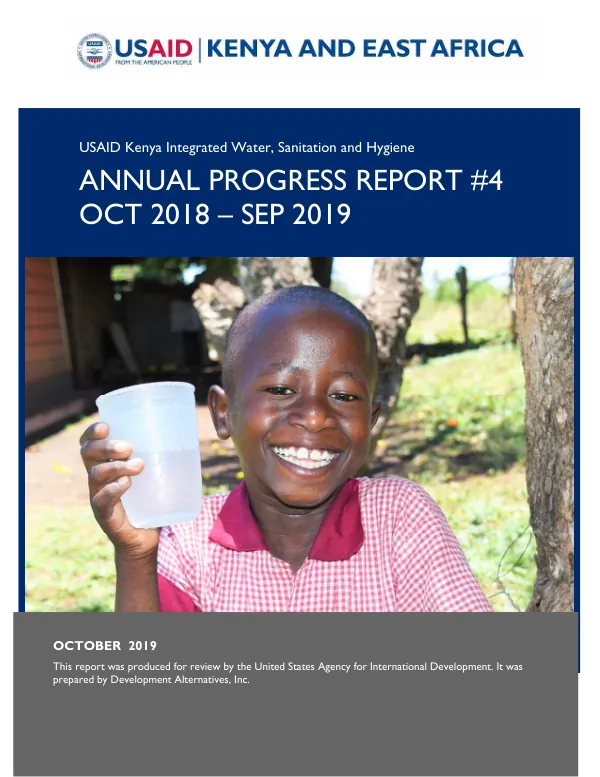
USAID/KENYA KIWASH PROGRESS REPORT FOR FY 2019
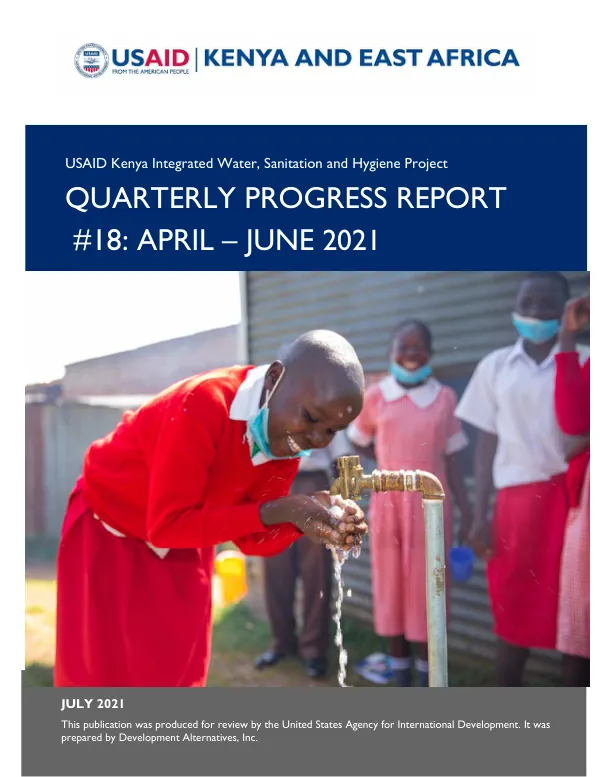
The Kenya Integrated Water, Sanitation and Hygiene project (KIWASH) aims to improve the lives and health of 1 million Kenyan citizens in nine counties through the development and management of sustainable water, sanitation, hygiene, and nutrition services.
2019 · 114 pages
Sign in to readA free account is required to download.
Abstract
This report covers the period from October 1, 2018 to September 30, 2019. Establishing self-reliant water supplies and communities is a key objective of KIWASH. Through continuous training, coaching, and mentoring, coupled with strategic infrastructure investments for 13 county water service providers and 231 WASH enterprises, 305,899 people gained access to basic and improved drinking water in FY 2019. Community water entrepreneurs are playing a vital role in rural service delivery, economic, and personal well-being of citizens. The enterprises have achieved tremendous growth during the year, with 12 enterprises in Migori County increasing revenue by an average of 95 percent in just 12 months. This growth enables enterprises to improve their cost recovery and financial sustainability, leading to better operations, greater efficiencies, and expanded services. Strategic infrastructure investments and peer-to-peer learning are transforming water efficiencies and access. KIWASH's technical assistance to project owners has enhanced their skills in operating and managing commissioned water supply projects, resulting in greater efficiencies and cost-effectiveness of services. Improved operations and maintenance reduced non-revenue water of all project-supported WSPs and WASH enterprises by an average of 17 percent. Regular maintenance and timely repairs will allow systems to operate throughout their useful design life. As a result of this support, some WASH enterprises are expanding their water distribution pipelines to reach out to more beneficiaries with clean water. This is made possible by the extra resources generated by more efficient and accountable systems, supported by strategic capital investments in improved technologies such as solar-powered water pumping or infrastructure rehabilitation to reduce non-revenue water. KIWASH has also identified and named corruption as a key contributor to low efficiency in water utilities. In Migori, students of Wiser Secondary School have access to clean, reliable water at home and school as a result of capacity development and strategic infrastructure investments with Muhuru Bay Water Project to improve operational efficiencies. The project has made significant progress in scaling up market-based WASH delivery models, sustained access for financing/credit for WASH, and environmental sustainability of WASH services. KIWASH has also strengthened governance and policy, supported infrastructure development, and recovered grants. In terms of quantitative impact, KIWASH has achieved the following results: 305,899 people gained access to basic and improved drinking water; 231 WASH enterprises were supported; and 13 county water service providers received technical assistance. The project has also reduced non-revenue water by an average of 17 percent. KIWASH has faced several constraints and opportunities, including limited resources, corruption, and lack of capacity. However, the project has made significant progress in addressing these challenges and has achieved notable successes in improving water, sanitation, and hygiene services in Kenya. The project has also made progress in performance monitoring, gender strategy, environmental mitigation and monitoring, links to other USAID programs, links with GOK agencies, and USAID Forward. KIWASH has also developed a sustainability and exit strategy, which includes plans for transitioning the project to local ownership and management. In terms of financial information, KIWASH has received funding from USAID and has made significant investments in infrastructure and technical assistance. The project has also generated revenue through the sale of water and other services. Overall, KIWASH has made significant progress in improving water, sanitation, and hygiene services in Kenya. The project has achieved notable successes in scaling up market-based WASH delivery models, sustained access for financing/credit for WASH, and environmental sustainability of WASH services.
Related documents