USAID DEC
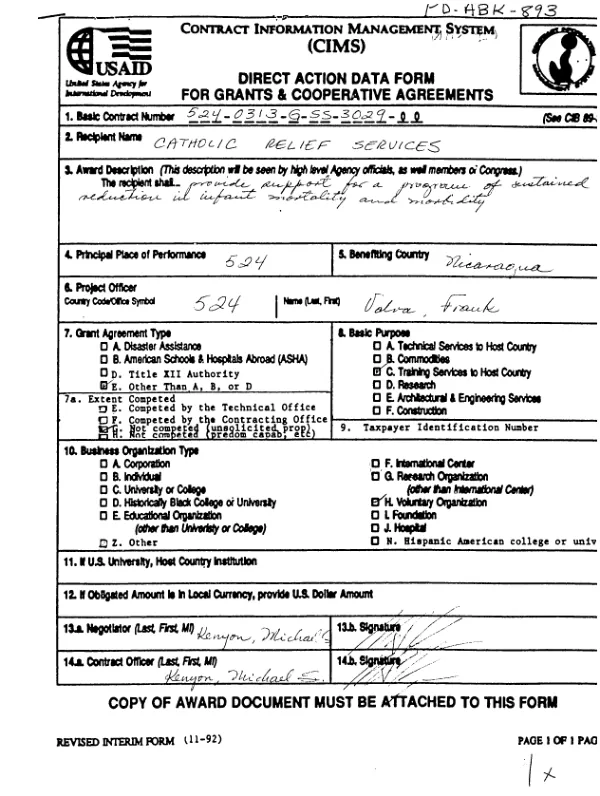
AID grant no. 524-0313-G-SS-3029-00 to Catholic Relief Services (CRS) to provide support for a program of sustained reduction in infant mortality and morbidity
Sign inUSAID. MISSION TO NICARAGUA
AID grant no. 524-0313-G-SS-3029-00 to Catholic Relief Services (CRS) to provide support for a program of sustained reduction in infant mortality and morbidity
Grant is provided to Catholic Relief Services (CRS) to expand community-based child survival interventions in 46 communities in the Departments of Managua and Masaya in Nicaragua.
1993
Sign in to readA free account is required to download.
Abstract
CRS will work with its local affiliate, Comision de Promocion Social Arquidiocesana (COPROSA) in implementing the project. CRS/COPROSA will train 260 volunteer health promoters, organized into 26 Community Health Committees (CHCs), in prevention and control of diarrhea and acute respiratory infections, oral rehydration therapy, immunizations, breastfeeding, maternal care, nutrition/Vitamin A, environmental sanitation, and management of health programs. Each promoter will cover about 25 families. Maternal/child health services will be provided in cooperation with Sistemas Locales de Atencion Integral de Salud (SILAIS), the local health service, and will include the following. (1) Vaccination campaigns will be launched for children under the age of five. Promoters will administer vaccinations and maintain vaccination records, which at the end of the vaccination period will be forwarded to local health posts. SILAIS will supply vaccines (and ORT supplies) as well as 20 small refrigerators at rural health centers to store the vaccines. (2) CHCs will conduct three workshops on prevention and management of diarrhea each year for women with children under age 3; participants will be provided with oral rehydration packets. (3) CHCs will also conduct three prenatal care workshops each year, and will arrange for participants to visit the SILAIS doctor at least three times during their pregnancy and ensure that they receive tetanus vaccinations. (4) Finally, the CHCs will conduct three nutrition and cooking workshops each year for women with children under age 5 to teach participants to prepare low-cost foods with high vitamin and protein content (with a focus on the use of greenleaf and soya bean), to exclusively breastfeed their children until they are 4 months old, and how to properly wean children at age 4-6 months. CHCs will monitor the growth of participating children, visiting those who are at high risk. Finally, the project will develop potable water systems for the communities of El Arenal, Los Manguitos, Los Lopez, El Palenque, and Los 24, which currently do not have access to potable water. With project training, village water committees will install and maintain the systems, which will meet family needs for drinking, cooking, bathing, and cleaning. System maintenance will be funded through monthly user fees.
Related documents
Documents in this collection
 1996
1996USAID DEC
USAID grant no. 687-0107-G-00-6030-00 to Catholic Relief Services to support child survival in Madagascar
Open record 1990
1990USAID DEC