USAID DEC
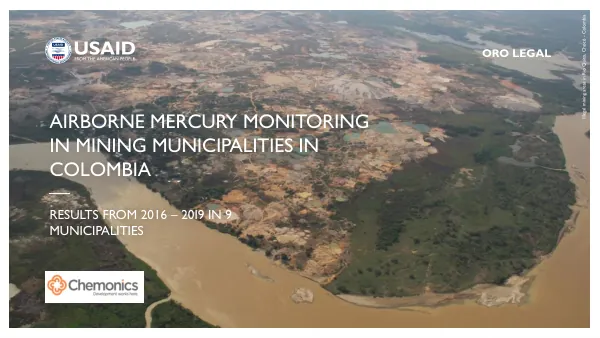
Airborne Mercury Monitoring in Mining Municipalities in Colombia: Results from 2016 – 2019 in 9 Municipalities
Sign inUSAID
Airborne Mercury Monitoring in Mining Municipalities in Colombia: Results from 2016 – 2019 in 9 Municipalities
The airborne mercury monitoring protocol in mining municipalities in Colombia was developed by USAID's "Oro Legal" Activity to reduce mercury contamination resulting from small and medium-scale artisanal mining practices in Antioquia and Chocó.
2020 · 21 pages
Sign in to readA free account is required to download.
Abstract
The protocol was applied in nine municipalities over three years, beginning in 2016. The Activity aimed to monitor and control the impact of airborne mercury in different municipalities. Sources of mercury contamination from mining include alluvial mining, hard rock mining, and burning amalgam. Alluvial mining involves the use of mercury in sluices and direct emissions to water bodies and air. Hard rock mining involves direct emissions to air, and burning amalgam releases mercury into the atmosphere. The Colombian legal context, as outlined in Law #1658, 2013, promotes the reduction and elimination of mercury use in mining. Article 3 of the law sets a maximum term for elimination of five years from 2013, and Article 9 prohibits new mercury-using processing plants and promotes control of existing ones. Mercury mass balances were developed by Oro Legal in 116 mining processing units (MPUs) towards the end of 2018. On average, 3.46 grams of mercury were used to produce 1 gram of gold. Oro Legal has prevented 45 tons of mercury from being released to the environment as of 2016 to date. The estimated mercury mass balance varies by type of operation, department, and number of MPUs. For example, in alluvial mining in Antioquia, 2.04 grams of mercury were used to produce 1 gram of gold, while in hard rock mining in Antioquia, 4.98 grams of mercury were used to produce 1 gram of gold. Airborne mercury levels of exposure were monitored using a Lumex RA 915M, which measures mercury concentrations in high-risk areas such as markets, schools, and health centers. The sampling protocol involves establishing routes based on the location of gold shops and relevant sites, setting up the Lumex in a backpack or on a vehicle, and taking measurements every second. The GPS and Lumex must be initiated simultaneously at the starting point of the sampling route, and sampling routes must be at least 20 minutes and should not exceed one hour. An interval of half an hour must be left between samplings to avoid measuring the tail end of the previous sampling route. The data is then downloaded from the GPS and Lumex and uploaded to ArcGIS or an available GIS system to process the data. Each municipality must have 12 sampling days per year divided into 3 sampling trips spaced over the year. The results of the airborne mercury monitoring protocol in the nine municipalities show varying levels of mercury exposure. The World Health Organization Standard establishes the tolerable annual limit at 0.2μg/m3 and the maximum dangerous limit of annual exposure at 1μg/m3. The National Air Quality Standard, as outlined in Resolution # 601, 2006, sets maximum permissible levels of pollutants in the atmosphere and procedures to sample air quality. The protocol aims to reduce airborne mercury levels and prevent exposure to mercury in mining municipalities in Colombia.