USAID DEC
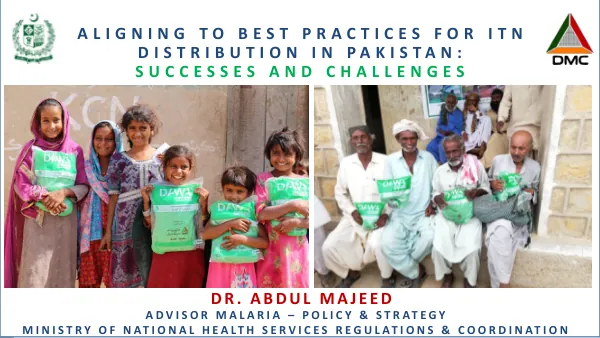
Aligning to Best Practices for ITN Distribution in Pakistan: Successes and Challenges
Sign inTHE WORLD FOOD PROGRAMME
Aligning to Best Practices for ITN Distribution in Pakistan: Successes and Challenges
Aligning to Best Practices for ITN Distribution in Pakistan: Successes and Challenges Pakistan, with a population of approximately 220 million, is a moderate malaria endemic country.
2018 · 520 pages
Sign in to readA free account is required to download.
Abstract
The highest endemic areas are located on the borders with Iran and Afghanistan. According to the 2018 World Malaria Report, an estimated 98% of the Pakistan population is at varying risk of malaria, with 29% in high-risk transmission areas and 69% in low transmission areas. An estimated 1 million malaria cases occur annually, with Plasmodium vivax and Plasmodium falciparum being the prevalent species of parasites. Plasmodium vivax is responsible for more than 80% of reported confirmed cases in the country. Pakistan has been distributing insecticide-treated nets (ITNs) since 2009, mainly with the support of The Global Fund. Approximately 16 million ITNs have been distributed. Initially, LLIN support was limited to high-risk populations, including pregnant women and children under 5 years old (2009-2012). LLIN support was later extended to cover populations living in epidemic-prone areas (2013-2015) and was scaled up to universally cover the rural population in targeted districts (2016) through a rolling distribution mechanism. In 2018, LLIN distribution was conducted using a mass distribution campaign strategy, aligning with best practices for ITN distribution. The mass campaign was conducted in 11 districts, selected based on disease burden, and aimed to cover 960,147 households and distribute 2,880,440 ITNs. The campaign was implemented through a tripartite partnership agreement between the National Malaria Control Program, Indus Hospital Network, and renowned organizations, including the World Food Programme and Pakistan Red Crescent Society. The campaign faced several challenges, including tight timelines, limited budget, poor coordination, and a complex operating environment. One of the major challenges was the tight timeline, which compromised microplanning workshops and trainings. The campaign documents were developed but not endorsed and well understood by the implementing partners. The microplanning process was affected by the lack of required documents and the absence of all stakeholders. Trainings were also impacted by the absence of a training manual, practical exercises, and post-tests. The household registration process was marred by missed households, settlements, and wrong entries, with no door marking in more than 40% of monitored households. The limited budget affected all dimensions of the campaign, including microplanning workshops, training of district and union council staff and volunteers, household registration, distribution, and social and behavioral change communication (SBCC). The approved budget for LLIN distribution did not match the mass distribution campaign strategy, and savings from the Global Fund grant were identified to finance the campaign. The limited budget resulted in half-day microplanning workshops, half-day training of district and union council staff and volunteers, and planning for registration of 70 households per day. Poor coordination was another significant challenge, with a strong coordination structure at the national level between all partners and stakeholders, but not effectively replicated at the provincial and district levels. The centrally controlled project resulted in the lack of ownership of the campaign by the provincial malaria control program and district health management teams. The sub-committee remained non-functional during the campaign, further exacerbating the coordination challenges.