USAID
Pakistan Acts Quickly to Recall Contaminated Medicines
The Drug Regulatory Authority of Pakistan (DRAP) plays a crucial role in ensuring the quality and safety of medicines in the country.
2018 · 1 pages
Sign in to readA free account is required to download.
Abstract
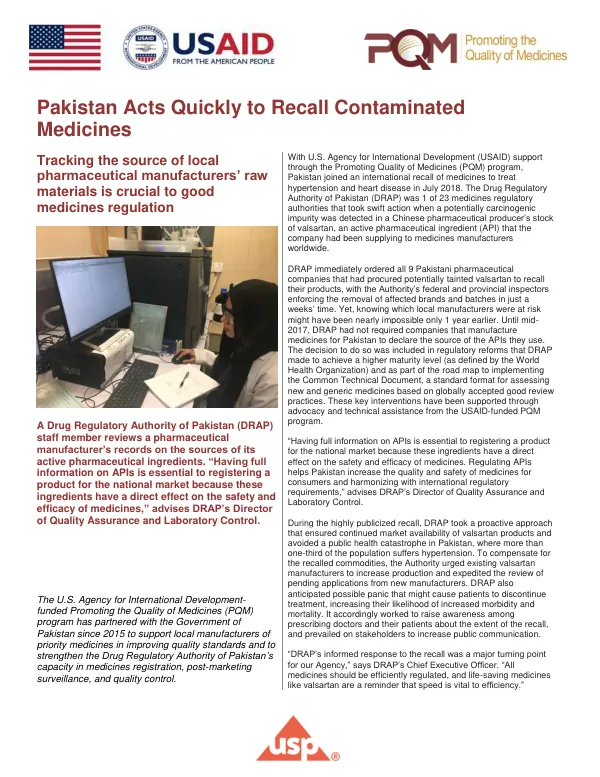
A key aspect of this effort is tracking the source of local pharmaceutical manufacturers' raw materials, specifically active pharmaceutical ingredients (APIs). DRAP's Director of Quality Assurance and Laboratory Control emphasizes the importance of having full information on APIs, as these ingredients directly affect the safety and efficacy of medicines. In 2015, the U.S. Agency for International Development-funded Promoting the Quality of Medicines (PQM) program partnered with the Government of Pakistan to support local manufacturers of priority medicines in improving quality standards. The program also aimed to strengthen DRAP's capacity in medicines registration, post-marketing surveillance, and quality control. This partnership has been instrumental in enhancing DRAP's regulatory capabilities, enabling the Authority to take swift action in response to potential threats to public health. In July 2018, DRAP joined an international recall of medicines to treat hypertension and heart disease, following the detection of a potentially carcinogenic impurity in a Chinese pharmaceutical producer's stock of valsartan. DRAP immediately ordered all 9 Pakistani pharmaceutical companies that had procured potentially tainted valsartan to recall their products. The Authority's federal and provincial inspectors enforced the removal of affected brands and batches within a week, demonstrating the effectiveness of DRAP's regulatory framework. The decision to require companies to declare the source of APIs was a key regulatory reform implemented by DRAP in mid-2017. This move was part of the Authority's efforts to achieve a higher maturity level, as defined by the World Health Organization, and to implement the Common Technical Document, a standard format for assessing new and generic medicines. The USAID-funded PQM program provided advocacy and technical assistance to support these key interventions. DRAP's proactive approach during the recall ensured continued market availability of valsartan products and avoided a public health catastrophe in Pakistan, where more than one-third of the population suffers hypertension. The Authority worked to raise awareness among prescribing doctors and their patients about the extent of the recall, and prevailed on stakeholders to increase public communication. This informed response was a major turning point for DRAP, highlighting the importance of efficient regulation and speed in ensuring public health.
Related documents