USAID DEC
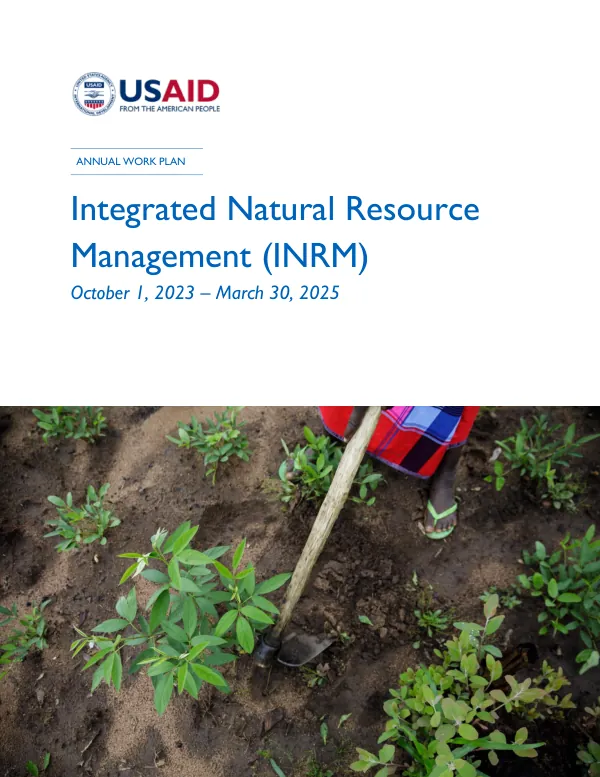
Annual Work Plan for Integrated Natural Resource Management (INRM) October 1, 2023-March 30, 2025
Sign inCOASTAL RESOURCES CENTER OF THE UNIVERSITY OF RHODE ISLAND
Annual Work Plan for Integrated Natural Resource Management (INRM) October 1, 2023-March 30, 2025
Integrated Natural Resource Management (INRM) is a five-year task order under the STARR II IDIQ, managed by the Center for Environment, Energy, and Infrastructure (EEI) in the Bureau for Development, Democracy, and Innovation (DDI).
2023 · 48 pages
Sign in to readA free account is required to download.
Abstract
INRM provides strategic support and facilitation to USAID's Missions, technical offices, and other operating units on integrated environmental and natural resource management programming in alignment with the Agency's Environmental and Natural Resource Management (ENRM) Framework. INRM supports and promotes integrated programming across sectors traditionally classified as "environmental," such as land use, forestry and biodiversity conservation, and climate change, as well as many sectors that traditionally have not been linked to environment programming but are in fact strongly connected (e.g., food security, health, and governance). By using a multi-sectoral lens, the task order strengthens the impacts of USAID's core environmental programming by recognizing synergies, adopting best practices, and building broader constituencies for integrated programming. To achieve this, INRM works across the USAID Program Cycle and supports assessment; strategy; activity design; piloting of new approaches; adaptive management; monitoring, evaluation, and learning; and communications. The mechanism responds to integrated programming requests through five task areas: assisting Missions with analysis and development of an evidence base to support integrated NRM programming; supporting and facilitating design and adaptive management of integrated NRM programming; testing innovative approaches for integrated NRM programming; supporting integrated monitoring, evaluation, and learning of multi-sectoral programs; and supporting communications and knowledge management. The INRM work plan outlines the activities and interventions that will be implemented over the next 18 months, from September 2023 to March 2025. The plan includes ongoing activities that stretch across implementation years four and five, activities that are undergoing scoping, and activities waiting to be scoped. INRM will complete most, if not all implementation, by the end of March 2025 and focus the final five months on close-out efforts. The work plan is organized into four sections: INRM Description and Theory of Change; Management, Integration, and Learning (MIL); Portfolios, Blended Funding Activities, and Buy-ins; and Activities, Buy-ins, and MIL Budgets. The INRM description section includes an explanation of how INRM interprets and applies the term "integrated." The MIL section focuses on the operational aspects of implementation that support all INRM initiatives, including scoping of activities and buy-ins, Mission outreach and engagement, INRM specific communications and knowledge management, cross-cutting gender equality and social inclusion, and the development and implementation of the INRM monitoring, evaluation, and learning plan. The Portfolios, Blended Funding Activities, and Buy-ins section describes the various portfolios and blended funding activities that INRM will support, including the Biodiversity Portfolio, Natural Climate Solutions Portfolio, HEARTH Portfolio, Land and Resource Governance Portfolio, and Women's Economic Empowerment Portfolio. The Activities, Buy-ins, and MIL Budgets section outlines the specific activities and buy-ins that will be implemented, as well as the associated budgets. Overall, the INRM work plan provides a comprehensive framework for implementing the task order and achieving the goals outlined in the contract.