USAID DEC
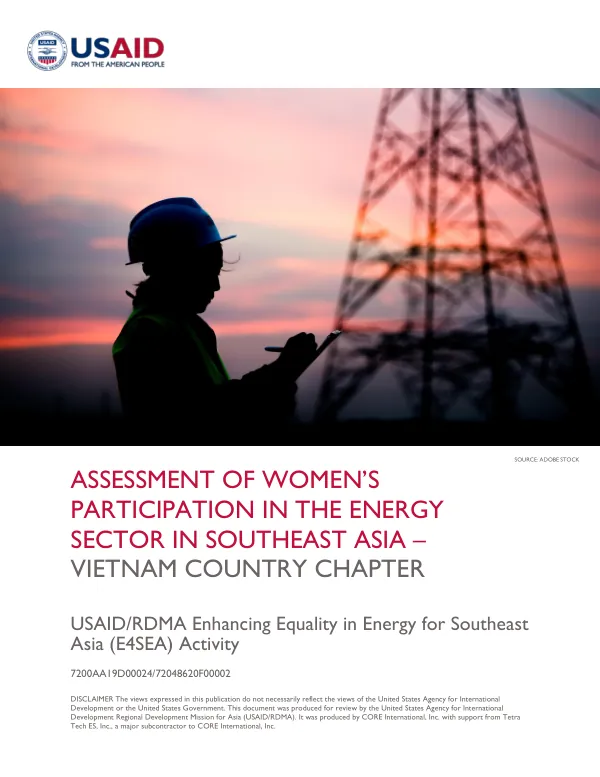
Assessment of Women’s Participation in the Energy Sector in Southeast Asia – Vietnam Country Chapter
Sign inCORE INTERNATIONAL, INC.
Assessment of Women’s Participation in the Energy Sector in Southeast Asia – Vietnam Country Chapter
Women's participation in the energy sector in Southeast Asia is a critical issue, with women underrepresented in the formal workforce, particularly in male-dominated industries.
2023 · 67 pages
Sign in to readA free account is required to download.
Abstract
This underrepresentation is not only an issue of equity but also a missed economic opportunity for countries, companies, and communities. Research has shown that increased gender equality is linked to stronger business outcomes, innovation, and higher overall productivity. The energy sector in Southeast Asia is characterized by a lack of women's participation, with women holding fewer positions of power and influence. This is due to various factors, including cultural biases, limited access to education and training, and a lack of role models and mentors. Women's participation in the energy sector is essential for accelerating inclusive economic and social development, and for adding trillions of dollars to global GDP. The E4SEA Activity, a USAID-funded initiative, aimed to assess women's participation in the energy sector in Southeast Asia. The activity conducted desk research on seven countries, including Vietnam, and prepared two documents: the Gender Equality and Social Inclusion (GESI) Analysis Report and the Gender and Inclusive Development Action Plan (GIDAP). The activity then conducted primary research in three focus countries, including Indonesia, the Philippines, and Thailand, using a methodology that included in-depth interviews, focus group discussions, and baseline citizen surveys. The Vietnam Country Chapter report, part of the E4SEA Activity, provides an assessment of women's participation in the energy sector in Vietnam. The report highlights the challenges and opportunities for women's participation in the energy sector, including limited access to education and training, a lack of role models and mentors, and cultural biases. The report also provides recommendations for addressing these challenges and opportunities, including the need for focused studies and assessments to inform country-specific impactful programming for energy and gender activities. The report emphasizes the importance of addressing the root causes of women's underrepresentation in the energy sector, including cultural biases, limited access to education and training, and a lack of role models and mentors. It also highlights the need for targeted interventions to increase women's participation in the energy sector, including training programs, mentorship initiatives, and policy reforms. The E4SEA Activity's assessment of women's participation in the energy sector in Southeast Asia, including the Vietnam Country Chapter report, provides valuable insights into the challenges and opportunities for women's participation in the energy sector. The report's recommendations for addressing these challenges and opportunities can inform policy and programming decisions to increase women's participation in the energy sector and promote inclusive economic and social development in Southeast Asia.
Related documents