USAID DEC
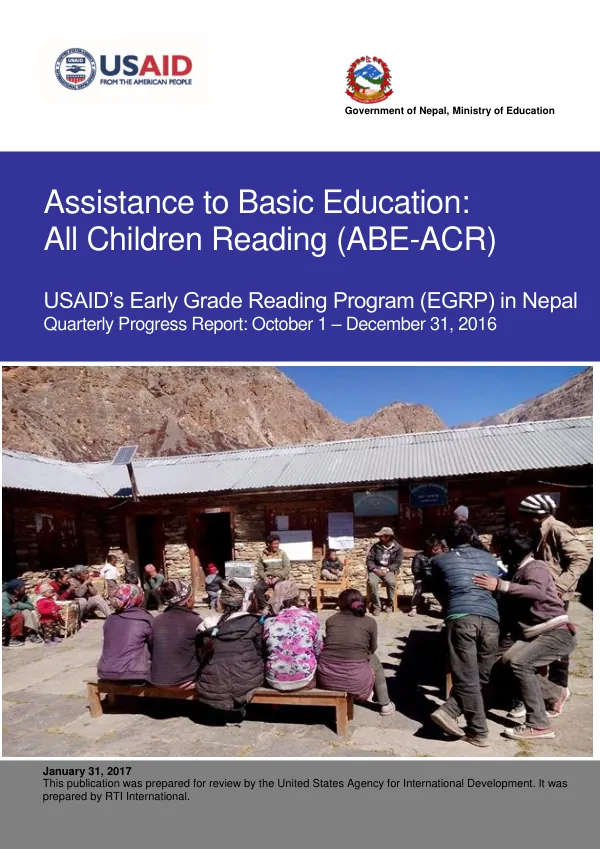
Assistance to Basic Education: All Children Reading (ABE-ACR) Quarterly Progress Report: October-December 31, 2016
Sign inGOVERNMENT OF SENEGAL
Assistance to Basic Education: All Children Reading (ABE-ACR) Quarterly Progress Report: October-December 31, 2016
The Early Grade Reading Program (EGRP) in Nepal is a USAID-funded initiative aimed at improving early grade reading instruction, national and district early grade reading service delivery, and family and community support for early grade reading.
2016 · 74 pages
Sign in to readA free account is required to download.
Abstract
The program is implemented by RTI International and is supported by the Ministry of Education. The program's expected results include improved early grade reading instruction, with a focus on teacher training and the development of reading materials. The program also aims to improve national and district early grade reading service delivery, including the establishment of a national early grade reading program. Additionally, the program seeks to increase family and community support for early grade reading, through the establishment of reading motivators and the development of supplementary reading materials. The program's quarterly progress report for October 1 – December 31, 2016, highlights several key accomplishments. The report notes that 1,200 teachers received training in reading instruction, and 1,500 students participated in reading activities. The program also established 100 reading motivators, who provided support to students and teachers. The report also highlights several challenges faced by the program, including limited resources and infrastructure constraints. Despite these challenges, the program has made significant progress in achieving its expected results. The report notes that 90% of teachers reported an increase in student engagement and motivation, and 80% reported an improvement in student reading skills. The program's implementation progress is monitored and evaluated through a variety of methods, including classroom-based early grade reading assessments and surveys of teachers and students. The program also engages in partnership and knowledge sharing with other organizations, including the Ministry of Education and the Asia Regional Office. The program's sustainability and exit strategy are also discussed in the report. The report notes that the program aims to establish a national early grade reading program that can continue to support the development of reading instruction and service delivery after the program's completion. The program's management and administration are also discussed in the report. The report notes that the program is managed by a team of professionals, including a chief of party, a contracting officer's representative, and a technical support unit. The program also engages in regular communication with stakeholders, including the Ministry of Education and the USAID mission in Nepal. The report also highlights several lessons learned by the program, including the importance of engaging with local communities and the need for ongoing support and training for teachers. The report also notes that the program has identified several areas for improvement, including the need for more effective monitoring and evaluation systems. The program's short-term technical assistance and office support are also discussed in the report. The report notes that the program receives support from the USAID mission in Nepal, including technical assistance and funding for program activities. Overall, the Early Grade Reading Program in Nepal has made significant progress in achieving its expected results, despite facing several challenges. The program's quarterly progress report highlights several key accomplishments, including teacher training, student participation, and the establishment of reading motivators. The report also discusses several challenges faced by the program, including limited resources and infrastructure constraints.