CHEMONICS
BIJAK BULLETIN Volume 1 October - December 2018
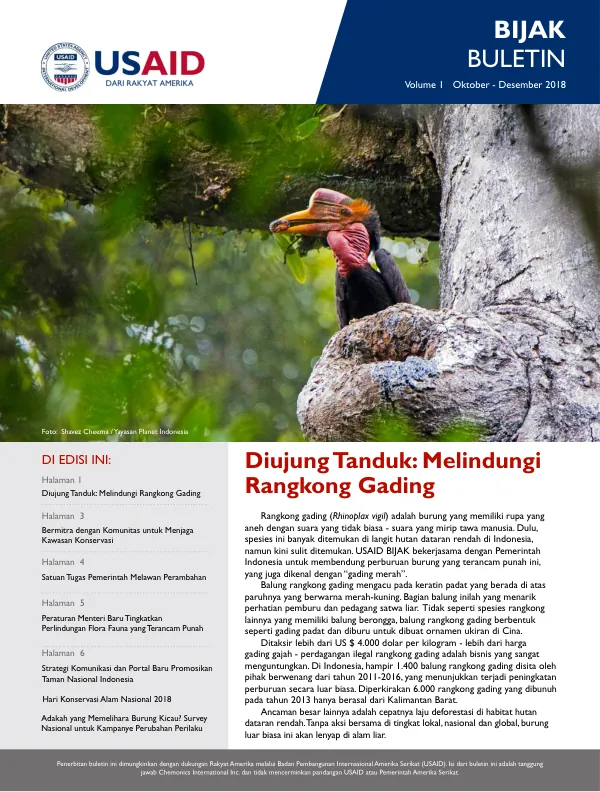
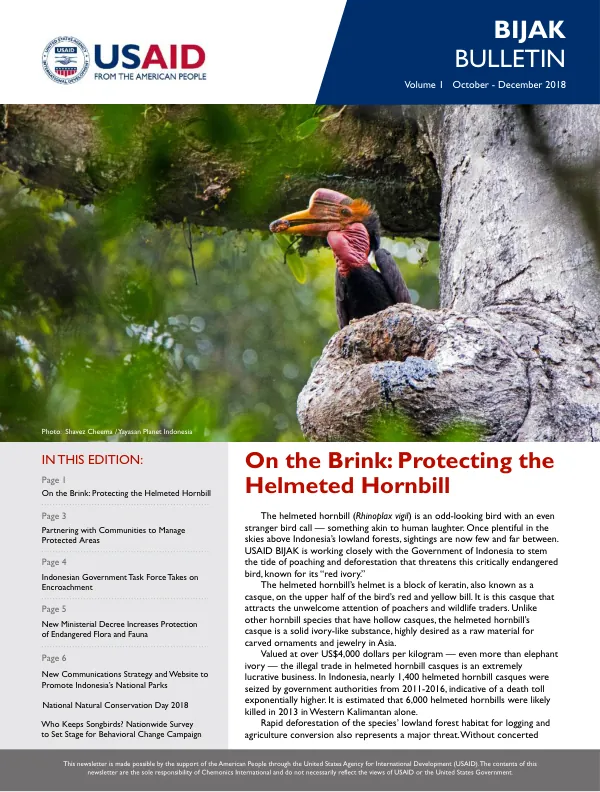
The helmeted hornbill is a critically endangered bird species native to Indonesia's lowland forests.
2018 · 6 pages
Sign in to readA free account is required to download.
Abstract
Once plentiful in the skies above Indonesia, sightings of the bird are now few and far between due to poaching and deforestation. The helmeted hornbill's helmet, a block of keratin on the upper half of its red and yellow bill, is highly valued as a raw material for carved ornaments and jewelry in Asia. The illegal trade in helmeted hornbill casques is a lucrative business, with nearly 1,400 casques seized by government authorities in Indonesia from 2011-2016, indicative of a death toll exponentially higher. The helmeted hornbill plays an important role in maintaining the health of forests, dispersing fruit seeds along a 100 km range. The bird also serves as a powerful cultural symbol for local communities in Kalimantan and Sumatra, featuring its image on traditional headdresses, pendants, and other adornments. The Dayak tribe of Kalimantan has revered the bird as a symbol of unity for over 2,000 years. Protecting this unique and vulnerable species is now the shared responsibility of stakeholders at local, regional, and national levels, as well as a priority of the Government of Indonesia. The helmeted hornbill is listed on Appendix I of the Convention on International Trade in Endangered Species of Wild Fauna and Flora (CITES), which prohibits trade in the species or its parts. In 2016, the Government of Indonesia pledged to define and lead actions needed to protect this highly endangered species. Over the course of a year, USAID BIJAK worked closely with the Ministry of Environment and Forestry (MoEF), Indonesian Institute of Sciences (LIPI), and other government partners to develop the National Conservation Strategy Action Plan (SRAK) for the protection of the helmeted hornbill. The SRAK's enactment as a government policy is the product of a complex process that included technical assistance and scientific research, as well as dozens of consultations, workshops, and public meetings to generate consensus around complicated policy and social issues. The ten-year action plan serves as a roadmap for the public and private sector and other key stakeholders to ensure the continued survival of the species. On November 1, USAID BIJAK and Indonesia's Directorate of Biodiversity Conservation (KKH) ceremonially handed over the Helmeted Hornbill SRAK to the government of North Sumatra Province at a socialization event in Medan. The event drew over 100 participants from local governments across Sumatra, conservation NGOs, academia, and the private sector. Participants committed to implement the SRAK in Sumatra in a variety of ways, including raising awareness of helmeted hornbill conservation at the community level, developing species population monitoring guidelines, repurposing the government's stockpile of seized casques for DNA studies, and participating in the newly established Sumatra Rangkong Gading working group. At the press briefing following the event, officials from North Sumatra urged Sumatra's other ten provinces to promote protection of the helmeted hornbill and coordinate on preventing poaching and illegal trade. The helmeted hornbill's casque is highly valued as a raw material for carved ornaments and jewelry in Asia, with a value of over US$4,000 per kilogram. The illegal trade in helmeted hornbill casques is a lucrative business, with nearly 1,400 casques seized by government authorities in Indonesia from 2011-2016. The bird's casque is a solid ivory-like substance, highly desired for its beauty and rarity. The helmeted hornbill is listed on Appendix I of the Convention on International Trade in Endangered Species of Wild Fauna and Flora (CITES), which prohibits trade in the species or its parts. The Government of Indonesia has pledged to define and lead actions needed to protect this highly endangered species. Over the course of a year, USAID BIJAK worked closely with the Ministry of Environment and Forestry (MoEF), Indonesian Institute of Sciences (LIPI), and other government partners to develop the National Conservation Strategy Action Plan (SRAK) for the protection of the helmeted hornbill. The SRAK's enactment as a government policy is the product of a complex process that included technical assistance and scientific research, as well as dozens of consultations, workshops, and public meetings to generate consensus around complicated policy and social issues. The ten-year action plan serves as a roadmap for the public and private sector and other key stakeholders to ensure the continued survival of the species. The SRAK provides a unified, practical approach to protecting this iconic species, empowering NGOs, local governments, and the private sector to work together to improve conservation area management. The regulation establishing conservation partnerships from the Directorate General of Ecosystem and Natural Resources Conservation (KSDAE) provides an innovative way for conservation area managers to work directly with local communities, including village governments, to halt deforestation, protect wildlife, and improve overall management of protected areas. Presently, over 22 million