USAID
CHAMP Quarterly Report Oct-Dec 2010
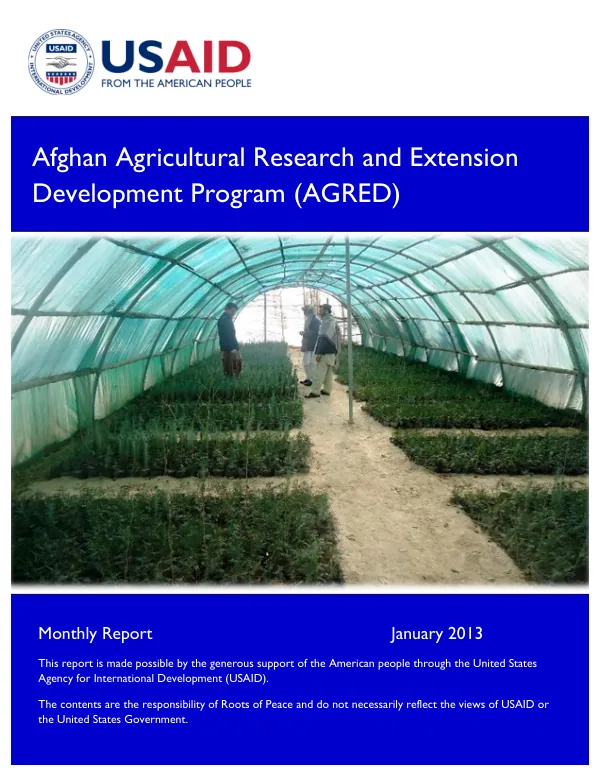
The Afghan Agricultural Research and Extension Development Program (AGRED) is a USAID-funded initiative aimed at building the capacity of the Government of the Islamic Republic of Afghanistan's (GIRoA) Ministry of Agriculture, Irrigation and Livestock (MAIL) and Directorates of Agriculture, Irrigation and Livestock (DAIL) to sustainably procure, develop, and deploy productivity-enhancing technologies and good farming practices.
2010 · 19 pages
Sign in to readA free account is required to download.
Abstract
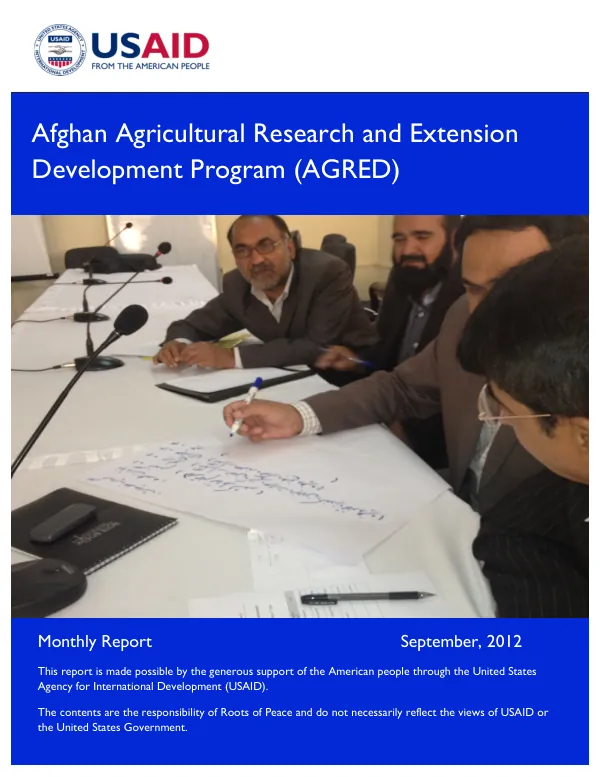
The program has four main components: Communication, Infrastructure, Training, and Research and Extension. The Communication component focuses on improving access to improved technologies, knowledge, and education for Afghan farmers, while the Infrastructure component involves the development of applied research and extension infrastructure in seven target sub-national Research Centers and fifty target districts. The Training component aims to build the capacity of research and extension staff to deliver services to Afghan communities, and the Research and Extension component involves the provision of extension and advisory services. AGRED's program start-up phase continues, with meetings between the AGRED team and USAID, followed by a series of meetings with USDA, USDA's AAEP and CBCMP programs, and with MAIL. The AGRED team briefed MAIL on its relationship with other USG programs, including AGRED's participatory and collaborative approach to planning MAIL on-budget activities. The Participatory Research and Extension Planning Process involves seven stakeholder workshops in November, which will identify weaknesses in agricultural value chains that can be addressed by MAIL and DAIL research and extension programs. The Technical Working Group will consolidate the research and extension needs identified in the workshops into a proposal for on-budget funding under USAID Implementation Letters. AGRED has made significant progress in September, including the recruitment of key staff members, including the COP Kingsley Bash and six Afghan staff members, and the hiring of another expat, Director of Women's Program Dr. Hasina Rasuli, and three local staff members. The AGRED team also met with USAID and USDA in Kabul to ensure a shared understanding of the program strategy and coordinate activities. The Performance Monitoring Plan (PMP) will be a unique effort, reflecting both the AGRED team performance against their objectives and indicators to monitor MAIL performance. AGRED will assist MAIL in identifying research and extension priorities to address using on-budget funding, but the MAIL must apply for the funding and use it according to the "conditions precedent" of USAID Implementation Letters (ILs). AGRED will monitor progress toward its own indicator targets, and also toward the MAIL's targets, as defined in ILs. AGRED has secured and occupied new offices, established its security, organized project vehicles, and procured the initial supplies to build the program. The program has also established a strong organizational structure, with a total of three expats and 42 local staff, including five Regional Research Coordinators, five Regional Extension Coordinators, and 18 Provincial Extension Coordinators. The AGRED team has also made significant progress in establishing relationships with key stakeholders, including USAID, USDA, and MAIL. The team has briefed MAIL on its relationship with other USG programs and has ensured a shared understanding of the program strategy and coordinated activities with USAID and USDA. Overall, AGRED has made significant progress in its start-up phase, including the recruitment of key staff members, the establishment of a strong organizational structure, and the establishment of relationships with key stakeholders. The program is well-positioned to achieve its objectives and make a positive impact on the agricultural sector in Afghanistan.
Related documents