USAID DEC
Consistency of Pregnancy Outcome and Contraceptive Reporting Using the Pregnancy History versus Birth History (MR35) - Analysis Brief
Sign inICF
Consistency of Pregnancy Outcome and Contraceptive Reporting Using the Pregnancy History versus Birth History (MR35) - Analysis Brief
The DHS Program has used monthly calendars in surveys to collect information about women's pregnancy and contraceptive events over the past six years since 1990.
2023 · 4 pages
Sign in to readA free account is required to download.
Abstract
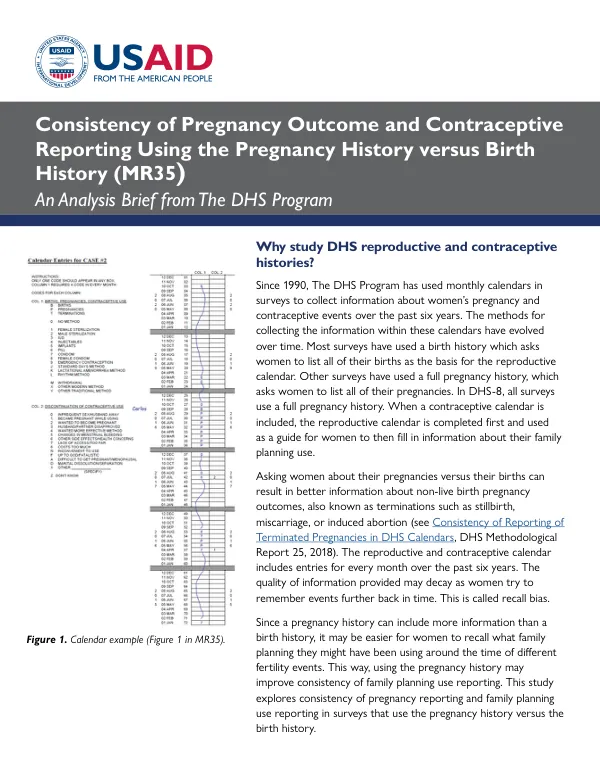
The methods for collecting this information have evolved over time, with most surveys using a birth history that asks women to list all of their births as the basis for the reproductive calendar. However, in DHS-8, all surveys use a full pregnancy history, which asks women to list all of their pregnancies. Asking women about their pregnancies versus their births can result in better information about non-live birth pregnancy outcomes, such as stillbirth, miscarriage, or induced abortion. The reproductive and contraceptive calendar includes entries for every month over the past six years, and the quality of information provided may decay as women try to remember events further back in time, a phenomenon known as recall bias. The study explores consistency of pregnancy reporting and family planning use reporting in surveys that use the pregnancy history versus the birth history. The analysis includes data from 191 DHS surveys from 67 countries that used a reproductive calendar. Of these, 100 surveys included a contraceptive calendar and had a DHS survey conducted within six years prior. For pregnancy reporting, the outcomes are live birth or termination. For family planning use, the outcomes are use of any family planning, use of traditional methods of family planning, and coitus-based family planning method use. A measure of consistency was developed and used to explore whether recall bias has affected the quality of the data. The measure of consistency used for pregnancy reporting is the difference between the rate of terminations in the earlier half of the reproductive calendar and the later half. The study finds that asking respondents for a pregnancy history, rather than a birth history, is associated with more consistent reporting of pregnancy outcomes. Surveys that used a pregnancy history have greater odds of having consistent birth and termination reporting compared to surveys that used a birth history. For the first condition, all three surveys are classified as similar because one or both points representing calendar estimates of family planning use fall within the 95% confidence interval around the current use estimate trend line. However, for family planning use reporting, the study finds that few surveys have consistent reporting on use of any family planning method, traditional methods, and coitus-based methods. Inaccurate reporting of monthly family planning use may be due to recall bias, especially among women with complex reproductive or contraceptive histories. Estimates using the contraceptive calendar for all three categories of family planning use are more consistent later in the calendar, i.e., for more recent events. The study recommends using a pregnancy history-based reproductive calendar, as it is associated with more consistent, better quality data on pregnancy outcomes. Data users can be confident in pregnancy outcome and coitus-based family planning use measures that are estimated from the reproductive calendar. However, the study also finds that using a pregnancy history as the basis for the contraceptive calendar does not generally improve the consistency of contraceptive use reporting.
![Regional Disparities and Determinants of Anemia and Modern Contraceptive Use among Women in Myanmar [FA126]](https://covers.devme.ai/gen/143956.webp)