USAID DEC
CRS/Sudan Annual Report (October 2012 – September 2013) Darfur Rapid Emergency Response Fund
Sign inADVENTIST DEVELOPMENT AND RELIEF AGENCY INTERNATIONAL
CRS/Sudan Annual Report (October 2012 – September 2013) Darfur Rapid Emergency Response Fund
The Darfur Rapid Emergency Response Fund (DRERF) is a two-year and seven-month project implemented by Catholic Relief Services (CRS) in Sudan, with the goal of assisting humanitarian agencies to effectively and promptly respond to natural and man-made emergencies in the three Darfur States.
2013 · 11 pages
Sign in to readA free account is required to download.
Abstract
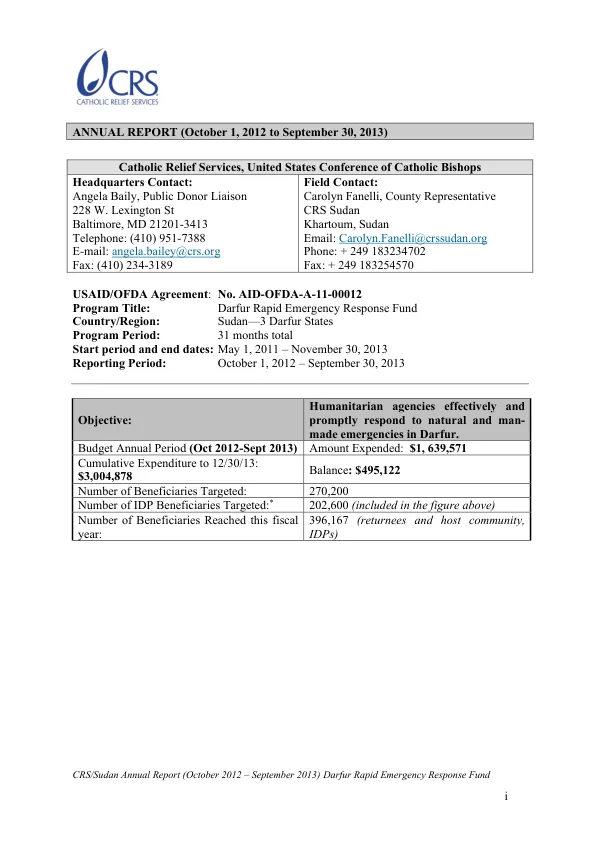
The project was extended through no-cost extensions and a no-cost modification, with the overall goal of assisting humanitarian agencies to effectively and promptly respond to emergencies affecting the local target population, particularly in the sectors of Health, Water, Sanitation and Hygiene, and Shelter and Settlements. During the reporting period of October 1, 2012 to September 30, 2013, CRS received eleven full project proposals, of which seven were approved. One proposal was withdrawn due to security reasons in the operational area. The funded proposals were implemented by various organizations, including Almassar Charity Organization for Nomads and Development and Environmental Conservation, Child Development Foundation, Sudan Peace and Humanitarian Organization, Great Family Organization, Plan Sudan, Adventist Development and Relief Agency, and United Methodist Committee for Relief Sudan. These projects focused on providing emergency shelter, sanitation and hygiene promotion, non-food items, and health awareness on yellow fever disease among nomadic communities. The DRERF project implemented three closely intertwined strategies to achieve its goal. The first strategy involved building up a database of potential implementing partners through comprehensive financial and programmatic capacity assessments. The second strategy utilized a streamlined grant application, funding, and reporting system to facilitate quick response to emergencies while maintaining acceptable levels of accountability. The third strategy focused on building the capacity of implementing partners and ensuring compliance with relevant USG grant management regulations through trainings and follow-up. The review process for submitted sub-partner proposals was three-tiered, with CRS responsible for initially reviewing, vetting, and supporting revisions of proposals before they were submitted to the OFDA mission in Khartoum for technical review and approval and then to OFDA HQ for final approval. The DRERF Technical Review Committee (TRC) reviewed all proposals received by CRS, and proposed interventions were cross-checked with HAC, relevant local government ministries, relevant UN sector leads, and other I/NGOs working in the proposed target areas to ensure there would be no duplication of efforts if the proposal was approved. Capacity building for national NGOs operating in the Darfur States was one of the main activities of the DRERF project. The project team focused on mentoring NNGOs through one-on-one meetings and larger capacity building workshops, providing hours of mentoring to the national NGOs that submitted proposals in line with the objectives of the DRERF funding mechanism. CRS's most senior technical staff also assisted participating NNGOs with program design, recommending the most effective and efficient implementation strategies. The DRERF project achieved significant results during the reporting period. A total of 396,167 beneficiaries were reached, including returnees and host communities, IDPs. The project also provided emergency shelter, sanitation and hygiene promotion, non-food items, and health awareness on yellow fever disease among nomadic communities. The project's overall expenditure for the reporting period was $1,639,571, with a cumulative expenditure of $3,004,878 as of December 30, 2013.
Related documents