GOVERNMENT OF SENEGAL
Disaster Risk Reduction: Reducing Disaster Risk for Long-term Development
Disaster Risk Reduction in Nepal is a critical issue due to the country's high level of disaster vulnerability.
2012 · 4 pages
Sign in to readA free account is required to download.
Abstract
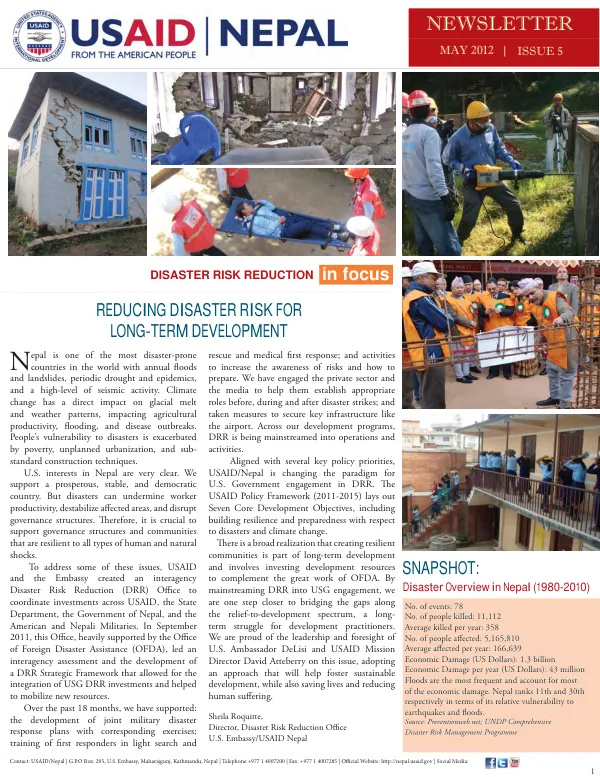
Nepal is one of the most disaster-prone countries in the world, with annual floods and landslides, drought, and epidemics, as well as a high level of seismic activity. Climate change has a direct impact on glacial melt and weather patterns, affecting agricultural productivity, flooding, and disease outbreaks. The people's vulnerability to disasters is exacerbated by poverty, unplanned urbanization, and sub-standard construction techniques. The U.S. Government supports a prosperous, democratic, and democratic country in Nepal. However, disasters can undermine worker productivity, destabilize areas, and disrupt governance structures. Therefore, it is crucial to support governance structures and communities that are resilient to human and natural disasters. To address these issues, the U.S. Government and the Embassy created an interagency Disaster Risk Reduction (DRR) Office to coordinate investments across USAID, the State Department, the Government of Nepal, and the American and Nepali Militaries. The DRR Office led an interagency assessment and the development of a DRR Strategic Framework in September 2011, which allowed for the integration of USG DRR investments and helped mobilize new resources. Over the past 18 months, the U.S. Government has supported the development of joint military disaster plans with corresponding exercises, training of first responders in search and rescue and medical first response, and awareness-raising activities to increase the understanding of disaster risks and how to protect oneself against them. The U.S. Government has engaged the private sector and the media to help them establish appropriate measures before, during, and after disasters strike. The DRR Office has also taken measures to secure key infrastructure, such as the airport. Across U.S. Government programs, DRR is being mainstreamed into operations and activities. The U.S. Government is changing the paradigm for U.S. Government engagement in DRR, aligning with several key policy objectives. The USAID Policy Framework (2011-2015) outlines Seven Core Development Objectives, including building resilience and preparedness with respect to disasters and climate change. Mainstreaming DRR into U.S. Government engagement is one step closer to bridging the gaps along the relief-to-development spectrum, a long-term struggle for development practitioners. Nepal ranks 12th in terms of relative vulnerability to earthquakes and 30th in terms of relative vulnerability to floods. Floods are the most frequent and cause most of the economic damage. The U.S. Government works to enhance Nepal's capacity to prevent, mitigate, and respond to disasters, address the needs of vulnerable populations, and increase awareness of disaster risks. The U.S. Government supports programs that improve preparedness for and response to natural disasters, enhance the capacity of first responders, improve communities' ability to respond, and work with regional actors to cooperate on disaster risk reduction. The U.S. Government also works to increase understanding of the importance of disaster risk reduction measures by mainstreaming them into government planning and budgets, increasing private sector engagement, enhancing the capacity of media to cover all aspects of disasters, and increasing people's understanding of risks and how to protect themselves against them. The U.S. Government has supported the development of a DRR mascot, the Red Panda, to provide safety messages for earthquakes, landslides, and other hazards in Nepal. The Red Panda will be launched by the Government of Nepal at the Regional Asia International Search and Rescue Advisory Group meeting in Kathmandu. The official DRR logo will also be launched and will be used by all partners in DRR. The U.S. Government is working with leading banks in Nepal to include disaster preparedness messages on ATMs, a low-cost method to increase awareness of disaster risk among the general public. USAID supplies the content, and the banks display the messages on their machines, rotating them every couple of days. This public-private collaboration is occurring at no cost to the U.S. Government. The U.S. Government is also working to increase awareness of disaster preparedness through public awareness campaigns. The DRR Office is working with the Ministry of Home Affairs to develop a DRR mascot to be used by the Government of Nepal, NGOs, donors, and the private sector in promoting disaster awareness and preparedness campaigns. The U.S. Government has also supported the development of a DRR Public Awareness Campaign, which aims to increase awareness of disaster risks