USAID DEC
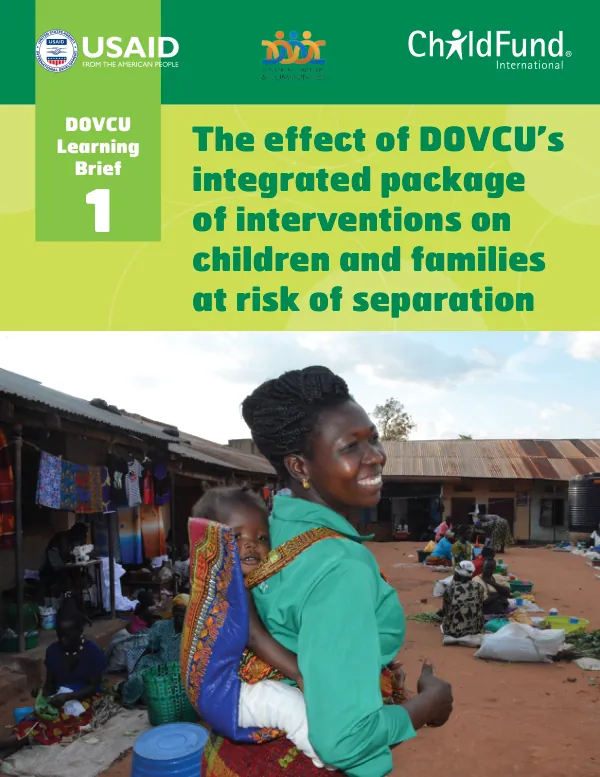
DOVCU Learning Brief 1: The effect of DOVCU’s integrated package of interventions on children and families at risk of separation
Sign inCHILD FUND INTERNATIONAL
DOVCU Learning Brief 1: The effect of DOVCU’s integrated package of interventions on children and families at risk of separation
The DOVCU project, implemented by ChildFund International in Uganda from July 2014 to June 2017, aimed to keep and reintegrate children into the care of families.
2018 · 9 pages
Sign in to readA free account is required to download.
Abstract
The project delivered an integrated package of interventions to decrease household vulnerabilities for households at risk of child separation and households with children reintegrating from childcare institutions. The project also aimed to strengthen the institutional capacities of government officials and other key stakeholders to adapt the Alternative Care Framework and strive toward family-based care for all children. The project's integrated package of interventions included economic services, social interventions, and vocational training. Economic services followed a graduation approach, which involves meeting the immediate needs of destitute families, connecting families that struggle to make ends meet to skills and resources, and then supporting families to grow out of poverty. Social interventions, including parenting groups, psychosocial support, and referrals, were combined with economic interventions to provide a holistic response to vulnerability. The project analyzed quantitative data from a sample of 1,511 households and 2,675 children at risk of separation, collected over a three-year implementation period. Children and families were assessed for vulnerability in three categories: Household Vulnerability, Household Economic Vulnerability, and Child Vulnerability. Assessments were carried out using the Family Status Vulnerability Index (FSVI) and the Child Status Index (CSI). The project classified households at baseline based on their respective vulnerability scores, using an ecological framework for addressing child separation. The framework highlights the multi-dimensional nature of risk and the need for integrated service delivery. The project's approach to addressing vulnerability at the family level complements other efforts to evaluate DOVCU's macro-level work. The project analyzed the demographic characteristics of the at-risk cohort at baseline to obtain a profile of households considered vulnerable to separation. The analysis also assessed change in vulnerability scores between baseline and endline depending on participation in various DOVCU project offerings. The results aim to illuminate which individual interventions were the most promising for reducing child and household vulnerabilities. The sample for this analysis is comprised of 1,511 households and 2,675 children at baseline. The mean age of sampled children participating in the project was 8.9 years, with 47 percent female. The project's findings will be presented in a series of three learning briefs, each designed to be read independently but providing a comprehensive view of the program's effects when reviewed together. The DOVCU project's integrated package of interventions showed promising results in reducing child and household vulnerabilities. The project's approach to addressing vulnerability at the family level, combined with economic and social interventions, provided a holistic response to vulnerability. The project's findings highlight the importance of integrated service delivery and the need for a comprehensive approach to addressing child separation in Uganda. The project's results indicate that the DOVCU project's interventions were effective in reducing household vulnerabilities, particularly in the areas of economic and social support. The project's findings also suggest that the combination of economic and social interventions was more effective in reducing child and household vulnerabilities than individual interventions alone. The DOVCU project's approach to addressing vulnerability at the family level, combined with economic and social interventions, provides a model for other projects and programs working to address child separation in Uganda. The project's findings highlight the importance of integrated service delivery and the need for a comprehensive approach to addressing child separation in Uganda. The project's results have implications for policy and practice in Uganda, highlighting the need for a comprehensive approach to addressing child separation and the importance of integrated service delivery. The project's findings also suggest that the DOVCU project's approach to addressing vulnerability at the family level, combined with economic and social interventions, is a promising model for other projects and programs working to address child separation in Uganda.