FOOD AND AGRICULTURE ORGANIZATION OF THE UNITED NATIONS IN GEORGIA
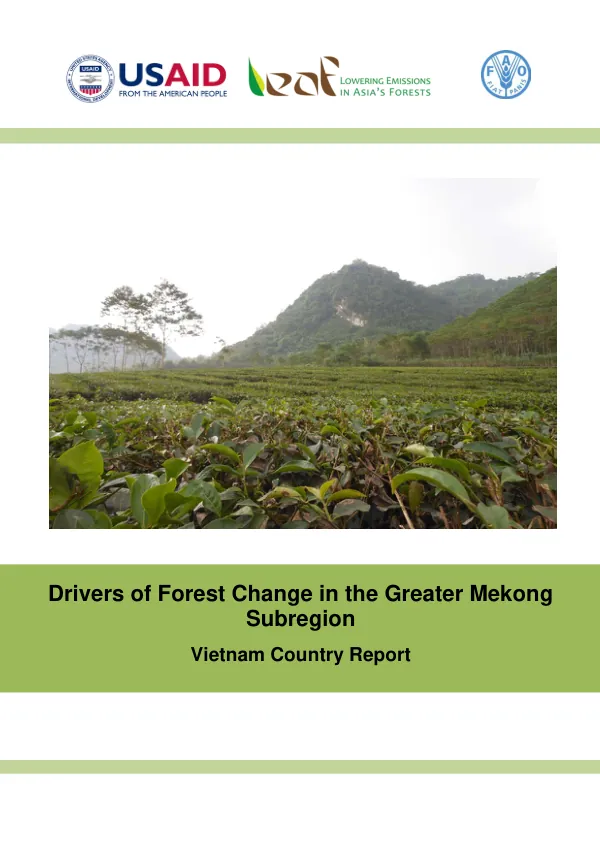
Drivers of Forest Change in the Greater Mekong Subregion Vietnam Country Report
The forest cover of Vietnam has slightly increased from 35.8% in 2002 to 39.7% in 2013, primarily due to the expansion of forest plantations established for commercial purposes.
2015 · 27 pages
Sign in to readA free account is required to download.
Abstract
However, the remaining natural forests are still decreasing and have become increasingly degraded. Deforestation and forest degradation in Vietnam are mainly driven by increasing demand for agricultural crops to meet local food needs and high-value plantation products, such as rubber and coffee, destined for international markets. Insufficient recognition of local communities' rights to forestlands and ineffective governance exacerbate the problem. The significant expansion of forest plantations has contributed to the net increase in forest areas, with about 10.4 million hectares of natural forests and 3.5 million hectares of forest plantations in 2013. The total area of natural forests in Vietnam has remained almost unchanged between 2003 and 2013, with a slight increase of 1,390 hectares due to natural regeneration of forest on fallow land used for shifting cultivation and promotion of natural forest regeneration through protection activities funded by the government. However, most of the remaining natural forests in Vietnam are classified as degraded and poor natural forests. The drivers of deforestation and forest degradation in Vietnam can be categorized into direct and underlying drivers. Direct drivers include the loss of natural forests and plantation forests, while underlying drivers include increasing demand for agricultural crops and high-value plantations, insufficient recognition of local people's rights to forests and forestlands, and ineffective governance. The increasing demand for agricultural crops and high-value plantations is driven by the growing population and economy of Vietnam, while the insufficient recognition of local people's rights to forests and forestlands is due to the lack of clear policies and laws governing forestland allocation and use. To tackle deforestation and forest degradation, Vietnam forestry policy should aim towards two key objectives: sustainable management of the remaining high conservation value natural forests for biodiversity conservation and long-term provision of forest products and environmental services, and improving incomes and livelihoods of forestland owners. To reach these goals, it is necessary to establish a permanent national forest estate to promote strict protection of important natural forest ecosystems by state agencies. More importantly, forest policy should emphasize the application of market instruments to generate economic benefits for forestland users and aim to improve public participation in forest governance. The USAID Lowering Emissions in Asia's Forests (USAID LEAF) Program is a five-year regional project focused on achieving meaningful and sustainable reductions in greenhouse gas emissions from the forest-land use sector across six target countries, including Vietnam. The program aims to reduce deforestation and forest degradation by promoting sustainable forest management, forest conservation, afforestation, and reforestation. The program also aims to improve forest governance and policy, and to promote the use of market-based instruments to generate economic benefits for forestland users. The report highlights the need for revised policies and measures (PAMS) related to forest change drivers in Vietnam. The current PAMS addressing deforestation and forest degradation are inadequate, and there are significant gaps in policies on forestland allocation and contracting, and on sustainable forest management and afforestation and reforestation. To address these gaps, the report recommends the establishment of a permanent national forest estate, the promotion of sustainable forest management, and the improvement of public participation in forest governance.
Related documents